

Apple's surprise Mac refresh pairs its first 2nm chip with AI-focused silicon as memory costs push prices higher.
Apple's surprise Mac refresh pairs its first 2nm chip with AI-focused silicon as memory costs push prices higher.
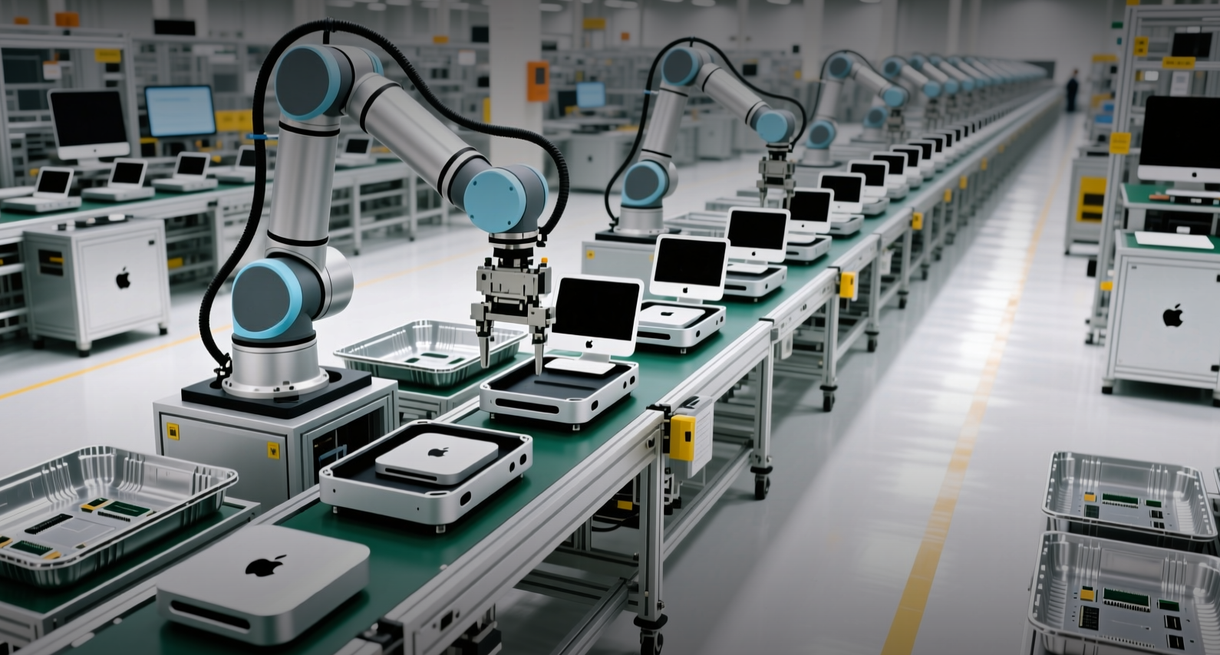
Apple unveiled new Mac mini and Mac Studio models with its first 2nm processor and a new M5 Ultra chip, raising entry pricing to $899 as AI demand and memory costs reshape the desktop lineup.
"The M6 delivers the world's fastest single-threaded performance and up to four times faster AI performance than the previous generation," Apple said. Tim Cook, Apple's chief executive, told The Wall Street Journal in June that "price increases are unavoidable" because of surging memory and storage chip costs.
The Mac mini with M6 starts at $899, up $100 from the M4 model, with a 12-core CPU, 12-core GPU and dual 16-core Neural Engine. The M5 Pro version starts at $1,699. The Mac Studio with M5 Max starts at $2,499, while the M5 Ultra — which Apple calls its most powerful silicon ever — starts at $5,499, up $200 from the M3 Ultra. The M5 Ultra pairs two M5 Max dies via UltraFusion into a quad-die architecture with up to 36 CPU cores, 80 GPU cores and 1.2TB/s memory bandwidth.
The refresh arrives as Apple's desktop Macs became sleeper hits for AI workloads. The Mac mini typically accounts for about 3 percent of Apple's U.S. Mac unit sales, according to Consumer Intelligence Research Partners, but demand from users running on-device large language models and AI agents like OpenClaw outstripped supply. Apple removed the largest memory configurations earlier this year before restoring them with this launch — the Mac Studio now supports up to 512GB of RAM, shipping in late October.
Apple's unified memory architecture, where the CPU and GPU share the same memory pool on a single chip, has made Macs particularly attractive for running local large language models. This design allows models to process prompts and generate responses faster than systems that require data to move between separate CPU and GPU memory pools.
The M6 is Apple's first 2-nanometer processor, a node shrink that packs more transistors onto a smaller die for better performance and power efficiency. The chip's 12-core CPU — two super cores, four performance cores and six efficiency cores — delivers up to 40 percent faster CPU performance than the M5, Apple claims. The GPU adds Neural Accelerators in each core, supporting the FP8 format for AI inference workloads.
The Mac mini with M5 Pro, previously available only in the MacBook Pro, starts at $1,699 with 24GB of unified memory and 512GB of storage. Both Mac mini configurations gain Wi-Fi 7 and Bluetooth 6 via Apple's N1 networking chip, with the M5 Pro model offering Thunderbolt 5 connectivity at up to 120Gb/s.
The M5 Ultra marks the first time Apple has added Neural Accelerators to its Ultra-class silicon. The chip's up-to-80-core GPU delivers up to 1.8x faster graphics than the M3 Ultra, while CPU performance improves 1.3x. Memory bandwidth reaches 1.2TB/s, and the Media Engine supports up to 33 simultaneous streams of 8K ProRes video.
Apple claims the M5 Ultra delivers up to 4.3x faster AI compute than the M3 Ultra, with benchmarks showing up to 9.8x faster LLM prompt processing in LM Studio compared to the M1 Ultra. The M5 Max Mac Studio, meanwhile, offers up to 50 percent faster GPU performance than the M4 Max with 614GB/s of memory bandwidth. Apple did not disclose the test conditions for its benchmark comparisons.
The new Macs ship Sept. 22 running macOS 27 Golden Gate. Preorders opened Tuesday. The M5 Ultra configuration with 512GB of memory arrives in late October with pricing not yet disclosed.
Apple's desktop refresh comes as the company's Mac Pro line was discontinued, making the Mac Studio its most powerful desktop. With the memory shortage driving component costs higher, Apple's Houston assembly line for the Mac mini is set to begin production later this year, though the company has not said whether it can meet the demand that left previous models backordered for weeks.
For investors, the higher price points could support Apple's Mac average selling prices and margins if demand holds. But supply constraints may cap volume growth, limiting the financial upside of the refresh. The M5 Ultra's AI compute claims position Apple's desktop line against Nvidia-powered workstations for on-device inference, though Apple has not disclosed how it measured the performance gains. Apple shares rose 0.32 percent on the announcement.
This article is for informational purposes only and does not constitute investment advice.
