

Apple's Siri AI smart home hub, new Apple TV and HomePod mini mark the company's biggest push into the smart home market, sending its market cap above $5 trillion for the first time.
Apple's Siri AI smart home hub, new Apple TV and HomePod mini mark the company's biggest push into the smart home market, sending its market cap above $5 trillion for the first time.
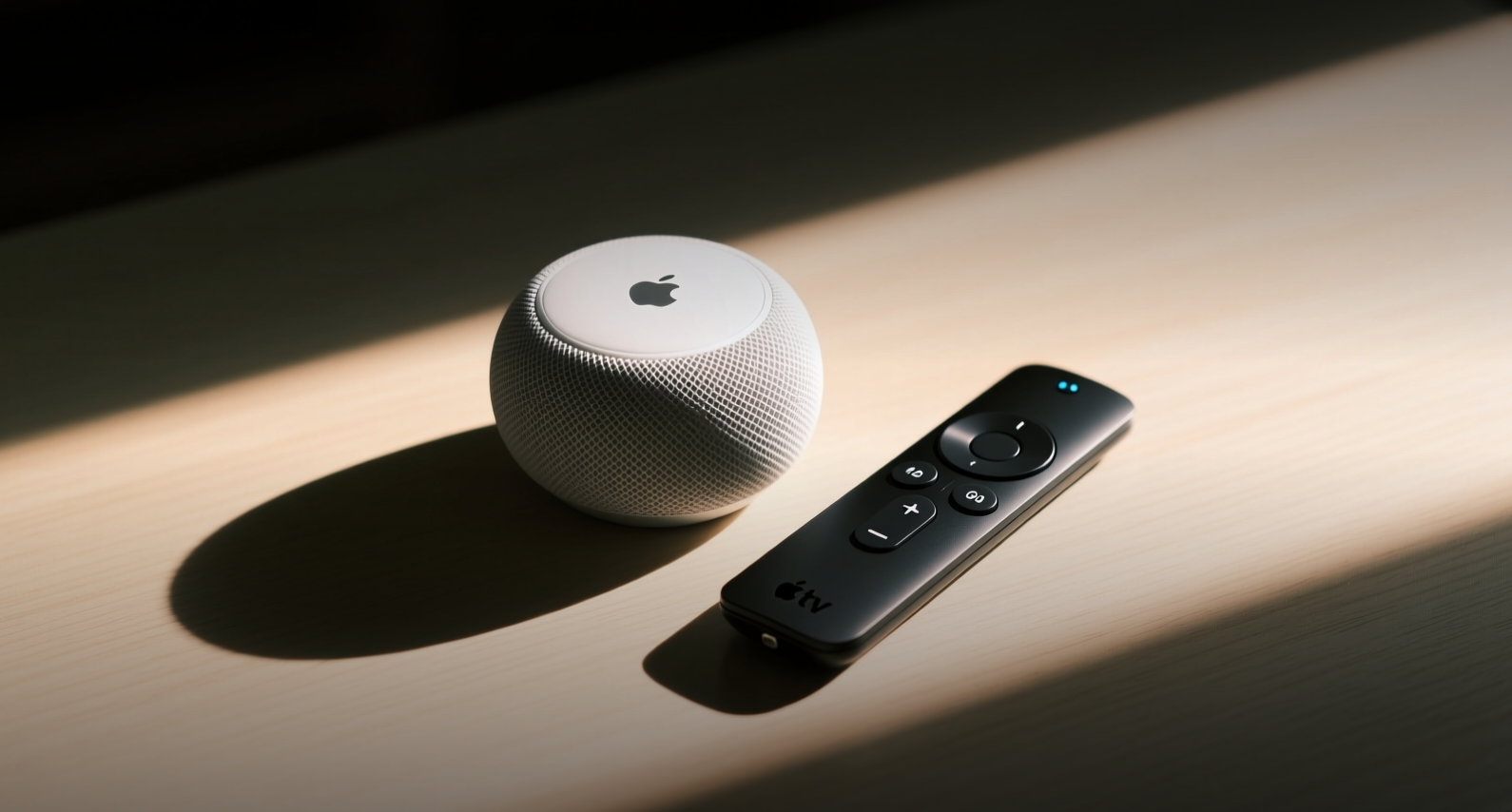
Apple Inc. is nearing completion of three new smart home products — a wall-mountable hub with facial recognition, a refreshed Apple TV and an updated HomePod mini — all powered by a revamped Siri AI launching this fall, according to people familiar with the development. The company's stock rose 1.8% to $342.89 on Tuesday, pushing its market capitalization past $5 trillion for the first time.
The centerpiece is a new smart home hub with a roughly 7-inch square display, running a tvOS-derived operating system that blends design elements from watchOS and iOS. The device can identify users by face and adjust its interface — showing personalized calendars, reminders and music preferences based on who is standing in front of it. Apple has developed two versions: a tabletop model (codenamed J490) with a screen perched on a dome-shaped base resembling a sliced HomePod mini, and a wall-mountable variant (J491) that attaches via a horizontal bracket. The company envisions households deploying multiple units across different rooms to form a unified home control network.
The new Apple TV (J265) and HomePod mini (B525) retain their current industrial designs but receive faster processors to support Siri AI. Pricing is expected to remain at $199 for the Apple TV and $129 for the HomePod mini. All three devices were originally slated for a 2024 launch but were delayed multiple times as Apple struggled to complete the Siri overhaul, which will now ship as "Siri AI" with iOS 27 this fall. The delays pushed the product timeline from 2024 to spring 2025, then fall 2025, and finally to 2026. Because the devices depend heavily on Siri AI for core functionality, the products could face further postponements, the people said.
Competing With Amazon and Google
Apple's smart home push directly challenges Amazon and Google, which have dominated the category for years with their Echo Show and Nest Hub lines. Amazon's Echo Show devices start at $89.95, while Google's Nest Hub family has anchored the search giant's home strategy. Neither offers on-device facial recognition for personalized multi-user experiences — a feature Apple is betting will justify the hub's likely premium price point. The timing is strategic: Amazon's smart home momentum has slowed amid broader cost-cutting, and Google has deprioritized hardware under its efficiency drive.
Beyond the First Wave
Apple is already planning higher-end variants. A robotic version of the hub with a roughly 9-inch display and a mechanical arm that tracks users as they move around a room is in development, along with an indoor security camera (codenamed J450) and a full home security system aimed at Amazon's Ring lineup. These products would extend Apple's home ecosystem beyond the three devices expected to ship this year.
For investors, the smart home push represents a potential growth catalyst for Apple's hardware business at a time when iPhone upgrade cycles have lengthened. The $5 trillion market cap milestone — the first for any publicly traded company — underscores investor confidence that Apple can open a new product frontier. Apple shares rose 1.8% to $342.89 on the news, though the stock already trades at a premium reflecting expectations for new categories to drive the next growth cycle. The key variable is Siri AI: if the assistant delivers on its promise after years of delays, Apple could replicate its ecosystem lock-in strategy in the home. If it stumbles, the hardware lineup risks being a collection of screens without a compelling reason to buy.
This article is for informational purposes only and does not constitute investment advice.
