

Key Takeaways:
- M5 Ultra Mac Studio delivers 4.3x AI performance over M3 Ultra with 80-core GPU
- Quad-die chip supports up to 512GB unified memory at 1.2TB/s bandwidth
- Pre-orders open August 25, shipments begin September 22 from $5,499
Key Takeaways:
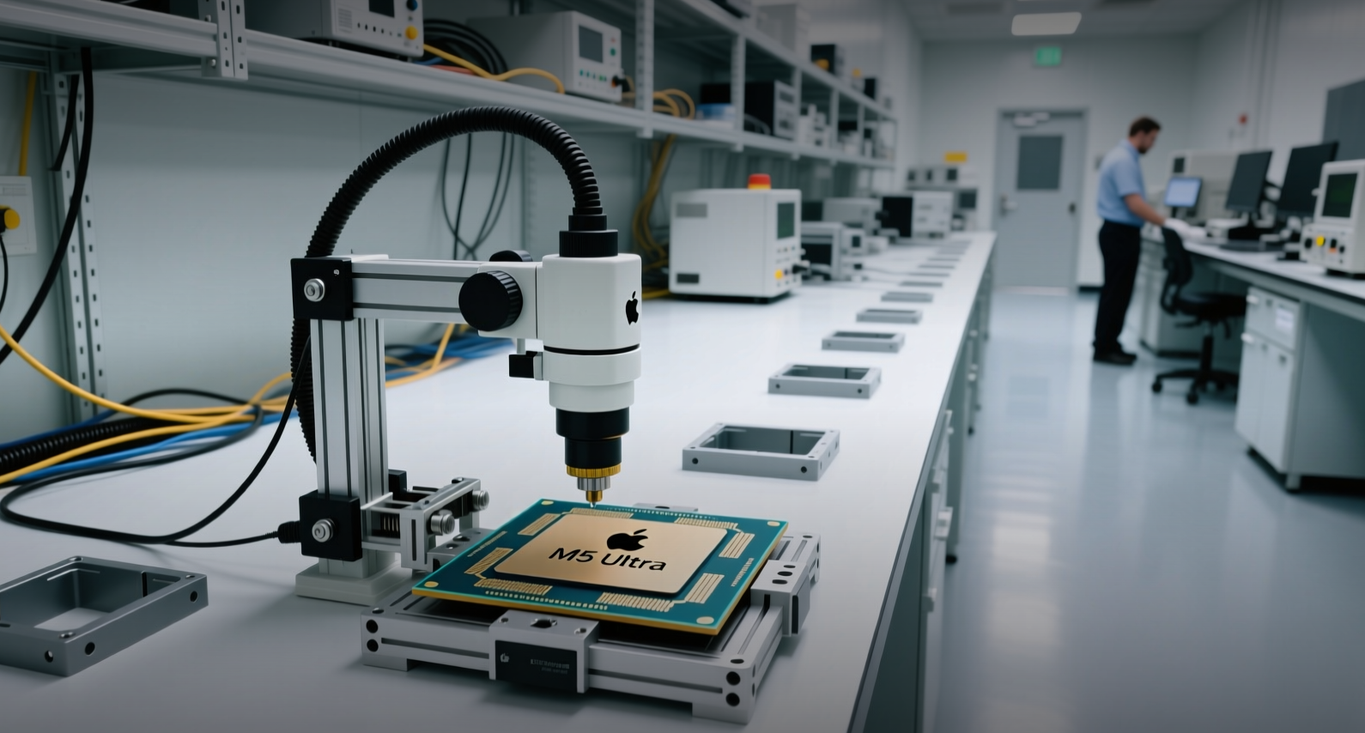
Apple's new M5 Ultra Mac Studio delivers up to 4.3x the AI performance of its predecessor, marking the company's most aggressive desktop silicon refresh in years.
Apple unveiled the M5 Ultra Mac Studio on Tuesday, a quad-die processor with an 80-core GPU and up to 512GB of unified memory that delivers 4.3x the AI performance of the M3 Ultra it replaces. The company also refreshed the Mac Studio with the M5 Max chip, previously seen in the MacBook Pro, and announced a new M6 Mac mini built on a 2nm process.
"The M5 Ultra is the most powerful silicon we have ever created," Apple said in its announcement, citing Neural Accelerators in every GPU core for the first time on an Ultra chip. The dedicated AI hardware sits inside each of the 80 GPU cores, a design shift that accelerates local machine-learning workloads without relying on the separate Neural Engine.
The M5 Ultra pairs a 36-core CPU with 12 super cores and 24 performance cores, delivering 1.3x higher multithreaded performance than the M3 Ultra. Memory bandwidth reaches 1.2TB/s, up 50 percent from the prior generation. The chip joins two M5 Max dies through Apple's UltraFusion interconnect, creating the company's first quad-die processor with over 4.4TB/s between-die throughput. Software sees the entire package as a single processor with one pool of unified memory.
The M5 Ultra Mac Studio starts at $5,499, a $200 increase over the M3 Ultra model, while the M5 Max version holds at $2,499. Pre-orders opened Tuesday with shipments beginning September 22, though the 512GB memory configuration arrives in late October. The M5 Max model offers an 18-core CPU, up to a 40-core GPU, and 128GB of unified memory at 614GB/s bandwidth.
Apple's benchmark claims against the M3 Ultra show the scale of the jump: 4x faster LLM prompt processing in LM Studio, 4.3x faster text-to-image generation, 3.3x faster CopyCat ML training in Foundry Nuke, and 1.7x faster scene rendering in Maxon Redshift. The Media Engine now handles 33 simultaneous streams of 8K ProRes 422 video at 30fps, doubling the encode and decode blocks of the M5 Max.
The company is positioning the machines for local AI inference, a market where Nvidia's RTX workstations and cloud GPU instances have dominated. Apple's Mac business grew almost 30 percent last quarter, and the company credits part of that to developers buying Mac mini and Mac Studio units to run models on their own desks rather than in someone else's cloud.
Thunderbolt 5 connectivity at up to 120Gb/s enables a new clustering capability: four Mac Studios can pool their memory into one shared space via RDMA, allowing users to load frontier-class open-weight models with over a trillion parameters. Apple says the entire four-node cluster runs off a standard wall outlet, eliminating per-token cloud costs after the hardware purchase.
The launch comes as Apple faces an industry-wide memory shortage that has forced it to trim configurations across its lineup. The M4 Max Mac Studio previously started at 36GB of memory and maxed out at 96GB as of last month, down from its original 128GB ceiling. The M5 Ultra's 512GB option is delayed to late October, and Apple offered no assurances on supply beyond saying it will build as many as it can.
The M6 Mac mini, announced alongside, marks Apple's first 2nm processor with a 12-core CPU, 12-core GPU, and dual 16-core Neural Engine. It starts at $899, up $100 from the M4 model, reflecting both the process-node jump and memory cost pressures. The M5 Pro Mac mini option starts at $1,699.
For investors, the refresh strengthens Apple's position in the professional computing segment against Nvidia-powered workstations and cloud AI providers. Apple's silicon strategy — unified memory that eliminates the CPU-GPU data transfer bottleneck — gives it a structural cost advantage for local inference workloads. The company's Mac revenue growth of nearly 30 percent last quarter suggests the strategy is gaining traction, though the memory shortage and $200 price increase on the M5 Ultra could temper demand from price-sensitive prosumers.
This article is for informational purposes only and does not constitute investment advice.
