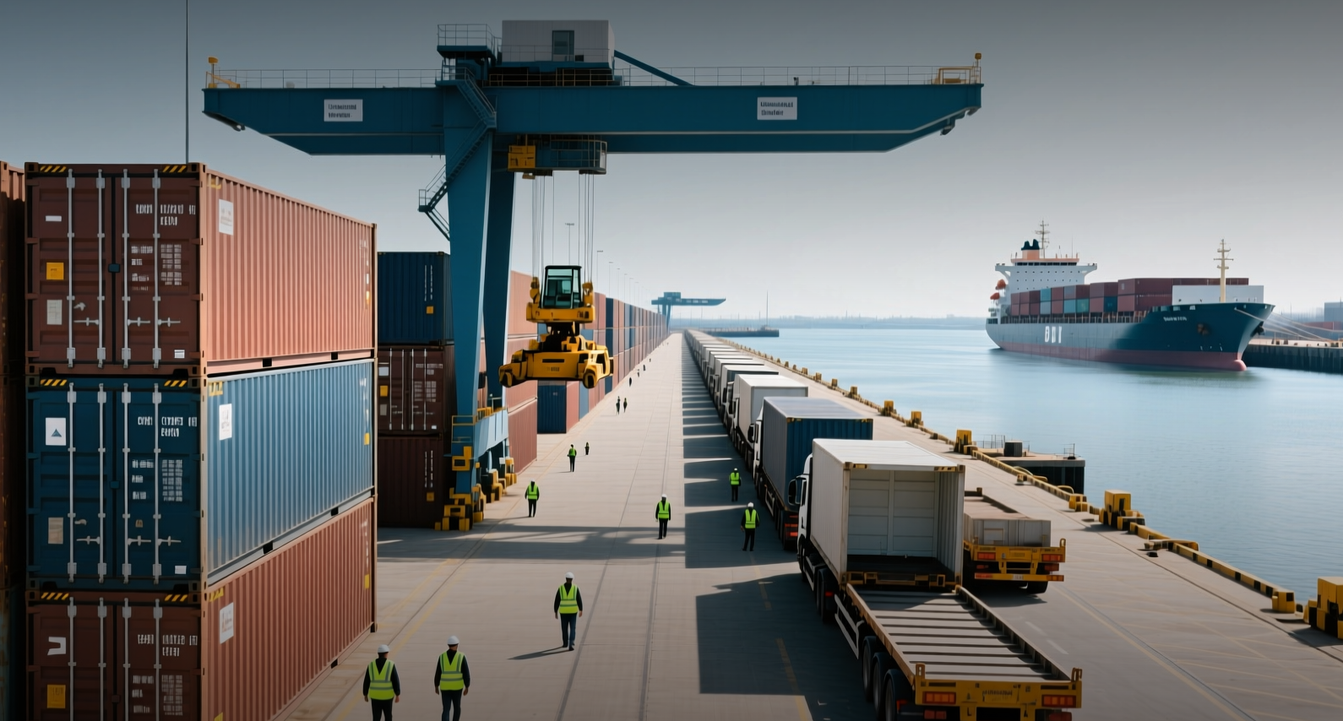
Beijing put a number on the tariff talks for the first time Thursday, confirming that negotiators are drafting a framework to cut duties on $30 billion of two-way goods — roughly 5 percent of the $585 billion the two economies trade annually.
"China and the U.S. economic and trade teams are earnestly implementing the consensus reached by the two heads of state at their Beijing meeting, and are consulting on a $30 billion reciprocal tariff reduction framework arrangement, striving for early implementation," Commerce Ministry spokesperson Huang Ling said at a weekly briefing in Beijing.
The framework is the tariff component of the U.S.-China Board of Trade that President Donald Trump and President Xi Jinping agreed to establish at their May meeting in Beijing, alongside a parallel Board of Investment. Its design is narrow by construction: negotiators are identifying equivalent volumes of "non-sensitive" goods on each side and cutting duties on matching amounts, rather than reopening the broader tariff architecture. Trump and Xi are expected to meet in Washington on Sept. 24, their third face-to-face session in a year, and the tariff truce the two sides reached after the 2025 escalation expires on Nov. 10.
A $30 billion cut against a $585 billion trade base
The scale of the proposed reduction is modest relative to the flow it governs. China shipped about $440 billion of goods to the United States in 2024 and imported roughly $145 billion, according to U.S. Census Bureau data. A $30 billion reciprocal cut therefore covers about 5 percent of the two-way total — enough to move landed costs for the specific product lines named, not enough to reset the average tariff burden.
That arithmetic explains why Barclays told clients this week that "trade will be front and center at the summit" while cautioning that the scope for a broad trade deal is limited and that targeted tariff reductions are the more likely outcome. The bank's note flags the Nov. 10 truce expiry as the operative deadline.
The transmission runs through import costs first. A 10 percentage point reduction on $30 billion of goods removes roughly $3 billion in annual duty payments, split between U.S. importers of Chinese inputs and Chinese buyers of American agricultural, energy and aerospace products. For U.S. importers, that is a direct margin line; for Chinese buyers of soybeans and LNG, it narrows the price gap against Brazilian and Qatari alternatives that widened during the tariff war. Equity exposure sits in agriculture, semiconductors, autos, logistics and Chinese ADRs — the sectors whose revenue lines are tied to the specific goods on the list, which has not been published.
The mandate is political, the calendar is not
The Beijing consensus supplies the political cover for both sides to cut without appearing to concede. Foreign Ministry spokesperson Guo Jiakun framed the mechanism on Thursday: "Leaders' diplomacy plays an irreplaceable strategic guiding role in China-U.S. relations." That language matters because it lets negotiators attribute any reduction to a leaders' agreement rather than to bilateral bargaining — the same construction both governments used to sell the May truce.
What the mandate does not supply is a date. Huang said the teams are "striving for early implementation" and did not elaborate on scope, product lists or timing. The last comparable round followed the same pattern: after the May summit produced the Board of Trade agreement, the tariff file took months to move from announced to drafted, and the truce that made it possible was extended rather than converted into a permanent arrangement. Markets that bought the May headline gave back part of the move as the drafting slipped.
The Sept. 24 meeting is the next dated checkpoint. If the two leaders sign a framework with a named effective date, the $3 billion in annual duty relief becomes a forecastable line item and the Nov. 10 expiry stops being a cliff. If the meeting produces another statement of intent, the truce deadline arrives with no signed text, and the tariff schedule reverts to its pre-truce setting absent an extension — the scenario that would reverse the current optimism in trade-exposed equities fastest.
This article is for informational purposes only and does not constitute investment advice.