
Key Takeaways: China's 2026-2030 industrial policy names 6G, quantum computing, and embodied AI as growth engines, targeting 100 demonstration parks by 2035.
Key Takeaways: China's 2026-2030 industrial policy names 6G, quantum computing, and embodied AI as growth engines, targeting 100 demonstration parks by 2035.
China's Ministry of Industry and Information Technology unveiled plans to build integrated circuits, aerospace, and intelligent robotics into pillar industries during the 15th Five-Year Plan (2026-2030), while pushing 6G toward commercial readiness.
"China will accelerate breakthroughs in core 6G technologies, continue trials and standards development, and promote ecosystem maturity to prepare for commercialization," Liu Yulin, an official at MIIT, said at a State Council Information Office briefing in Beijing.
The plan targets 100 demonstration parks and 1,000 leading demonstration enterprises by 2035, according to MIIT officials. Nearly 200 key AI standards have been developed, and AI has penetrated the full chain from R&D design to operations maintenance. The ministry will promote "5G+," "AI+," "robot+," and "industrial internet+" applications across key industrial sectors.
The policy shows Beijing's intent to channel state resources into high-value technology sectors as traditional growth engines slow. With China's real estate sector contracting and export demand facing tariff headwinds, emerging industries are expected to fill the gap — a shift that could redirect capital flows toward A-share and Hong Kong-listed technology companies over the next five years.
The 15th Five-Year Plan marks a departure from the 14th (2021-2025), which focused on supply-side reform and "dual circulation." The new framework explicitly names future industries — quantum technology, bio-manufacturing, hydrogen and fusion energy, brain-computer interfaces, embodied intelligence, and 6G — as "new economic growth drivers," a designation that carries funding and policy implications for state-backed enterprises and private firms alike.
On 6G specifically, MIIT said it will accelerate core technology breakthroughs, continue trials and standards development, and foster a mature industry ecosystem to lay the groundwork for commercial use. The timeline aligns with global expectations for 6G standardization around 2028-2030, with China's major telecom operators — China Mobile, China Telecom, and China Unicom — already conducting early-stage research.
Xin Guobin, vice-minister of MIIT, said AI is injecting strong momentum into economic growth. On the supply side, China will support R&D of high-end training chips and multimodal algorithms, advance brain-inspired intelligence, and iterate intelligent terminals such as humanoid robots and brain-computer interfaces. On the application side, the focus will be on high-value industry scenarios, cultivating lightweight, low-cost, and easy-to-deploy solutions so enterprises can adopt AI effectively.
Yao Jun, director of MIIT's planning department, said the ministry will promote large-scale deployment of new technologies through "5G+," "AI+," "robot+," "industrial internet+," and "BeiDou Navigation Satellite System+" initiatives. Multiple cities are organizing AI ethics review and service practice programs, according to MIIT. The ministry also said it will speed up construction of next-generation telecommunication networks and computing-power networks while strengthening cyberspace data security.
The policy also includes a tiered cultivation system for quality enterprises, fostering specialized SMEs that produce new and unique products, and creating more "little giant" enterprises and manufacturing single-category champion enterprises.
100 Parks, 1,000 Enterprises by 2035
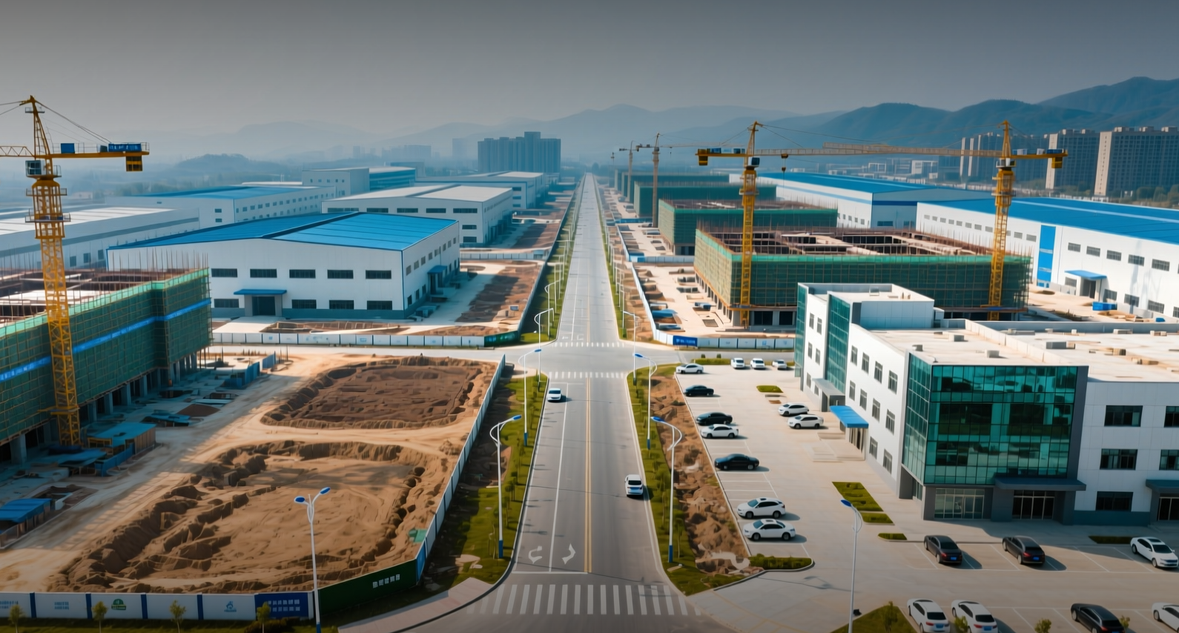
The demonstration park target is the most concrete metric in the plan. By 2035, China aims to establish 100 demonstration parks with strong radiating effects and 1,000 leading demonstration enterprises, according to MIIT officials. The parks will focus on next-generation information technology, new energies, new materials, intelligent connected new-energy vehicles, robots, bio-medicine, high-end equipment, and aerospace.
What This Means for Markets
The policy provides a clear roadmap for state capital allocation over the next five years. Companies in integrated circuits, aerospace, biopharmaceuticals, low-altitude economy, new energy storage, and intelligent robotics are likely to see increased government procurement, subsidies, and R&D funding. The 6G push could benefit telecom equipment makers and chip designers, while the AI emphasis supports the broader semiconductor supply chain.
For investors, the key question is execution. The 14th Five-Year Plan similarly identified emerging sectors, yet many — including hydrogen and brain-computer interfaces — remain at early commercialization stages. The 100-park target by 2035 suggests Beijing expects a decade-long buildout, with near-term milestones likely to emerge as provincial governments compete for demonstration park designations. For global technology supply chains, the plan reinforces China's ambition to reduce dependence on foreign semiconductor and AI technology, a dynamic that could reshape trade flows and investment patterns across the Asia-Pacific region.
This article is for informational purposes only and does not constitute investment advice.
