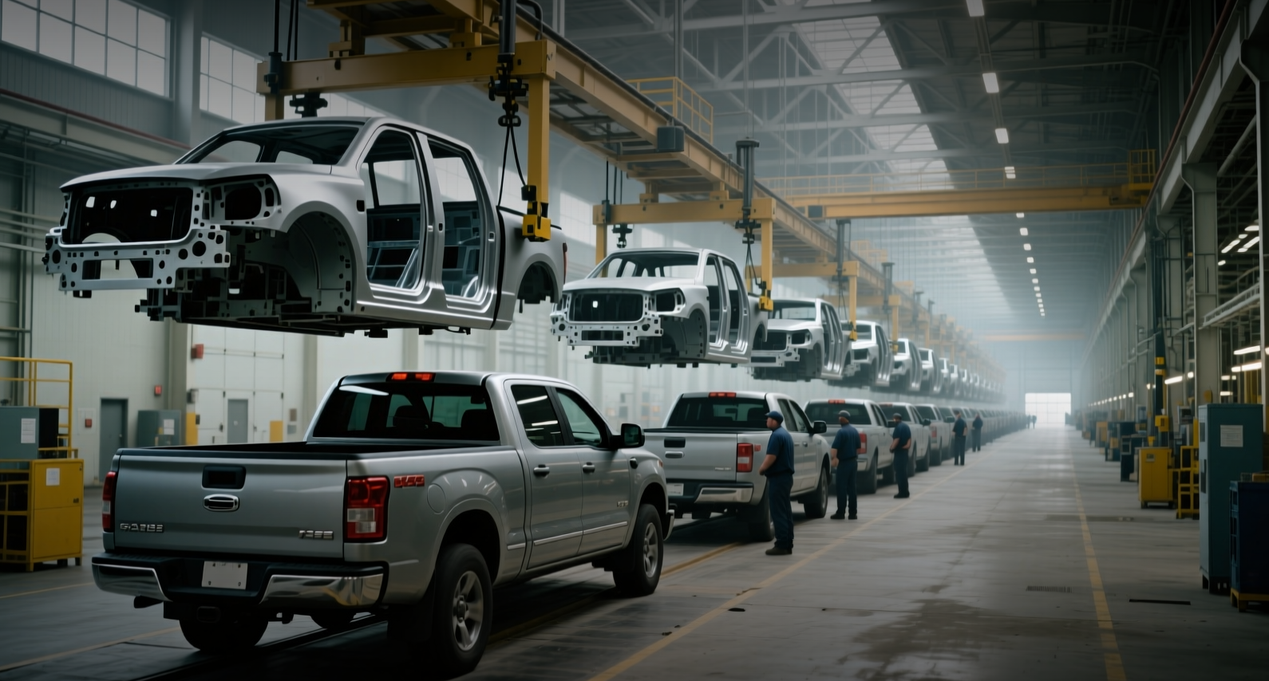
General Motors is expanding Canadian heavy-duty truck production even as Washington threatens to double tariffs on vehicles crossing the border.
General Motors plans to spend C$144 million ($104 million) adding next-generation heavy-duty GMC Sierra assembly to its Oshawa, Ontario plant as part of a tentative deal with Unifor covering 4,600 workers — a bet on Canadian production that runs against a looming 50 percent U.S. tariff threat.
The agreement, reached Saturday and pending member ratification this weekend, also commits GM not to immediately sell or close its Ingersoll, Ontario assembly plant, according to a bargaining report from the union. Both Unifor and GM's Canadian division declined comment ahead of the vote, Reuters reported.
The investment lands as U.S.-Canada trade talks collapsed last week over unresolved issues, including whether to cut duties on medium- and heavy-duty vehicles. U.S. President Donald Trump has said tariffs on all Canadian cars, trucks, automotive parts and steel will rise to 50 percent starting January 1, 2027, up from the current 25 percent.
Canada has said it cannot accept a trade deal unless the agreement ensures the survival of a strong Canadian auto assembly and parts industry. The GM-Unifor deal represents a bet that heavy-duty truck production — a high-margin segment where GM holds significant share — can remain competitive in Ontario even as tariffs climb from 25 percent to a proposed 50 percent.
Heavy-Duty Trucks at the Center of the Fight
The Oshawa plant addition would expand GM's footprint in a segment that generates some of the industry's highest per-vehicle profits. Heavy-duty trucks command premium pricing, and the segment has been a key profit driver for Detroit automakers. The C$144 million investment is modest relative to the revenue potential of a new heavy-duty truck line, which could generate billions in annual sales across the Sierra and Silverado HD platforms.
The Ingersoll plant had been at risk of closure as GM restructures its Canadian operations. The pledge not to sell or close the facility provides stability for workers across the four Ontario sites covered by the agreement. The deal also signals GM's willingness to invest in Canadian assembly capacity at a moment when cross-border production economics are being reshaped by tariff policy.
Tariff Escalation Timeline
The current 25 percent tariff on Canadian-produced vehicles has already pressured cross-border auto supply chains. The proposed increase to 50 percent on all Canadian cars, trucks, parts and steel would take effect January 1, 2027, potentially adding thousands of dollars to the cost of vehicles assembled in Canada and sold in the U.S. That escalation would hit GM's Canadian operations directly, given the volume of vehicles the company ships south across the border.
The collapse of U.S.-Canada trade talks last week leaves the auto sector in limbo. Canada's position is clear: no trade deal without guarantees for its auto assembly and parts industry. GM's investment decision suggests the company is preparing for a scenario where Canadian production remains viable — or at least hedging against the worst-case outcome by locking in capacity commitments now.
At the current exchange rate of $1 = 1.3901 Canadian dollars, the C$144 million investment translates to roughly $104 million in U.S. terms. The ratification vote this weekend will determine whether the deal moves forward. If approved, GM would begin adding Sierra production to Oshawa, with the next-generation heavy-duty truck expected to launch in the coming years. The timing of that launch will be critical — it will determine whether GM brings the new Sierra HD to market before or after the proposed tariff increase takes effect.
This article is for informational purposes only and does not constitute investment advice.