

Key Takeaways: Humanoid robots operating at under $10 per hour could absorb a quarter of unfilled U.S. manufacturing jobs by 2030, JPMorgan analysts project.
Key Takeaways: Humanoid robots operating at under $10 per hour could absorb a quarter of unfilled U.S. manufacturing jobs by 2030, JPMorgan analysts project.
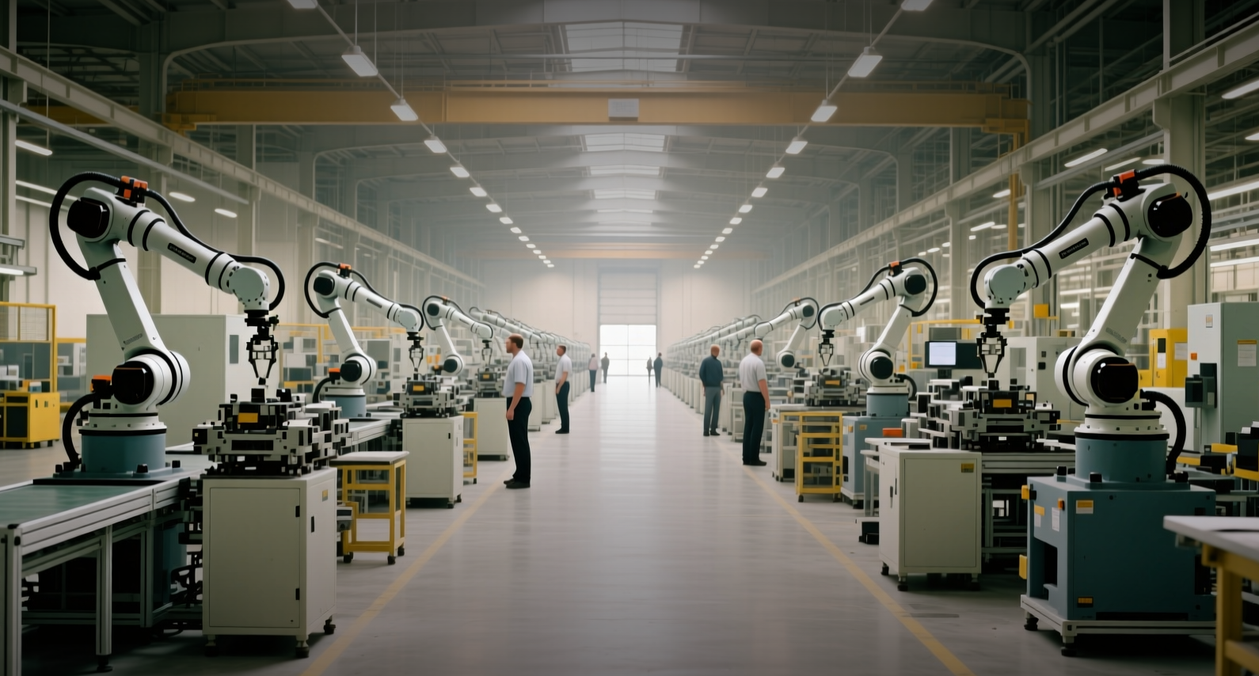
JPMorgan expects humanoid robots to fill 25 percent of the 462,000 unfilled U.S. manufacturing jobs, with operating costs below $10 per hour versus roughly $30 for warehouse labor.
The research note, published Aug. 25, comes from JPMorgan analysts covering Hyundai Motor and Kia, in which Hyundai holds a 35 percent stake. Hyundai also owns Boston Dynamics, a leading robot manufacturer.
The bank estimates humanoids will cost $10 to $12 per hour to operate in warehousing, versus $30 per hour for human labor. Currently two humanoids equal the output of one human worker, but JPMorgan projects that ratio will fall to 1.2 to 1.3 humanoids per worker. The analysts see three bottlenecks: brains, hands, and supply-chain readiness.
The forecast arrives as the humanoid robot industry navigates a shifting regulatory and competitive environment. The FCC added foreign-made humanoid and quadruped robots to its Covered List, blocking new imports on national security grounds — a move targeting China, which holds roughly 85 percent of the global humanoid robot market.
The bottlenecks JPMorgan identified are not trivial. The "brains" bottleneck refers to the AI systems that enable humanoids to perceive and navigate real-world environments, while the "hands" bottleneck concerns dexterous manipulation — a problem that has stumped robotics engineers for decades. Supply-chain readiness covers everything from actuator production to sensor availability. Hyundai is tackling the brain and supply-chain elements, the JPMorgan analysis said, but the hands component may end up sourced from a third party.
Chinese firms Unitree and AGIBOT each shipped more than 5,000 humanoid units in 2025, while American competitors such as Tesla and Figure AI shipped only a few hundred units apiece, according to CNN, citing technology research firm Omdia. Global humanoid robot shipments totaled roughly 15,000 units in 2025.
China's Foreign Ministry pushed back against the FCC restrictions, with spokesperson Mao Ning saying Beijing would take "all measures necessary" to defend the interests of Chinese businesses. "Protectionism does not make the U.S. more competitive, and it will only hurt the interests of U.S. companies and consumers," Mao Ning said.
Unitree, one of the leading Chinese humanoid robot makers, went public on Shanghai's STAR Market earlier this month. The company's stock closed 460 percent above its IPO price on its first trading day, valuing it at roughly $50 billion, according to Reuters. Unitree raised approximately 6.1 billion yuan ($905 million) in the listing. The company's revenue climbed to 1.70 billion yuan in 2025 from 392.77 million yuan in 2024, and it posted a net profit of 278.21 million yuan, according to its prospectus. Overseas sales, including the U.S. market, accounted for about 44 percent of its main-business revenue in 2025. Unitree's stock has since fallen 46 percent from its post-IPO high.
JPMorgan estimated an average selling price of some $120,000 per unit for humanoids — far above the long-term targets of $20,000 to $30,000 floated by Tesla CEO Elon Musk. The research note imagined that industrial buyers will be more interested in reliability and upgradability than a low list price. The bank also noted that humanoids can serve as complements rather than substitutes for human labor, with technology improvements potentially expanding the addressable share to 50 percent of unfilled roles by 2030.
For investors, the economics are becoming harder to ignore. Hyundai, through its Boston Dynamics subsidiary, is tackling the brain and supply-chain bottlenecks identified by JPMorgan, while the hands component may come from a third party. As the cost gap between automation and human labor narrows, robotics-focused companies and their suppliers stand to capture a growing share of industrial spending. The FCC import restrictions could accelerate domestic U.S. robot manufacturing even as Chinese makers dominate global shipments. With the U.S. manufacturing shortage projected to reach 1.6 million jobs by 2030, the addressable market for humanoids will only expand.
This article is for informational purposes only and does not constitute investment advice.
