
Key Takeaways:
- SanDisk stock surged 6,000% to $2,354 since its Western Digital spin-off in early 2025
- A $1,000 investment at the separation would now be worth roughly $61,000
- The rally was fueled by AI-driven NAND demand and gross margins above 78%
Key Takeaways:
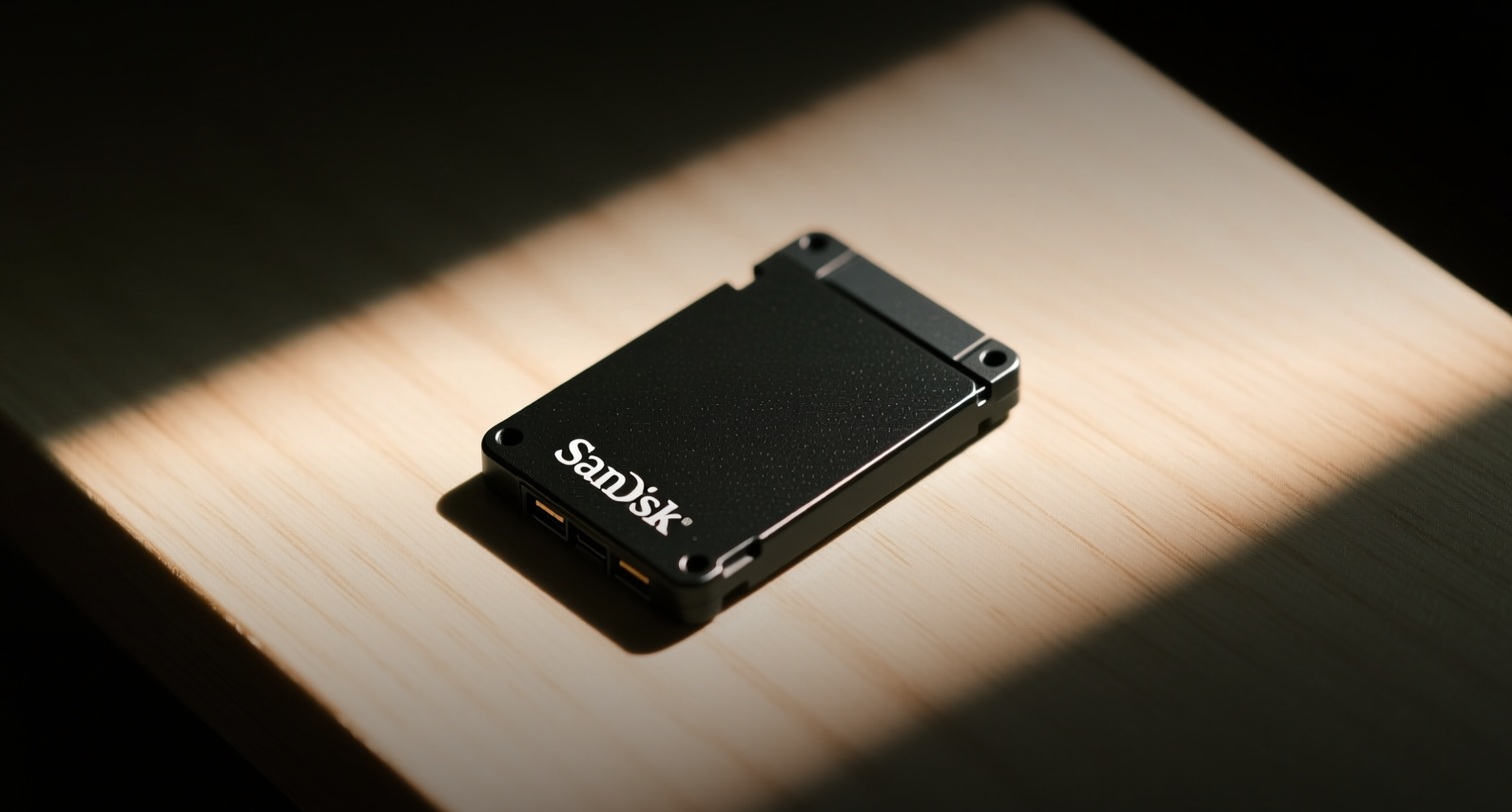
SanDisk's 6,000% surge from its Western Digital spin-off makes it the biggest winner of the AI memory boom.
SanDisk shares surged 6,000% to $2,354 since its spin-off from Western Digital in early 2025, as AI data center demand for NAND flash storage turned the former conglomerate castoff into a $235 billion company.
"The AI data center buildout has created unprecedented demand for high-performance flash storage," David Goeckeler, chief executive officer of SanDisk, said, calling the moment a "fundamental inflection point" for the business.
SanDisk posted fiscal third-quarter revenue of $5.95 billion and non-GAAP earnings of $23.41 a share, with gross margins of 78.4%. In the nine months ended April 3, revenue jumped about 110% to $11.3 billion from the comparable prior-year period, while earnings swung from a loss to a $5.4 billion gain.
SanDisk's market capitalization has swelled to $235 billion from roughly $8 billion at the time of the separation. The company is developing High Bandwidth Flash technology with SK Hynix, targeting a launch in the second half of 2026, which could further widen its lead in the AI storage market.
How AI Data Centers Drove the Transformation
SanDisk's solid-state drives provide the flash storage that data centers need for real-time inference and training workloads, a market that has grown faster than supply can keep up. Unlike traditional hard disk drives, which Western Digital specializes in, SSDs use NAND technology to deliver the high-speed retrieval required for active databases and user profiles in AI applications.
The supply-demand imbalance has given SanDisk extraordinary pricing power. The company is sold out through 2026 and is locking in long-term contracts starting in 2027 and 2028, according to a Fortune analysis. That scarcity has pushed prices up as much as 50% since the start of 2025.
The spin-off proved a strategic move. Western Digital retained the hard disk drive business, which handles "warm" and "cold" data requiring massive capacity at low cost per terabyte. SanDisk took the solid-state drive business, which serves the faster-growing "hot" storage segment. That separation allowed each company to focus on its core technology and capture the AI tailwind independently.
The AI Centurions Club
SanDisk is among six so-called AI Centurions — old-line industrial and technology companies that have each surpassed $100 billion in market capitalization by supplying equipment to hyperscale data centers. The group, which also includes GE Vernova, Seagate Technology, Western Digital, Vertiv and AppLovin, saw its combined valuation jump from $90 billion to roughly $1 trillion since mid-2023.
SanDisk's annualized stock gain of about 1,600% in its 18 months as an independent company far outpaces the other Centurions. Its market capitalization now exceeds those of Blackstone, Salesforce, Pfizer and Uber. A $1,000 investment at the time of the spin-off would now be worth roughly $61,000.
Competition Risks and the Path Forward
The stock has pulled back from its June peak, falling 12% on July 27 to $1,270 after China's ChangXin Memory Technologies surged more than 500% in its Shanghai debut, reviving fears of new competition in the memory market. Even after the decline, SanDisk's year-to-date gain stood at 505%.
CXMT is the world's fourth-largest DRAM maker with an 8% market share, trailing Samsung at 36%, SK Hynix at 29% and Micron at 24%. Apple is reportedly testing CXMT's DRAM chips, adding weight to the concern that Chinese memory could reach top-tier customers sooner than bulls had assumed. SanDisk remains protected by U.S. export controls on advanced chipmaking tools that limit CXMT's ability to scale NAND production.
For investors, the question is whether SanDisk's valuation can hold. The stock trades at a premium multiple reflecting expectations that the AI-driven memory supercycle will persist. SK Hynix's second-quarter earnings report, due July 28, could provide the next signal on whether demand remains strong enough to justify the sector's elevated valuations.
This article is for informational purposes only and does not constitute investment advice.
