
Bank Negara Malaysia held its overnight policy rate at 2.75% for a seventh straight meeting on Sept 3, as strong growth and mild inflation kept policymakers on hold.
Bank Negara Malaysia held its overnight policy rate at 2.75% for a seventh straight meeting on Sept 3, as strong growth and mild inflation kept policymakers on hold.
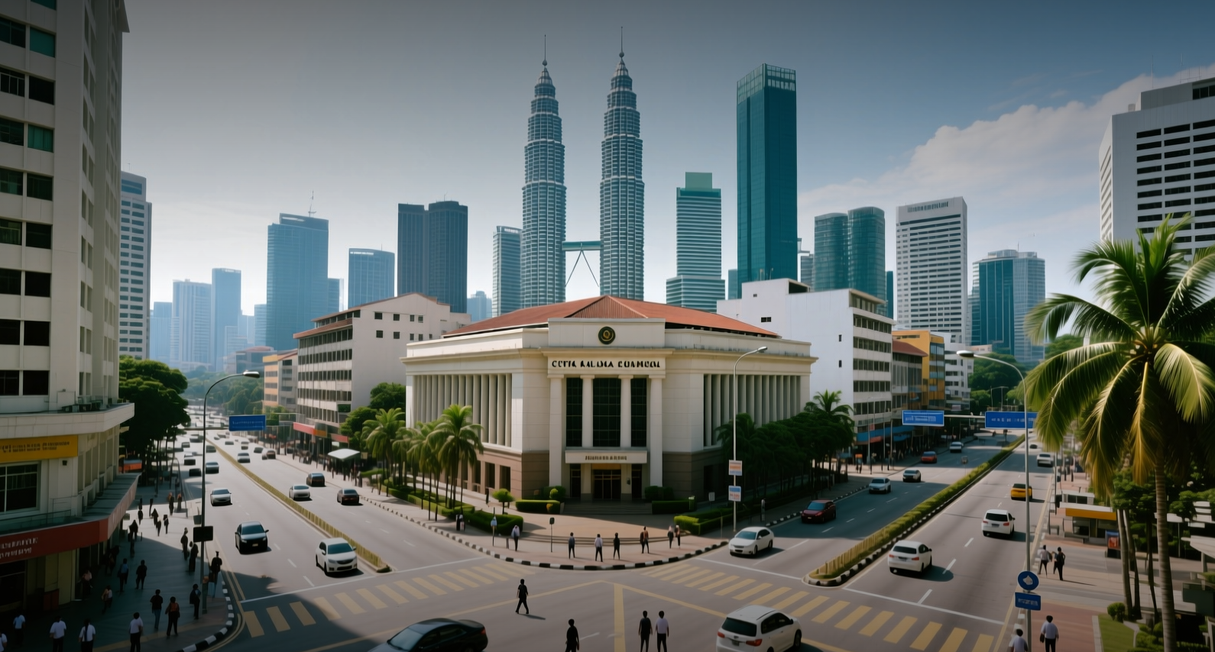
Bank Negara Malaysia kept its benchmark rate at 2.75% for a seventh consecutive meeting Thursday, holding policy steady as 6% second-quarter growth and contained inflation let the central bank diverge from tightening peers.
"At the current OPR level, the Monetary Policy Committee considers the monetary policy stance to be consistent with the outlook of continued price stability and sustainable economic growth," Bank Negara said in a statement.
The decision matched forecasts from all seven economists polled by The Wall Street Journal and 20 of 22 in a Bloomberg survey. Malaysia's economy expanded 6% year-on-year in the second quarter, accelerating from 5.4% in the first three months, with the central bank now projecting full-year 2026 growth of around 5% — the upper end of its 4% to 5% official range. Headline and core inflation averaged 1.8% and 2%, respectively, over the first seven months of 2026.
The hold widens Malaysia's divergence from central banks confronting renewed price pressures. The Reserve Bank of New Zealand raised its cash rate by 25 basis points to 2.75% on Sept 2, and the European Central Bank is expected to deliver a similar hike on Sept 10. Kenanga Investment Bank forecasts the OPR will stay at 2.75% through 2026, and 19 of 26 economists in a Reuters poll expect no change through end-2027.
Growth Momentum Carries Into 2027
The central bank said the economy's sound fundamentals should keep growth resilient into 2027, driven by strong export demand for electrical and electronics goods, continued strength in tech-related non-E&E exports and sustained tourist spending. "Stable labour market conditions and ongoing investment activity will remain supportive of domestic demand," it said, while flagging downside risks from a prolonged Middle East conflict and lower commodity production.
Malaysia has outperformed most regional peers in 2026, shielded in part by higher tech investment and exports tied to the global buildout of artificial intelligence infrastructure. The operationalisation of data centres and strong AI-related demand for E&E exports supported second-quarter services and manufacturing output. The economy grew 5.7% in the first half of 2026 despite the challenging global environment, driven by stronger-than-expected export performance and sustained domestic demand.
The Malaysian stock exchange and ringgit were largely unchanged following the rate decision, with the 10-year government bond yield at 3.935%. The muted reaction reflects how fully the market had priced in the hold — UOB Global Economics & Markets Research had flagged a "wait-and-see" stance ahead of the meeting, citing resilient domestic demand, ongoing government policy support and continued AI and data-centre investment. "These should provide important growth buffers," economist Lee Sue Ann said in a note.
Inflation Pass-Through Stays Contained
Despite elevated energy costs and strong economic growth, the pass-through to consumer prices has been contained by domestic policy measures and stable demand conditions, Bank Negara said. Prime Minister Anwar Ibrahim on Aug 30 restored higher quotas for subsidised petrol and diesel after lowering them earlier in 2026 to offset a jump in oil prices.
Inflation risks remain largely supply-driven, allowing Bank Negara to look past temporary energy-price swings unless they generate broader and more persistent pressures, Kenanga economists said. Federal Reserve Chair Kevin Warsh's hawkish remarks at Jackson Hole did not change Kenanga's outlook, with the economists saying the relatively narrow breadth of U.S. price pressures supports their view that global inflation remains largely supply-driven.
The central bank expects headline inflation to average between 1.5% and 2.5% this year. Second-quarter headline inflation came in at 1.9%, up from 1.6% in the preceding quarter, while core inflation eased to 1.9% from 2.1%.
The policy backdrop contrasts with a more complicated monetary environment elsewhere. UOB expects the Bank of Japan to resume tightening in the fourth quarter with a 25-basis-point increase to 1.25%, while Bank Indonesia is expected to stay on hold at 5.75% this month to preserve rupiah stability. The Federal Reserve is expected to leave rates unchanged for the rest of 2026, though Warsh's emphasis on inflation risks has raised the possibility of tightening this year.
Bank Negara will hold its sixth and final MPC meeting of 2026 later this year, with the OPR having remained unchanged since the 25-basis-point cut in July 2025. Bank Muamalat Malaysia Bhd chief economist Dr Mohd Afzanizam Abdul Rashid said there was little reason for the central bank to change its stance given strong economic growth and moderate inflation.
This article is for informational purposes only and does not constitute investment advice.
