
Orbbec is selling the shovels for embodied intelligence — data-capture hardware — as robot makers struggle to scale past 10,000 units.
Orbbec is selling the shovels for embodied intelligence — data-capture hardware — as robot makers struggle to scale past 10,000 units.
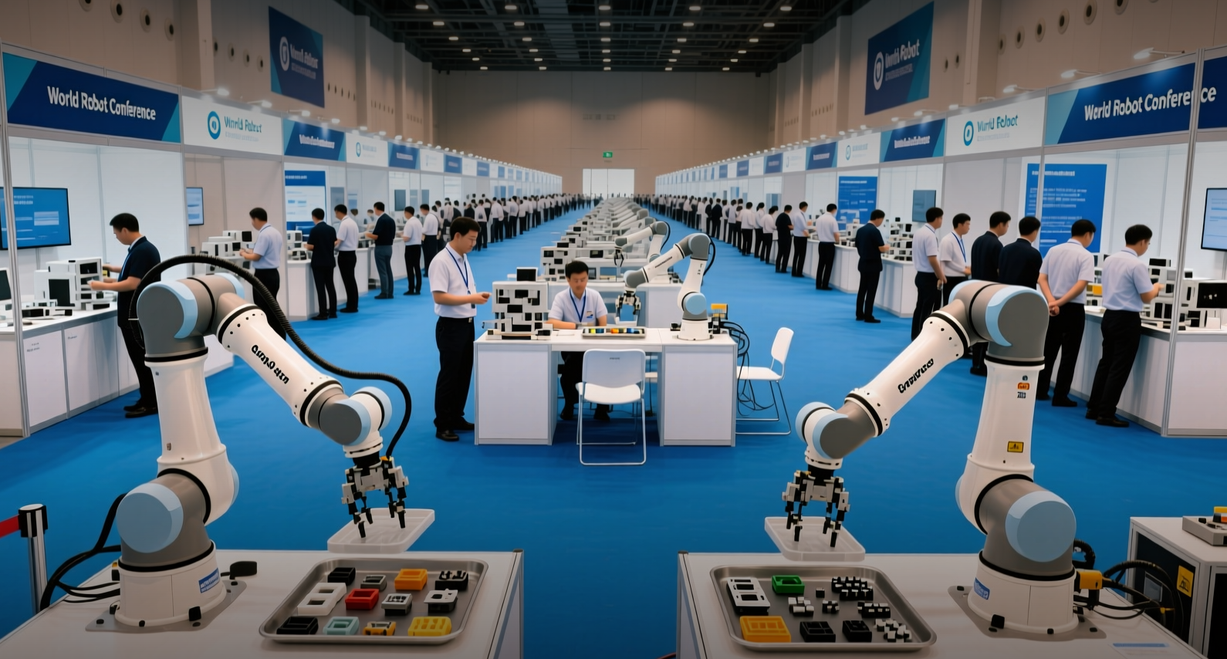
Robot makers cannot train machines to grasp or assemble without physical data, and Orbbec is betting that bottleneck is a business. The Shenzhen vision-sensor maker unveiled four data-capture devices at the World Robot Conference on Aug. 19.
Founder Huang Yuanhao said the launch marks a shift from hardware vendor to data platform. "Once tied to data, the importance and stickiness are completely different," Huang said, arguing that hardware alone carries no customer lock-in.
The lineup spans four devices: EGO for first-person capture, UMI for handheld operation, WristCam for near-field wrist data and Hub for multi-device synchronization. In some conditions the equipment records more than 37 hours continuously with zero frame loss on RGB and inertial data, and multi-camera hardware sync error stays under one millisecond, Orbbec said.
The bet comes as China's robot makers race toward mass production. Unitree, the world's largest humanoid seller, listed on Shanghai's STAR Market on Aug. 19 after raising 6.1 billion yuan ($905 million), while rivals including Agibot and UBTECH pursue Hong Kong listings. Orbbec has started its own Hong Kong listing to deepen global expansion, with data-capture equipment central to its capital story.
The data bottleneck is the industry's defining constraint. Large language models draw on the internet's stock of text and images, but robots that must grasp, assemble and sort need action trajectories, spatial positions and multimodal data generated by real interaction — a resource that does not yet exist at scale. Orbbec's devices aim to capture that data before robots reach customers.
The hardware sits upstream of a supply chain racing to hit volume targets. UBTECH has said it will mass produce 10,000 industrial humanoid robots this year, while Unitree's cumulative humanoid output has reached 18,000 units, according to its recent listing. Yet industry executives at the conference's main forum described a 10,000-unit delivery bottleneck that lies not only in the model "brain" but in production consistency and demand matching. Zhao Tongyang, founder of Q-One Robotics, said task success rates must climb from 99 percent to 99.99 percent before robots can enter real-world use.
Whether Orbbec's platform ambition becomes a large enough business remains unproven. No-body capture cannot fully replace the joint, torque and tactile data generated by real machines, and the industry has not settled on a data route or device standard. Huang's answer is to set the interface himself: with the highest market share in vision sensors, Orbbec can define how glove and arm data integrate into a common pipeline.
The pivot also carries a valuation logic. A hardware vendor sells a replaceable component; a data platform that binds models to its pipeline earns recurring value. Orbbec's Hong Kong listing, already under way, will test whether investors accept that framing.
The embodied intelligence supply chain is consolidating around whoever controls the data. Orbbec's move casts it as infrastructure rather than a component maker, but the market has yet to price in a data-platform premium. Rivals building their own data pipelines — Galaxy Universal with its 10-billion-level embodied dataset, and Nvidia's partnership with Unitree on embodied AI models — could narrow the window. Investors should watch whether Orbbec's data standard gains adoption beyond its own hardware before assigning platform value.
This article is for informational purposes only and does not constitute investment advice.
