
Escalating US-Iran attacks on tankers in the Strait of Hormuz pushed Brent to $96.80 a barrel, with daily ship transits at their lowest since May and ANZ forecasting constrained exports through 2026.
Escalating US-Iran attacks on tankers in the Strait of Hormuz pushed Brent to $96.80 a barrel, with daily ship transits at their lowest since May and ANZ forecasting constrained exports through 2026.
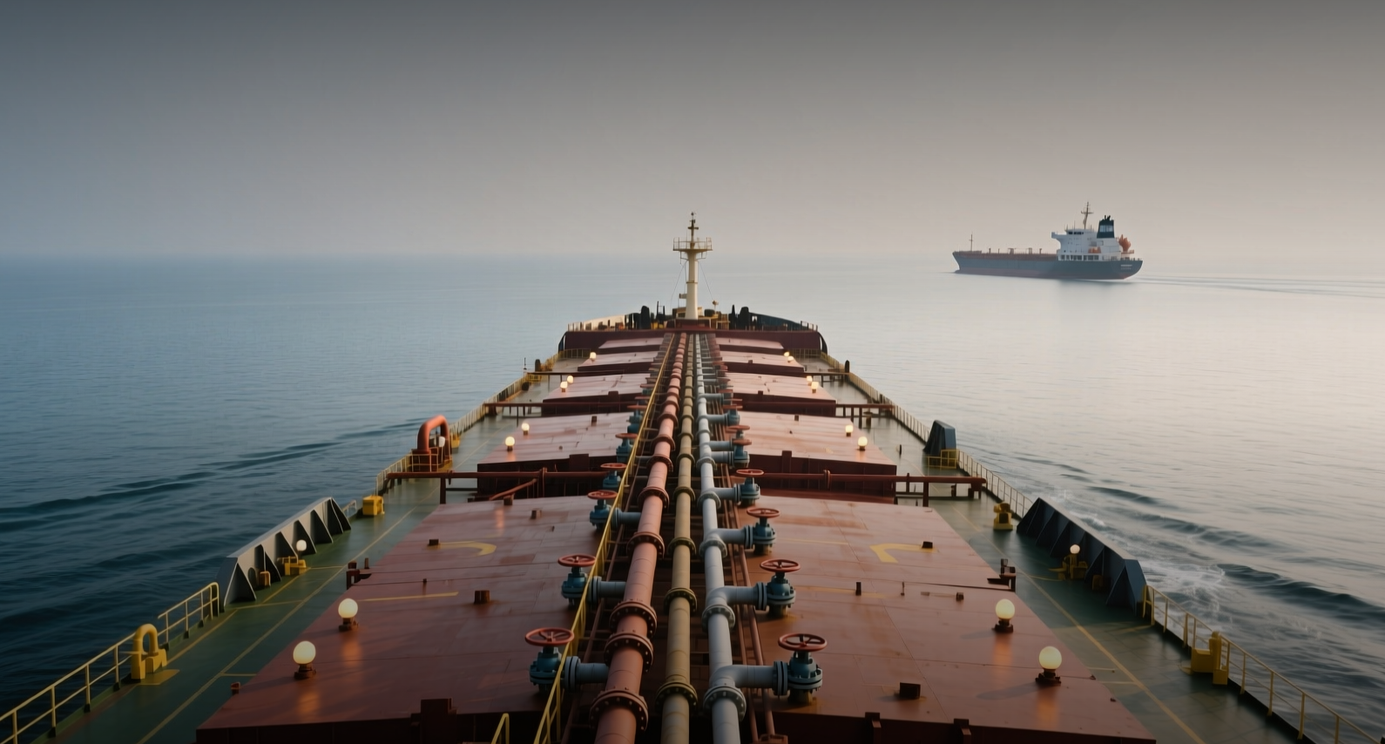
Brent crude climbed to $96.80 a barrel Monday as tit-for-tat US-Iran strikes on tankers in the Strait of Hormuz cut daily transits to the lowest since May, deepening supply-disruption fears across a waterway that carries a fifth of the world's oil.
"Commercial tankers are now being deliberately used as instruments of reciprocal economic pressure, substantially weakening the previous distinction between military confrontation and commercial shipping," maritime intelligence firm Marisks said.
US forces struck three Iranian oil tankers Saturday, including one off Kharg Island near Iran's key export hub, while Iran's Revolutionary Guard navy said it targeted three tankers on unauthorized routes in the strait plus three US vessels elsewhere. Brent rose 7.8% last week and WTI gained nearly 10%, with West Texas Intermediate at $92.14 a barrel, up 66 cents. An average of 10 commodity ships transited the strait daily over the past 10 days, the lowest since May, Kpler data showed.
A prolonged standoff punctuated by calibrated military action is the most likely scenario, ANZ analysts said, with exports expected to remain constrained through the rest of 2026 before a gradual reopening late in the fourth quarter. A return to pre-war throughput is not expected until late first quarter or early second quarter of 2027.
Fighting spreads beyond the waterway
The Saturday attacks marked a "major escalation in the maritime conflict," Marisks said, and the exchanges have since widened. The US military carried out additional strikes Tuesday on air defense sites, radar systems, maritime assets and communications facilities tied to Iran's Revolutionary Guard, prompting Tehran to fire ballistic missiles toward Jordan and drones at Bahrain and Kuwait. Iranian Health Minister Mohammad-Reza Zafarghandi said 18 people were killed and 108 wounded in the US attacks, according to state-run media. Oil futures climbed above $94 a barrel after the fresh US strikes were announced.
Iran's Supreme National Security Council secretary, Mohsen Rezaei, said a restricted zone will be announced outside the strait in coming days, according to state media. OPEC+ kept its output policy unchanged for October at a Sunday meeting, the producer group said, as it needs to agree new quotas before deciding its next output steps.
Recovery path hinges on reopening timing
The last comparable disruption to Hormuz transit came in 2019, when a series of tanker attacks pushed Brent above $75 before prices retreated within weeks as flows normalized. This episode differs in scale: commercial shipping is now a direct target, and Washington has signaled it intends to press its advantage. President Donald Trump said the US holds "almost total control of the Hormuz Strait," while Treasury Secretary Scott Bessent said the administration aims to "economically asphyxiate" Iran and predicted overland pipelines would render the strait "a worthless piece of water" within two years.
For crude markets the risk is asymmetric. If the standoff persists into the fourth quarter, ANZ projects constrained exports through 2026, keeping Brent elevated near current levels and feeding inflation pressure across importing economies. A de-escalation that restores normal transit would unwind the geopolitical premium quickly, but with both sides treating tankers as instruments of economic warfare, traders see little near-term path to that outcome.
This article is for informational purposes only and does not constitute investment advice.
