


Key Takeaways: The adversarial "long bitcoin, short the bankers" trade is over as traditional financial giants build and distribute digital assets.
Key Takeaways: The adversarial "long bitcoin, short the bankers" trade is over as traditional financial giants build and distribute digital assets.
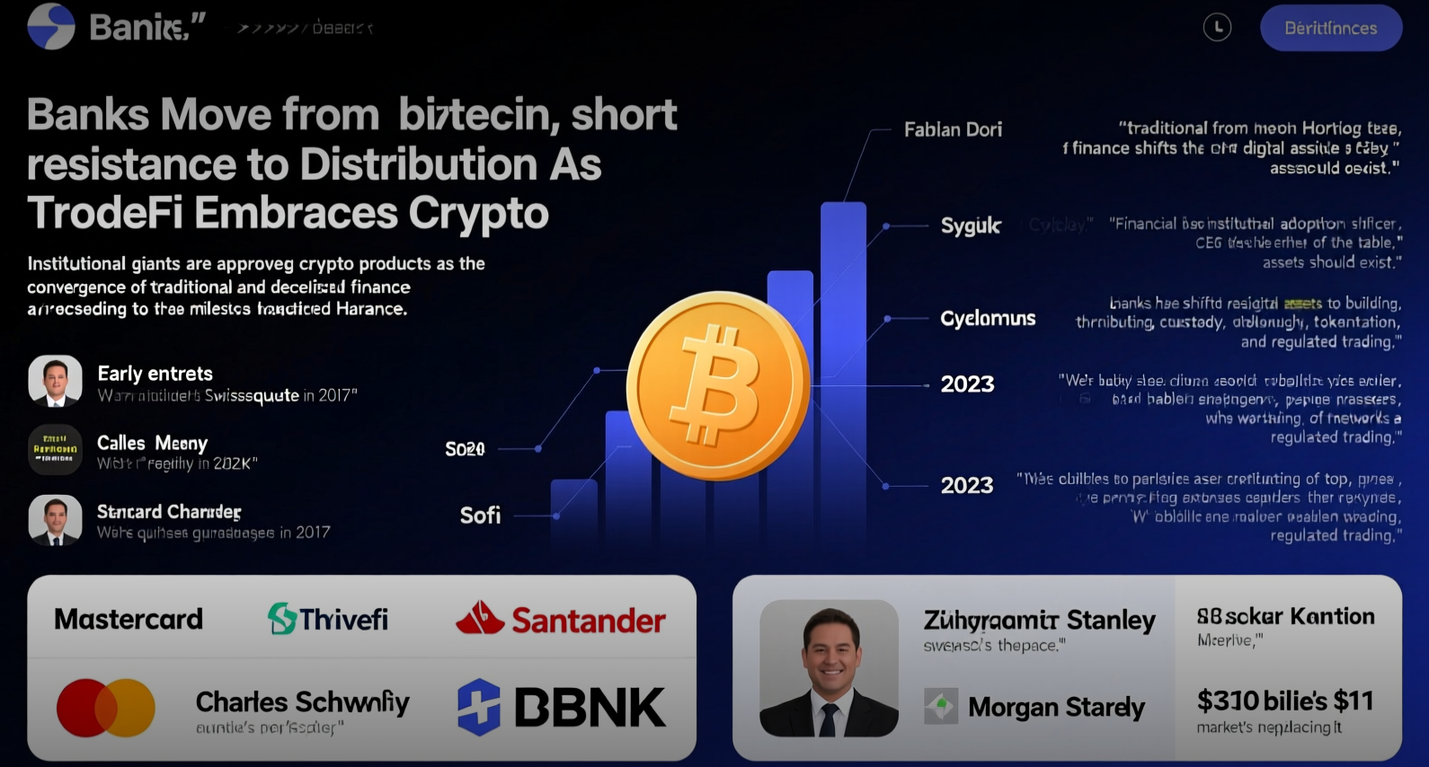
Two banks managing more than $1 trillion each approved crypto products, ending the "long bitcoin, short the bankers" era, Bitwise CEO Hunter Horsley said.
Financial institutions have moved to "the other side of the table" and are working to expand adoption rather than debating whether the asset class should exist, Horsley said in an interview with CoinDesk.
The shift is structural rather than cyclical, said Fabian Dori, chief investment officer at Sygnum. "Banks have moved from resisting digital assets to building and enabling or distributing them through custody, tokenization and regulated trading," he said. Early entrants included Swissquote in 2017, DBS in 2020, BBVA in 2021 and BNY Mellon's institutional custody service in 2022. St.Galler Kantonalbank and Santander followed in 2023, before Zürcher Kantonalbank added retail trading in 2024 and Standard Chartered, Charles Schwab, SoFi and Morgan Stanley entered the space.
The convergence reached a milestone this month when Mastercard closed its $1.8 billion purchase of BVNK, a London-based stablecoin infrastructure provider, positioning the payments giant to weave stable value tokens into its network of banks and merchants. Anchorage Digital CEO Nathan McCauley said the two worlds are becoming one: "We're quickly headed towards a world where there isn't 'traditional finance' and 'decentralized finance.' There's just 'finance.'"
Banks move from resistance to distribution
Large financial firms are partnering with specialist providers rather than building their own infrastructure, McCauley said. Real-world assets coming onchain and crypto wrappers created by large asset managers show the two worlds are increasingly converging, he said.
The expansion has not changed crypto's dependence on market prices, however. "What has not changed is the market's character," Sygnum's Dori said. "Institutionalization has added a layer of infrastructure on top of crypto's reflexive, narrative-driven trading rather than replacing it."
Stablecoin rails draw payments giants
Mastercard's BVNK deal, which closed Aug. 3, beat out a reported near-$2.5 billion bid from Coinbase. BVNK's platform operates in more than 130 countries, letting treasury teams move between fiat and on-chain rails with compliance built in. The stablecoin total addressable opportunity sits near $300 billion by some estimates, and Stripe's $1.1 billion acquisition of Bridge last year showed big tech's seriousness.
The formal embrace of digital assets by traditional financial giants could drive significant capital inflows into crypto, increase institutional legitimacy and potentially boost prices of major cryptocurrencies such as BTC and ETH. The structural shift from anti-banking sentiment to institutional collaboration could reduce volatility and broaden market participation.
This article is for informational purposes only and does not constitute investment advice.
