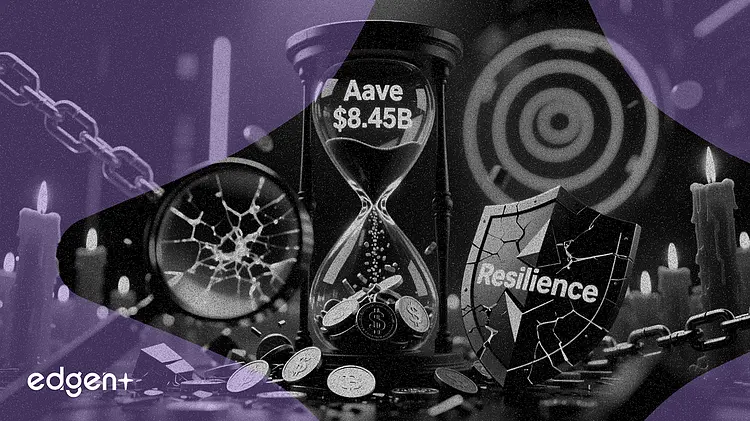
Aave's $8.45 billion deposit run in April exposed the gap between DeFi's narrative of autonomous resilience and the messy reality of human-led crisis management.
The world's largest decentralized lending protocol lost $8.45 billion in total value locked over 48 hours after a $292 million exploit of KelpDAO's LayerZero-powered bridge on April 19, according to DefiLlama data. The hack allowed attackers to deposit fraudulent collateral into Aave on Ethereum and drain authentic wrapped Ether, leaving the protocol saddled with an estimated $123.7 million in bad debt, blockchain risk modeling firm LlamaRisk later calculated.
Stani Kulechov, founder and CEO of Aave Labs, defended the protocol's track record at the Proof of Talk event in Paris last week. "Aave's existing V3 infrastructure has seen multiple market cycles," he said. "Aave has been really resilient during really turbulent times." Kulechov attributed the crisis to "third-party dependencies that are related to more traditional security," separating Aave's core smart contract code from the LayerZero infrastructure that was exploited.
The survival of Aave relied less on algorithmic defenses than on a chaotic $300 million emergency bailout. The Aave DAO pledged 25,000 ETH, and Kulechov personally contributed 5,000 ETH ($8.4 million at the time) to prevent a full-scale collapse. Banking analysts at the Bank Policy Institute pointed out in an April 25 note that Aave's inadequate insurance coverage exposed how DeFi platforms remain vulnerable to bank-run-style stress, undermining user protections that traditional finance takes for granted.
The V4 Pivot and Structural Risk
The accumulation of $123.7 million in bad debt from the April breach has accelerated Aave's shift toward its V4 upgrade. Kulechov said the new architecture will replace the current pooled token design with a modular hub-and-spoke system that can autonomously levy localized risk premiums and freeze specific collateral lines before contagion reaches primary lending reserves.
"When you have a completely auditable and public system, anyone can actually inspect the code and also do different kinds of risk analysis based on that," Kulechov said. "I think that is the key to building resilient software."
The upgrade represents a technical admission that Aave's existing unified pool model lacks the granular controls needed to ring-fence contagion from bridge failures. However, critics argue that increasing protocol complexity introduces its own attack vectors, and that Aave's reliance on community bailouts rather than native insurance depth remains a barrier to institutional adoption.
What's at Stake for DeFi
The April crisis has reignited debate over whether public blockchain protocols can handle systemic risk without centralized backstops. Aave remains the dominant player in decentralized lending, but the episode exposed a structural vulnerability: the protocol's solvency depends on the integrity of peripheral bridge infrastructure that smart contract audits often fail to capture.
For institutional allocators weighing DeFi exposure, the question is whether Aave's V4 upgrade can deliver the isolation mechanisms needed before the next multi-billion dollar stress test arrives. With no firm launch date yet announced for V4, the protocol's ability to retain user deposits and TVL in the interim will determine whether this episode becomes a turning point or a footnote in DeFi's evolution.
This article is for informational purposes only and does not constitute investment advice.