AMD's Advancing AI event on July 22 may reveal customer wins that could lift the stock 41% from current levels.
AMD's Helios rack-scale system packs 50% more high-bandwidth memory than Nvidia's Vera Rubin, and the chipmaker may announce hyperscaler customers beyond Meta at its July 22-23 event, potentially reversing a 5% monthly slide.
"We are seeing strong customer demand for the Helios platform," AMD management said on the company's May earnings call, adding that more details would be shared at the July event.
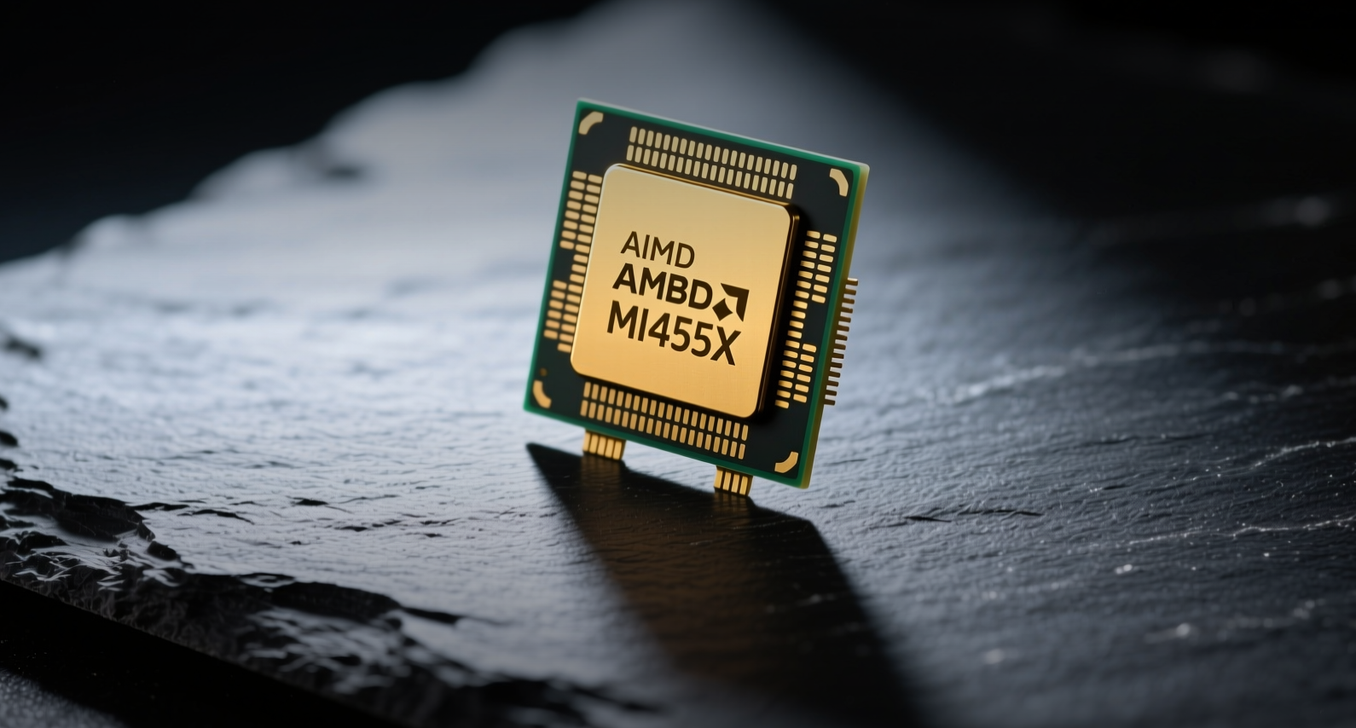
The Helios system, powered by AMD's MI455X graphics processing unit, features 432 gigabytes of HBM3 memory — well above the 288 GB in Nvidia's Vera Rubin NVL72. Memory bandwidth has emerged as a key bottleneck in AI training clusters, giving AMD a potential edge. Citigroup analysts flagged in May that AI startup Anthropic may have joined AMD's client list, with an announcement expected at the event.
AMD shares trade at 173 times trailing earnings and 73 times forward earnings. Analysts project earnings per share of $7.39 this year, up 77%, and $18.30 by 2028. At 40 times forward earnings — in line with the tech-focused Nasdaq Composite index — that implies a stock price of $732, or 41% above current levels.
Helios vs. Vera Rubin: The Memory War
The memory advantage is the centerpiece of AMD's competitive pitch. HBM (high-bandwidth memory) is the most constrained component in AI server production, with SK Hynix and Samsung Electronics struggling to keep pace with demand from Nvidia, AMD, and custom chip designers. AMD's 432 GB configuration gives AI workloads more room to keep model parameters in memory, reducing the need to shuttle data between GPU and system memory — a process that adds latency and consumes power.
Meta Platforms has already committed to deploying Helios servers in the second half of 2026. If AMD secures additional hyperscaler customers — Microsoft, Amazon's AWS, or Google Cloud are the most likely candidates — it would signal that the company is gaining real traction against Nvidia's dominant CUDA ecosystem. Nvidia controls an estimated 80 percent of the AI accelerator market, according to industry data.
Valuation and the Growth Premium
The stock's 131 percent gain in the first half of 2026 has compressed the window for new entries. At 73 times forward earnings, AMD is priced for perfection. But the earnings trajectory supports the premium if the company delivers on its product roadmap. The MI455X GPU and Helios platform represent AMD's most credible challenge to Nvidia's data center dominance since the MI300X launched in 2023.
The risk is execution. AMD's MI455X must prove its performance in real-world deployments, not just spec sheets. Nvidia's Vera Rubin platform, expected to sample later this year, will counter with its own memory and interconnect improvements. The July event will be AMD's best opportunity to show investors that its hardware can translate technical specs into customer wins and revenue growth.
This article is for informational purposes only and does not constitute investment advice.