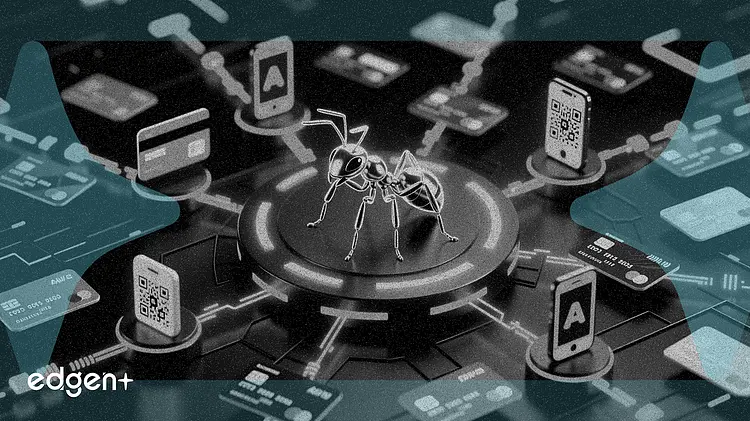
Ant Group's new protocol lets AI agents pay across 300 methods in 220 markets without human intervention.
Ant Group has launched the Agentic Mobile Protocol, or AMP, a standard designed to let artificial intelligence agents initiate and settle payments across the world's fragmented mobile wallet and digital banking infrastructure. The protocol, announced by the company's Ant International unit, targets a problem that has grown more urgent as AI shopping agents begin booking flights, ordering groceries and paying subscriptions on behalf of consumers — transactions that today often fail when the agent's payment method doesn't match the merchant's acceptance network.
"AMP creates a common language between AI agents and payment systems, so an agent shopping for a user in Thailand can pay through a Philippine wallet at a Japanese merchant without any of the three parties changing their existing infrastructure," Kelvin Li, General Manager of Platform Tech and Senior Vice President at Ant International, said.
Ant International's existing Alipay+ network already connects more than 300 payment methods across 220 markets, including 50 mobile wallet partners and 10 national QR systems such as Singapore's SGQR, Malaysia's DuitNow and Thailand's PromptPay. The company processes an average of over 20 million transactions daily through its infrastructure. AMP extends that connectivity into the AI domain by defining how an AI agent authenticates, authorizes and completes a payment — functions that today require a human to open an app, scan a QR code or enter card details.
The protocol arrives as cross-border payments grow rapidly on the back of expanding e-commerce and global trade. FXC Intelligence's 2026 Cross-Border Payments 100 list named 16 Asia-Pacific companies, up from 13 a year earlier, with Ant International among the honorees. Singapore led APAC representation with six entries, followed by Mainland China with five and India with three. The broader market for cross-border payment infrastructure is being reshaped by AI agents that can comparison-shop, negotiate prices and execute transactions autonomously — a shift that threatens to render today's payment rails obsolete if they cannot handle machine-to-machine settlement.
Why AMP matters for the payments stack
AMP's design treats each mobile wallet or digital bank as a node that can be discovered and invoked by an AI agent through a standardized handshake. The protocol handles authentication, currency conversion, fee disclosure and settlement confirmation — the steps that currently break when an agent tries to pay across incompatible systems. For merchants, this means a customer's AI agent can complete a purchase without redirecting to a separate payment page or requiring the customer to unlock their phone.
The competitive stakes are high. Ant International competes with cross-border payment platforms including Singapore-based Nium, which facilitates real-time payments across 100 corridors and payouts in more than 190 markets, and Airwallex, which processes over US$266 billion in transactions annually across 60 currencies. Both companies have built proprietary banking networks and API layers that could be adapted for AI-agent payments. Thunes, another Singapore-based network aggregator, connects directly to 12 billion mobile wallets and bank accounts worldwide and counts Uber and Deliveroo among its members.
Ant International's broader push into AI-enabled financial services includes the "Small AI" principle outlined in its 2025 Sustainability Report, which argues that the most useful AI for emerging markets fits inside apps people already use on phones they already own. The company's EPOS360 device, which combines payments and business operations for micro-merchants, costs a fraction of a smartphone. Its Antom Copilot AI assistant claims to improve merchant efficiency by as much as 46 percent through automated inventory and cash-flow tracking.
The investment angle
For investors tracking the fintech space, AMP represents an attempt to define the standard for AI-agent payments before competitors do. Ant Group's valuation — last marked at roughly US$150 billion in private secondary markets, down from its US$300 billion peak before regulators halted its 2020 IPO — will be influenced by whether AMP gains adoption across the 300-plus payment methods in its network. If the protocol becomes the default for AI-agent transactions, it could drive a step-change in transaction volume and take rate for Ant International, potentially reviving IPO speculation. The key risk: competing protocols from Nium, Airwallex or card networks could fragment the standard, delaying the network effects that make payment infrastructure valuable.
This article is for informational purposes only and does not constitute investment advice.