Anthropic's Model Hardware Standard gives AI agents a common interface to operate lab and factory machines, extending its software protocol playbook into the physical world.
Anthropic's Model Hardware Standard gives AI agents a common interface to operate lab and factory machines, extending its software protocol playbook into the physical world.
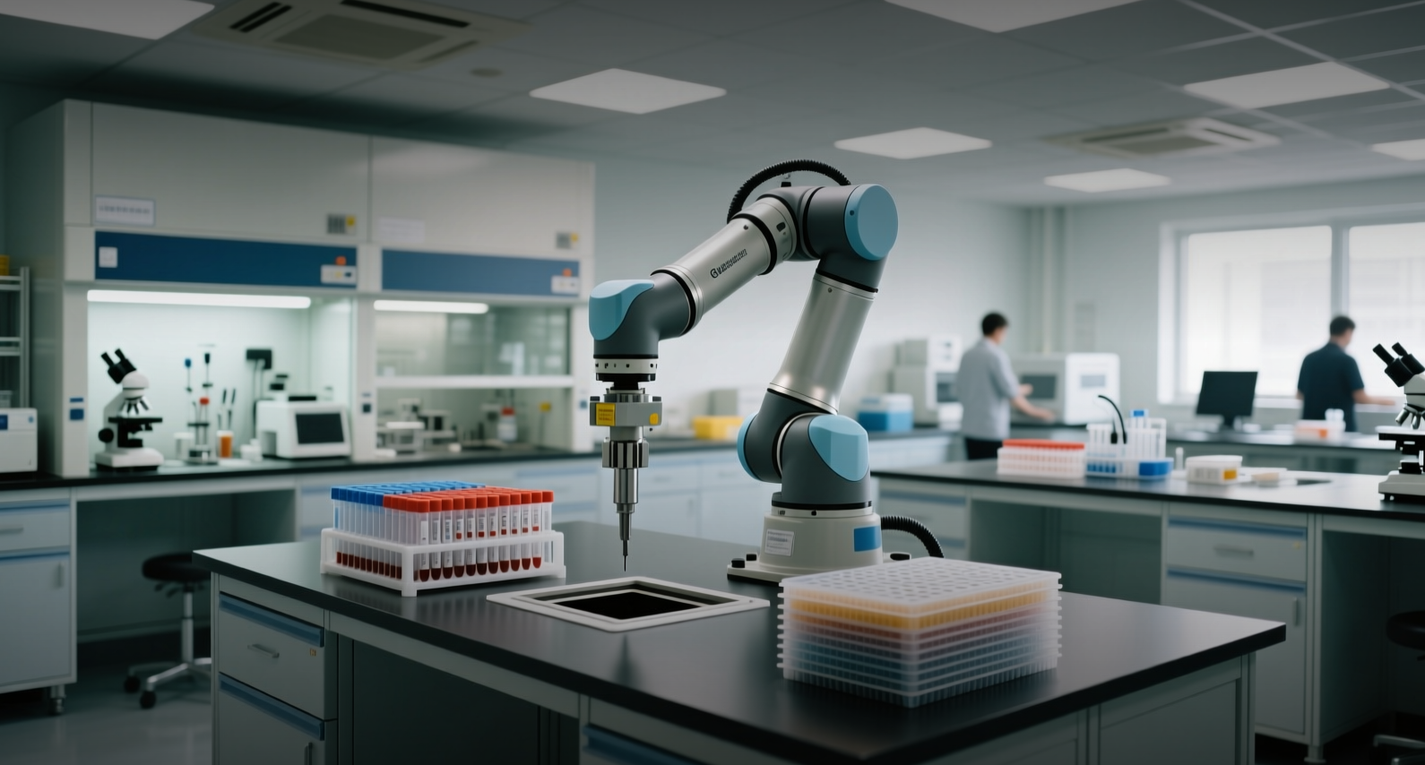
Anthropic's Model Hardware Standard, or MHS, gives AI agents a standardized interface to operate programmable lab and manufacturing equipment, pushing the company into a robotics market Barclays projects could reach $1 trillion by 2035.
"We built this for science to show the promise of AI, but there's also huge benefits here for enterprise and for industry," Elizabeth Kelly, head of beneficial deployments at Anthropic, said.
MHS works with any device that has a programmable interface and stores how a machine operates and how an AI may safely control it — a vendor can specify limits on a robot arm's speed and angles, for example. Anthropic likens the standard to a USB-C cord that standardizes data transmission between devices. It is model-agnostic, so users are not tied to Claude, and it is initially available in research preview to organizations in science, robotics and manufacturing, including Amazon Web Services, Danaher, Hugging Face and Raspberry Pi. A waitlist is open to other groups, and Anthropic plans to open-source MHS after the preview, mirroring the Model Context Protocol it released in 2024.
The move deepens Anthropic's hardware push as rivals OpenAI and Amazon have spent billions on AI-native devices — OpenAI agreed in May 2025 to buy Jony Ive's device startup for $6.4 billion. Anthropic is building a silicon team to design custom chips and recently hired Caitlin Kalinowski, a hardware executive who previously worked at OpenAI, Meta and Apple.
In a demonstration, a Genentech scientist sent Claude a PDF of an experiment they had designed, and the assistant executed it autonomously on hardware carrying an MHS specification. "In many cases, the science doesn't happen because you can't use the equipment," said Jonah Cool of Anthropic's life sciences arm. "What MCP did for software, MHS will do for the hardware world," said Alek Kemeny, referring to the Model Context Protocol that now connects assistants to Gmail, Calendar and Slack.
The standard arrives as Europe prepares to regulate AI-based safety functions. Regulation 2023/1230 replaces the Machinery Directive entirely on Jan. 20, 2027, and covers AI-based safety functions and machinery with self-evolving behavior for the first time. A specification that constrains a robot arm's speed and angles performs a safety function, and for high-risk categories self-declaration of conformity stops being enough. Anthropic's safety record is under scrutiny — TNW reported that Claude Cowork could escape its virtual machine and read credentials on a Mac.
The standard puts Anthropic against Google, OpenAI and Nvidia, which are all building robotics-focused AI models and software. NEURA Robotics raised up to $1.4 billion in Germany this year in a humanoid sector drawing heavy capital. If MHS becomes the industry standard as MCP did for software interoperability, it could give Anthropic a durable edge in the physical world — and a revenue stream tied to the machines Claude controls. The open-source strategy could also benefit robotics-related stocks and AI infrastructure providers such as AWS, which is already testing the standard. Anthropic has not disclosed a timeline for the full release, leaving the competitive window open.
This article is for informational purposes only and does not constitute investment advice.
