


Arm Holdings and Advanced Micro Devices both reported earnings within 24 hours in early May, offering investors a direct comparison of two chip companies competing for AI data center revenue.
Arm Holdings and Advanced Micro Devices both reported earnings within 24 hours in early May, offering investors a direct comparison of two chip companies competing for AI data center revenue.
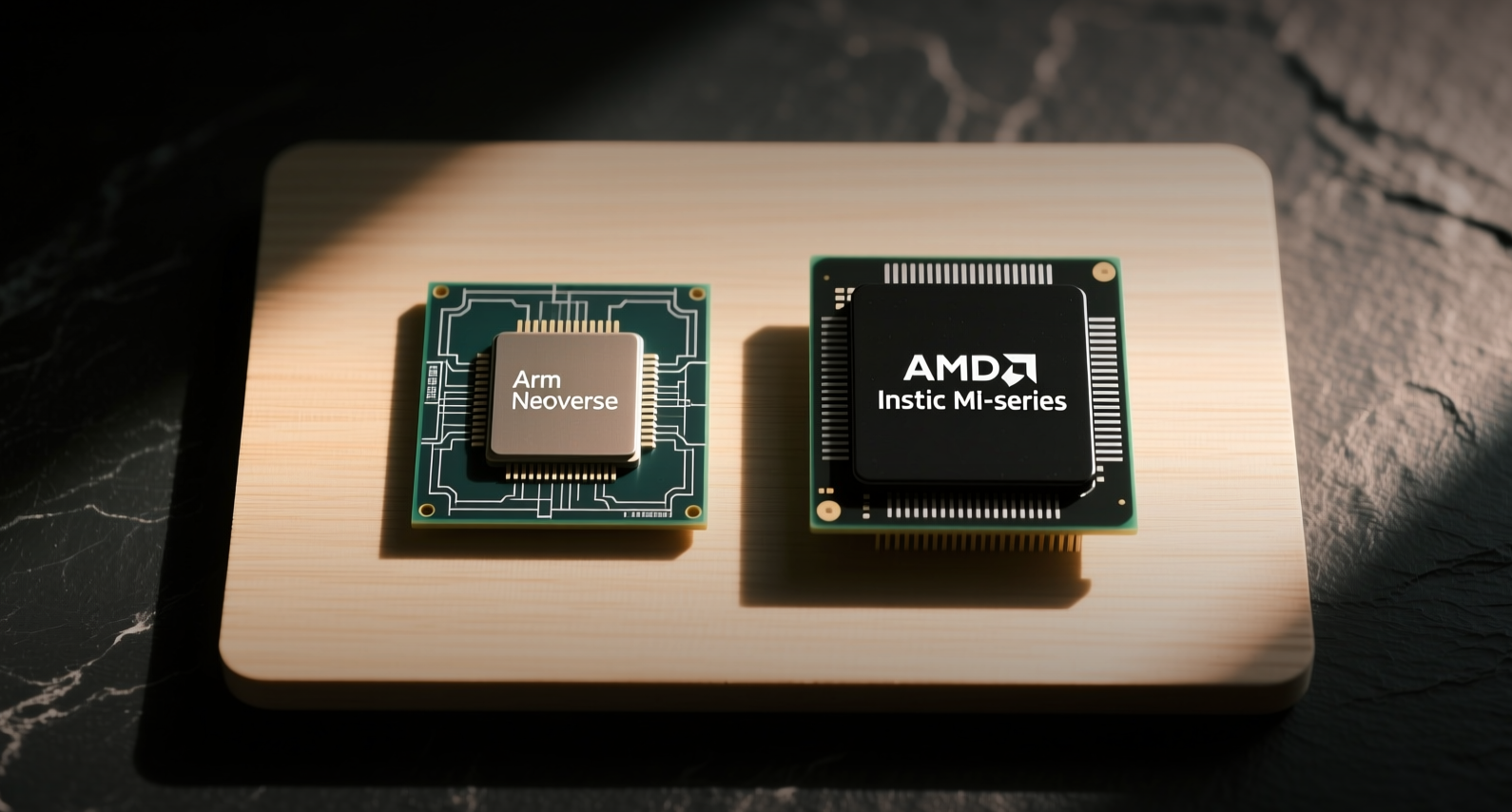
Arm Holdings and Advanced Micro Devices both reported earnings within 24 hours of each other in early May, giving investors a side-by-side view of two chip designers competing for AI data center spending as the Philadelphia Semiconductor Index has surged 246% over the past 14 months.
"The AI mania has taken semis to a place only seen once before," Charlie Bilello, chief market strategist at Creative Planning, said. "History doesn't repeat, but extremes tend to rhyme."
Arm has pushed its Neoverse compute subsystem (a chip design blueprint for data center processors) as a power-efficient alternative to x86 architecture, winning designs with cloud providers including Amazon Web Services and Microsoft. AMD has focused on its Instinct GPU line and EPYC server processors, positioning them as direct competitors to Nvidia's data center products. Both companies manufacture their chips through Taiwan Semiconductor Manufacturing Co., the dominant foundry for advanced AI processors.
The competition carries significant investment implications. Oracle reported remaining performance obligations worth $638 billion, up from $138 billion a year earlier, showing sustained demand for AI infrastructure. Oracle alone spent $55.7 billion on capital expenditures in its fiscal 2026, a 162% increase from the prior year. Which chip architecture captures that spending will determine revenue growth trajectories for Arm, AMD, and their respective supply chain partners.
Arm's Royalty Model vs AMD's Direct Sales
Arm generates revenue by licensing its architecture and collecting royalties on chips sold by partners including Nvidia, Amazon, and Ampere Computing. AMD sells finished processors and GPUs directly to data center operators. This structural difference means Arm benefits from broad adoption across multiple customers, while AMD captures higher revenue per design win but carries more execution risk.
Arm's energy-efficient architecture has become increasingly attractive as data center power costs rise. Cloud providers running AI inference workloads — the process of running trained AI models — have adopted Arm-based processors from Amazon's Graviton line and Ampere Computing to reduce electricity consumption. AMD's EPYC server chips, built on x86 architecture, compete directly with Intel's Xeon processors in traditional data center workloads while its Instinct GPUs target AI training and inference.
The Nvidia Factor Looms Over Both
Both companies compete against Nvidia, which dominates the AI data center GPU market with an estimated 80% or more market share. Nvidia held its annual shareholders' meeting in June and continues expanding into adjacent areas such as biomedical research with its BioNeMo Agent Toolkit, which equips AI agents to perform scientific work.
AMD has positioned its Instinct MI-series GPUs as a lower-cost alternative to Nvidia's H100 and Blackwell processors, targeting price-sensitive cloud customers. Arm-based processors from Amazon's Graviton and Ampere have gained share in cloud inference workloads, where power efficiency matters more than raw compute performance.
The competition shifted further in June when OpenAI and Broadcom announced their first custom AI chip, called Jalapeño, designed for inferencing. The move represents a direct challenge to Nvidia's dominance and shows that hyperscalers are increasingly willing to develop custom silicon rather than rely on merchant chip suppliers.
For investors, the key question is which company can gain market share against Nvidia's entrenched position. Arm trades at a premium valuation reflecting its royalty stream from multiple chipmakers, while AMD's valuation depends on its ability to take GPU market share. Both face the risk that AI spending growth could slow if hyperscalers tighten capital budgets after a period of aggressive expansion.
The broader semiconductor market has shown signs of volatility. The Philadelphia Semiconductor Index dropped more than 1% in afternoon trading on a recent session, and concerns about AI spending and higher borrowing costs have resurfaced. Shares of memory makers including Micron, SanDisk, and Seagate have experienced selling pressure, even as Micron beat earnings estimates with revenue of $41.5 billion and earnings per share of $25.11.
This article is for informational purposes only and does not constitute investment advice.
