
Key Takeaways:
- Big Four banks lost up to A$100 billion in market value since late February
- Mortgage growth expected to slow to 3%-4% next year from 7.5%
- RBA raised rates three times in 2026, returning borrowing costs to post-pandemic highs
Key Takeaways:
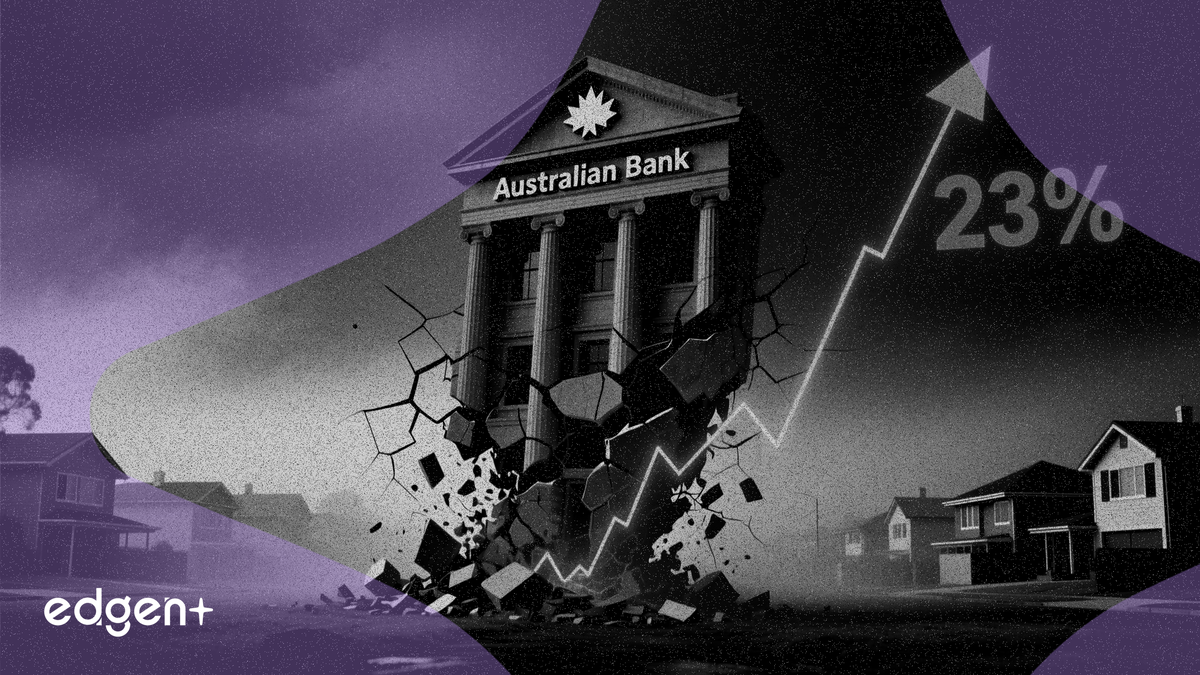
Australia's Big Four banks have lost as much as A$100 billion in combined market value as a three-decade housing super-cycle shows signs of ending.
Australia's biggest banks have lost as much as A$100 billion in combined market value since late February as a looming slowdown in mortgage lending, rising interest rates and tax policy changes end a three-decade housing super-cycle. National Australia Bank has fallen 23%, Westpac dropped nearly 14.5%, ANZ lost 11.2% and Commonwealth Bank of Australia dipped 5.6%, making them the worst-performing banking stocks in Asia.
"Aside from COVID, we cannot recall a time in the past 25 years when the operating conditions for banks have shifted so quickly," said Richard Wiles, Australian banking analyst at Morgan Stanley. "Three RBA rate hikes, proposed changes to property-related tax concessions in the federal budget, and the potential direct and indirect effects of the global energy shock have created a far more uncertain outlook."
The selloff accelerated after the federal budget earlier this month proposed changes to negative gearing and the capital gains tax discount, two property-related tax breaks long seen as politically untouchable. The Reserve Bank of Australia lifted rates for a third time this year in May, returning borrowing costs to post-pandemic highs. Morgan Stanley forecasts home prices could fall between 5% and 10%, the sector's largest decline in four decades.
The A$2.4 trillion ($1.7 trillion) mortgage market, which accounts for about 60% of the Big Four's combined credit books, faces growth slowing to 3% to 4% next year from 7.5% now, Morgan Stanley estimates. That compares with mortgages comprising 40% to 50% of loans at global peers, exposing Australian lenders to a concentrated housing bet with limited revenue diversification. The top four banks set aside A$955 million in total loan-loss provisions in their latest reporting periods, blaming the indirect cost of the Iran war.
Lack of Diversified Revenue Streams
"The growing challenges expose a lack of diversified revenue streams at Australian lenders compared to their global peers in areas such as investment banking, research and equities trading," said George Boubouras, managing director at K2 Asset Management. In the U.S., major bank share prices have recovered from the late February selloff triggered by the war, while Australian lenders remain under pressure.
CBA is the market leader in home lending with a 25% share, followed by Westpac, NAB and ANZ. Morgan Stanley gave ANZ an "overweight" recommendation while ranking CBA as its worst pick among the Big Four. UBS warned that CBA and Westpac were most vulnerable to a slowdown in mortgage growth.
Cost Cuts and a 'Zero-Sum Game'
With mortgage growth moderating, banks have limited appetite to compete aggressively on price. "It is a bit of a zero-sum game in Australia if you try to win with price, and they've all learnt the hard way," said Andrew Martin, co-chief executive of fund manager Alphinity, which owns shares in all four major banks.
Some lenders have begun job cuts, offshoring and technology changes, moves analysts say are likely to gather pace if revenue growth remains weak. Macquarie analysts have downgraded earnings per share forecasts for the banking sector by up to 2% in 2027 and between 2% and 4% in 2028, while cutting target price recommendations by up to 4%.
Foreign ownership of Australia's major banks edged higher over the past two years, with offshore investors now holding roughly a quarter to a third of shares. That foreign demand made CBA the world's most valuable lender last year. "We're cautious on the outlook. They still look pretty full from a valuation perspective," said Andy Forster, senior investment officer at Argo Investments, which owns shares in the four banks. "Dividends probably can be protected, but there's a little bit of risk there."
The last time Australian banks faced a comparable housing downturn was during the early 1990s recession, when mortgage arrears peaked above 6% and bank earnings contracted for three consecutive years. While the current environment differs in magnitude, the combination of tax reform, rate hikes and an energy shock creates a convergence of headwinds not seen in a generation.
This article is for informational purposes only and does not constitute investment advice.
