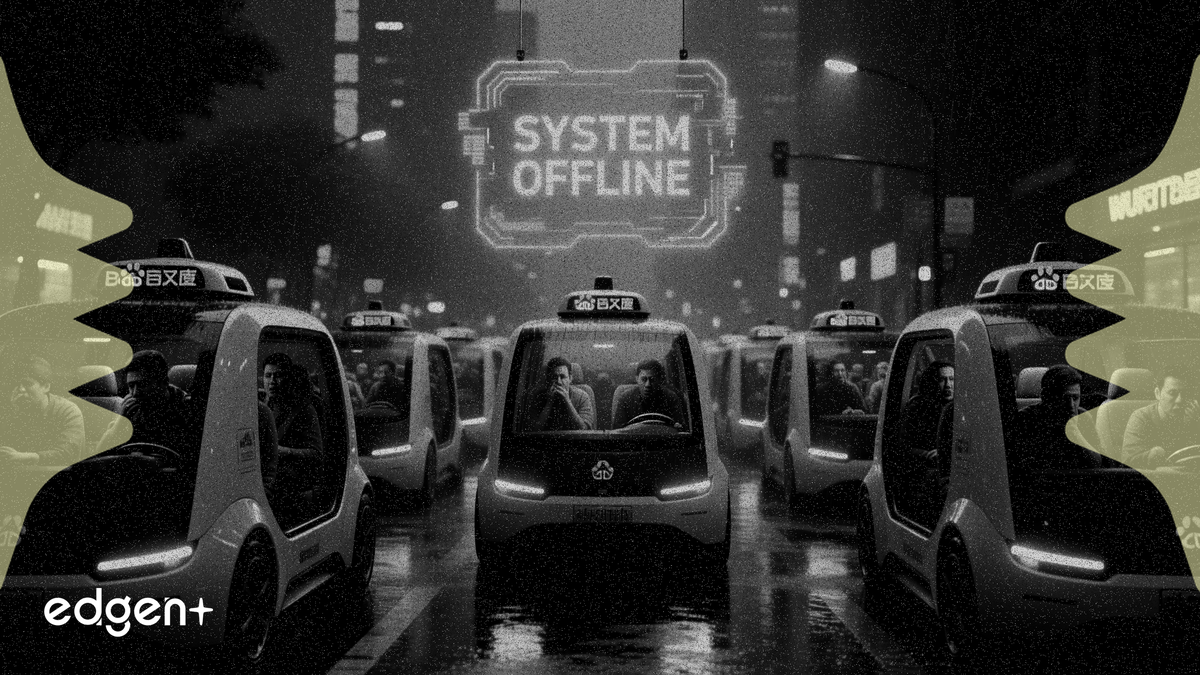
A city-wide network failure of Baidu's Apollo Go service highlights a critical vulnerability in autonomous driving systems, shifting the industry's focus from individual vehicle errors to fleet-level systemic risks.
More than 100 of Baidu Inc.’s Apollo Go robotaxis simultaneously stalled across Wuhan’s highways on March 31, leaving passengers stranded for up to two hours and triggering at least three traffic collisions, in a mass failure that exposes the systemic risks of large-scale autonomous fleets.
“A fleet-wide stall of this magnitude is a low-probability event, suggesting a potential issue with the central dispatch and monitoring system,” a person familiar with autonomous vehicle operations, who asked not to be identified discussing a competitor, said. “Even if individual vehicle hardware fails, there should be enough redundancy to pull over safely; a simultaneous halt points to a network or software backbone failure.”
The incident began around 9:00 PM local time, with passengers reporting that in-car SOS buttons and calls made via the vehicle’s screen were unresponsive. One passenger was trapped on the elevated Third Ring Road for nearly two hours as large trucks sped past. While Baidu’s customer service attributed the problem to “network issues,” the company has yet to release an official statement. This follows a December 2025 accident in Zhuzhou that led to the suspension of Apollo Go services in that city.
The Wuhan paralysis deals a significant blow to Baidu’s robotaxi ambitions, a key growth driver for the company, and could trigger stricter regulatory scrutiny in a market that had been one of its most permissive. The failure of Baidu’s emergency infrastructure and the subsequent traffic disruptions shift the safety debate from individual vehicle performance to the stability of the entire network, a concern for competitors like Waymo and Cruise which have experienced similar, smaller-scale outages.
‘Fail-Safe’ System Under Scrutiny
The mass stalling of Baidu’s robotaxis in Wuhan brings the concept of “fail-safe” systems in autonomous vehicles under intense scrutiny. This design principle, borrowed from aviation, dictates that a system should enter a safe state, such as stopping, when a fault is detected. However, the Wuhan incident, where nearly 100 vehicles stopped in the middle of high-speed elevated roads, demonstrates the potential dangers of this approach in a complex urban environment.
An industry insider, speaking on the condition of anonymity, suggested that the sector needs to move towards “fail-operational” systems. Such a design would allow a vehicle to retain minimal functionality even after a failure, enabling it to move to a safer location like the shoulder of the road, rather than becoming a stationary obstacle. This requires significant redundancy in critical systems, including power, communication, sensors, and computing platforms, to avoid a single point of failure.
A Pattern of Systemic Failures
While the scale of the Wuhan incident is alarming, it is not the first time a fleet of autonomous vehicles has been hobbled by a systemic issue. In December 2025, a power outage in San Francisco caused multiple Waymo robotaxis to stop in intersections, blocking traffic until remote operators could intervene. General Motors’ Cruise has also faced similar challenges, including a software glitch that led to a cluster of its vehicles congregating at a single intersection.
These events highlight a different risk profile for autonomous vehicles compared to human-driven cars. While much of the safety focus has been on preventing individual vehicles from making incorrect decisions at speed, the Wuhan outage demonstrates the potential for a single software or network event to disable an entire fleet, creating widespread disruption and danger.
Wuhan’s Permissive Stance Tested
The incident is particularly damaging for Baidu given Wuhan’s status as a flagship market for Apollo Go. The city has been a key partner, with local regulations designed to facilitate the deployment of robotaxis, including permitting fully driverless vehicles on highways. This permissive environment has allowed Baidu to rapidly scale its operations, with Apollo Go completing over 17 million rides globally as of November 2025.
The mass failure on the very highways where Baidu was granted its greatest operational freedom is likely to lead to a re-evaluation of the current regulatory framework. The incident not only raises questions about the robustness of Baidu’s technology but also about the adequacy of the safety protocols and emergency response mechanisms for large-scale robotaxi services.
This article is for informational purposes only and does not constitute investment advice.