
A seventh straight hold at 2.25% masks a sharpening policy dilemma: new U.S. tariffs and Canadian retaliation have raised inflation risks even as Q2 growth rebounded 3.3%, and markets now price three hikes by mid-2027.
A seventh straight hold at 2.25% masks a sharpening policy dilemma: new U.S. tariffs and Canadian retaliation have raised inflation risks even as Q2 growth rebounded 3.3%, and markets now price three hikes by mid-2027.
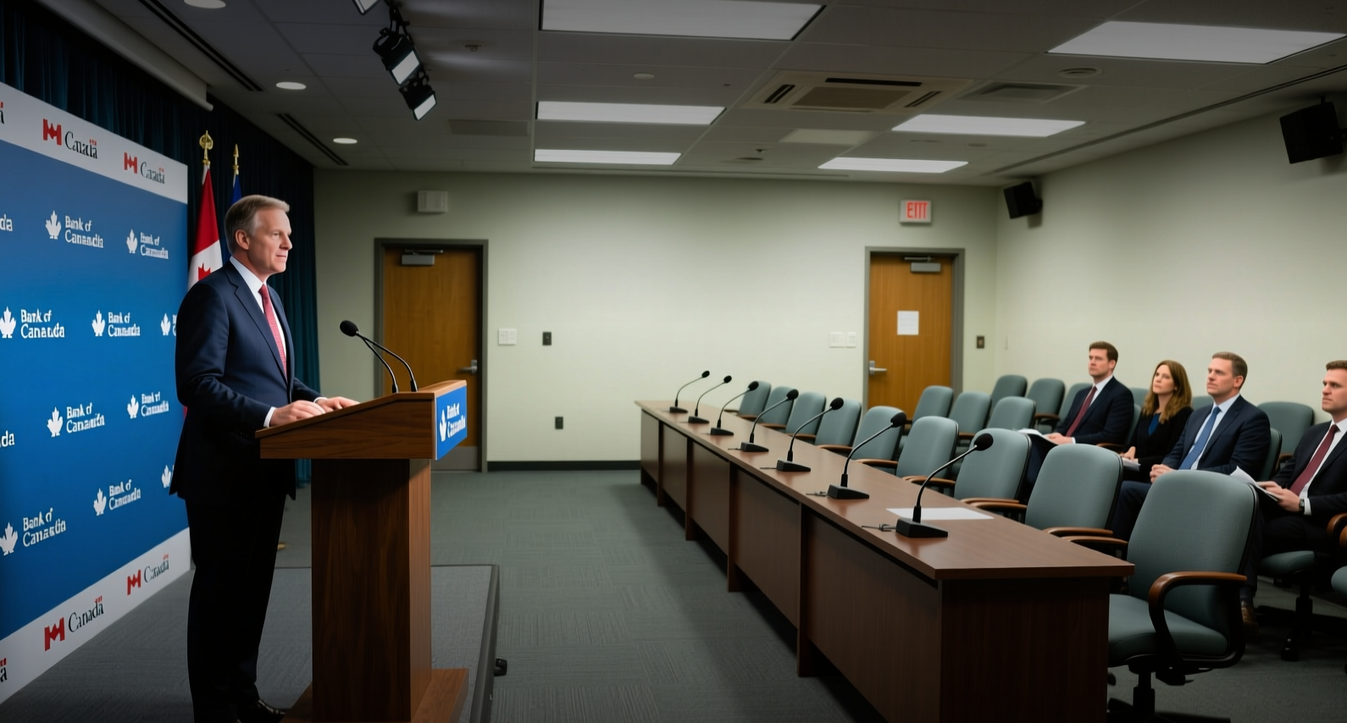
The Bank of Canada left its overnight rate at 2.25% for a seventh straight meeting on Sept. 2, but the escalation of the U.S.-Canada tariff war has flipped the central bank's risk calculus, with markets now pricing three quarter-point hikes by mid-2027 under a stagflation scenario. Governor Tiff Macklem said new U.S. duties and Canadian retaliation "will also raise costs for some businesses and could feed into consumer prices over time," adding that "the upside risks to inflation have increased, while new tariffs make growth prospects more uncertain."
"The risks are shifting and we are prepared to adjust monetary policy as needed," Macklem said in a press conference, while cautioning that "monetary policy cannot offset the effects of tariffs or influence global energy prices." The rate has been unchanged since December 2025, when the central bank last moved, and the decision matched the unanimous expectation of all 35 economists surveyed by Reuters.
The policy dilemma stems from two forces pulling in opposite directions. The United States imposed 50% tariffs on roughly $20 billion of Canadian goods on Aug. 22 after trade negotiations broke down a day earlier, and Ottawa will retaliate from Sept. 8 with duties of 15%, 25% or 50% on about 700 U.S. products worth a similar amount. Canada's economy, meanwhile, expanded at a 3.3% annualized pace in the second quarter after near-stagnation, with unemployment falling to a two-year low of 6.4% in July and headline inflation running at 3% — the top of the central bank's 1% to 3% control range.
Canadian short-term bonds sold off after the decision, pushing the two-year yield to 3.048%, while the loonie strengthened to 1.3847 per U.S. dollar. Swap markets now price roughly a 75% probability of a hike before year-end, up from 64% before the announcement, and LSEG data show three quarter-point increases priced by mid-2027. A Bloomberg survey found 63% of analysts expect the central bank to raise rates in the first half of 2027, matching overnight-swap pricing that has shifted from easing expectations to tightening under a stagflation scenario.
The last time the Bank of Canada faced a comparable two-sided risk profile was in the April-to-June window this year, when policy decisions flagged offsetting inflation and growth pressures before a brief reprieve in July. The current episode is more acute because the tariff shock lands on an economy already running above-target inflation, leaving the central bank little room to cushion growth without stoking prices.
A hawkish hold, but not a unanimous read
Economists split on how quickly the Bank of Canada might act. Stephen Brown, chief North America economist at Capital Economics, said a hike at the final meeting of the year in December is "arguably now looking more likely" than a delay to mid-2027, contingent on energy prices holding near current levels. RBC Economics' Nathan Janzen kept the base case that the overnight rate stays at 2.25% through 2026, with gradual increases beginning in 2027 "conditional on the Canadian economic backdrop continuing to improve."
Others read the statement as deliberately balanced. Avery Shenfeld, chief economist at CIBC Capital Markets, said there is "little prospect" for any policy change over the rest of the year given that both the oil and trade-war fronts could shift. Bank of America's Carlos Capistran argued the escalation of the trade war is "the more consequential development for monetary policy," while Goldman Sachs projects the measures will shave 0.3 percentage point off Canadian GDP growth and add 0.3 percentage point to inflation.
Macklem said the central bank does not expect a "large direct impact" from the newest tariffs, though targeted sectors could be hit hard and fourth-quarter growth will take a hit. He expressed some optimism that businesses have adapted to the uncertain status quo, noting they "are finding ways to do business." Ottawa has announced a C$7.5 billion aid package to support affected businesses and workers, which Macklem said will "likely mitigate some of the harm."
The next rate decision arrives Oct. 28 alongside a fresh Monetary Policy Report — the first updated projections since July — by which point the initial effects of both tariff measures should be visible in trade flows, business sentiment and price data. If inflation proves sticky while growth holds, the central bank's first hike in over a year could come sooner than its cautious language suggests; if the tariff drag dominates, the pause could stretch into 2027.
This article is for informational purposes only and does not constitute investment advice.
