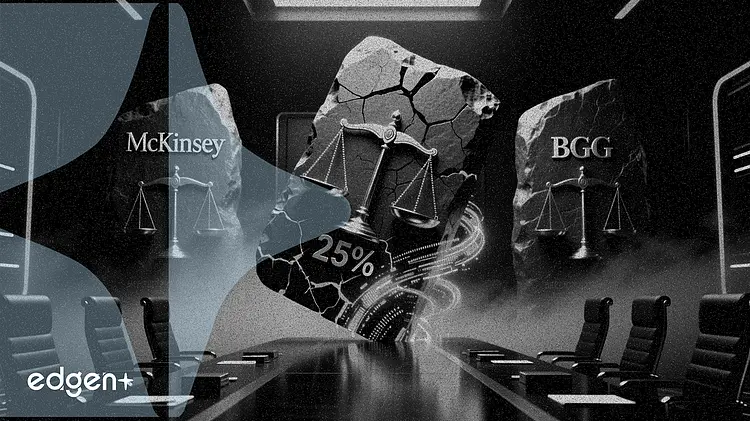
L'IA démantèle le modèle de l'heure facturable qui a bâti McKinsey, BCG et Bain en une industrie de 40 milliards de dollars.
McKinsey, BCG et Bain transfèrent environ un quart de leurs honoraires vers une tarification basée sur les résultats, alors que les outils d'IA compressent les heures qui ont fondé leur modèle de conseil à 300-500 dollars de l'heure.
« C'est un moment où nombre des fondamentaux du modèle des services professionnels sont remis en question », a déclaré Kate Smaje, responsable mondiale de la technologie et de l'IA chez McKinsey, lors d'un briefing à Londres.
L'assistant IA d'entreprise de McKinsey, Lilli, exécute désormais plus de 500 000 requêtes par mois en interne, les consultants rapportant jusqu'à 30 % d'économies de temps sur le travail de connaissance, selon Hunt Scanlon Media. Le PDG de BCG, Christoph Schweizer, a déclaré au Wall Street Journal que 75 % des plus gros dossiers IA du cabinet comportent désormais des modalités de rémunération variables, bien que moins d'un tiers du travail total soit basé sur les résultats. Bain & Company a indiqué que les revenus liés à l'IA et à la technologie représentent environ 30 % de son activité de conseil, la direction prévoyant que cette part atteigne 50 %.
Ce changement menace le modèle de recrutement pyramidal qui a défini le conseil en management pendant des décennies. Environ 150 anciens consultants de McKinsey, Bain et BCG ont été recrutés pour former des modèles d'IA à effectuer des tâches de conseil de niveau débutant, a rapporté Bloomberg — les personnes qui facturaient autrefois ces heures apprennent désormais à une machine à les remplacer.
Comment l'IA a brisé l'heure facturable
Pendant trois décennies, le modèle économique des Trois Grands reposait sur un principe simple : les clients payaient à l'heure ou sur la base d'un forfait lié à la taille de l'équipe. Les consultants juniors construisaient les présentations et analysaient les données. Les associés vendaient la stratégie. Les factures atteignaient des millions, souvent sans promesse explicite que la stratégie fonctionnerait.
L'IA compresse ce calendrier. Michael Birshan, associé gérant de McKinsey au Royaume-Uni, a déclaré qu'environ un quart des honoraires mondiaux du cabinet proviennent désormais d'accords basés sur la performance, selon Business Insider. Schweizer de BCG a indiqué que le chiffre d'affaires du cabinet a augmenté de 7 % pour atteindre 14,4 milliards de dollars au cours du dernier exercice, avec une expansion des effectifs alors que le cabinet s'efforce de répondre à ce qu'il a appelé un besoin quasi « infini » des entreprises en matière d'aide au déploiement de l'IA.
Bain a été le plus direct quant à son exposition à l'IA. Le partenariat du cabinet avec OpenAI s'étend sur plus de trois ans de travail conjoint avec des clients, culminant avec un investissement dans la nouvelle Deployment Company d'OpenAI aux côtés de TPG, Advent, Bain Capital et Brookfield.
Les challengers sont déjà là
Les cabinets spécialisés dans l'IA native s'efforcent de capter le marché que les Trois Grands sont en train de remodeler. Queen's Tower Advisory et Unity Advisory, toutes deux fondées par d'anciens associés des Big Four, visent des équipes composées de « 20 % d'humains, 80 % d'agents IA », a déclaré Mark Bunker, fondateur de Queen's Tower, au Financial Times. La Management Consultancy Association indique que les petits cabinets connaissent désormais une croissance allant jusqu'à 50 %, tandis que les Big Four ont réduit leurs recrutements de diplômés au Royaume-Uni et que les effectifs mondiaux de PwC ont diminué de 5 600 personnes l'année dernière.
Lisa Fernihough, responsable du conseil chez KPMG UK, a été exceptionnellement franche : « Je veux que cette organisation — nous — existe encore. Voilà à quel point je pense que l'IA sera disruptive. » KPMG a mis en place une initiative « air-gapped » appelée Project Watts pour contourner les processus d'approbation normaux lors de l'expérimentation d'outils d'IA aux côtés des clients.
Le private equity européen a engagé plus de 500 millions d'euros dans le cabinet de conseil fiscal WTS, qui vise à recruter 100 associés d'ici cinq ans.
Ce que cela signifie pour les investisseurs
Les proxies cotés en bourse du conseil et des services IT sont confrontés à une question de marges qui ne disparaîtra pas. L'action d'Accenture a chuté de plus de 50 % par rapport à son sommet de fin 2021, réduisant sa valeur de marché d'environ 260 milliards de dollars à environ 108 milliards. IBM fait face à une pression similaire alors que sa branche conseil est confrontée à des délais de projet compressés par l'IA.
Pour les clients corporate de ces cabinets — pratiquement la majeure partie du S&P 500 — la transition vers une tarification basée sur les résultats devrait offrir une valeur plus mesurable par dollar de conseil. Schweizer de BCG a déclaré que 1,7 million de personnes ont postulé au cabinet en 2025, avec moins de 1 % finalement embauchés, suggérant que la marque conserve son poids même si son modèle de tarification évolue.
L'ironie est difficile à manquer. Les Trois Grands ont fait fortune en disant aux boards du Fortune 500 de se transformer autour de la technologie. Aujourd'hui, ils sont contraints de faire la même chose, en premier, et en public.
Cet article est fourni à titre informatif uniquement et ne constitue pas un conseil en investissement.