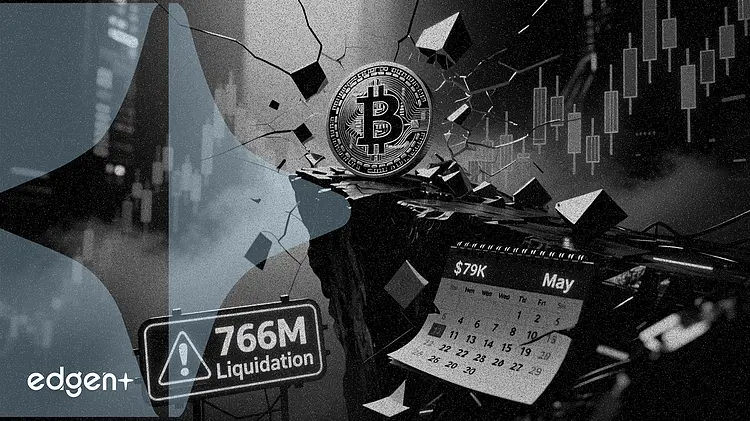
La recuperación de Bitcoin tras una liquidación de $766 millones se ha estancado cerca de los $79,000, mientras que los analistas de Bitfinex señalan una fuerte resistencia de punto de equilibrio que limita el alza.
Bitcoin cayó casi un 10% desde su máximo de principios de mayo hasta los $74,027 antes de recuperar su apertura mensual, pero el rebote se ha quedado sin impulso cerca de la apertura semanal, según analistas de Bitfinex.
"El nivel de $79,000 actúa como una fuerte resistencia de punto de equilibrio después de que compradores recientes quedaran en pérdidas", escribieron los estrategas de mercado de Bitfinex en un informe publicado el lunes, citando el fracaso de la base de costo acumulada a 30 días tras un cierre por debajo de $76,500.
El evento de desapalancamiento del 23 de mayo eliminó $766 millones en posiciones agregadas, incluyendo $458 millones en posiciones largas, marcando la mayor liquidación individual en tres meses. El interés abierto ha deshecho por completo la acumulación de las tres semanas anteriores, mientras que las tasas de financiación se han restablecido a niveles neutrales o ligeramente negativos, una señal de que el apalancamiento se ha eliminado aunque el impulso alcista sigue siendo frágil.
Bitcoin ahora cotiza por debajo del Precio Realizado del Tenedor a Corto Plazo, cerca de $78,600, y es probable que la zona de vacío de UTXO entre $72,000 y $82,000 defina el rango a corto plazo a menos que surja nueva demanda institucional, según Bitfinex. La base de costo del cohorte de noviembre a febrero, alrededor de $85,900, sigue siendo el principal techo estructural.
Los vientos macroeconómicos en contra agravan la presión
La inflación persistente en vivienda, energía y servicios sigue complicando la trayectoria política de la Reserva Federal, reduciendo la probabilidad de recortes de tipos a corto plazo. El rendimiento del bono del Tesoro estadounidense a 10 años alcanzó un máximo de 16 meses, presionando a los activos de riesgo en general. La confianza del consumidor ha caído a un mínimo histórico mientras los hogares enfrentan una disminución del poder adquisitivo, y las expectativas de inflación a largo plazo han aumentado considerablemente. Los salarios reales se han vuelto negativos, dejando a los consumidores con dificultades a pesar de un mercado laboral aún resistente, según el análisis de Bitfinex.
Las reservas en los exchanges se encuentran cerca de mínimos de siete años, y la oferta de tenedores a largo plazo se mantiene estable en 14.43 millones de BTC, lo que apunta a una toma de ganancias pasiva en lugar de una capitulación generalizada por parte de los tenedores de alta convicción.
La competencia de los ETF y los riesgos cuánticos emergen
En el mercado de fondos cotizados en bolsa, Truth Social retiró sus propuestas de ETF de bitcoin, citando la creciente competencia y la compresión de comisiones en un mercado estadounidense cada vez más saturado. Los analistas de Bitfinex consideraron la retirada como un reflejo del debilitamiento de la economía para los actores más pequeños que intentan competir con gigantes como BlackRock y Fidelity.
Por separado, el Departamento de Comercio de EE. UU. comprometió más de $2 mil millones en incentivos de la Ley CHIPS para empresas de computación cuántica, la mayor intervención federal en hardware cuántico hasta la fecha. Los analistas de Bitfinex señalaron que computadoras cuánticas suficientemente avanzadas podrían eventualmente amenazar los fundamentos criptográficos que sustentan las redes de Bitcoin y Ethereum, lo que genera urgencia en el desarrollo de la criptografía post-cuántica.
Por ahora, los traders de Bitcoin observan si el muro de punto de equilibrio de $79,000 se mantiene o se rompe. Sin nueva demanda institucional, el camino de menor resistencia sigue siendo lateral o a la baja.
Este artículo es solo para fines informativos y no constituye asesoramiento de inversión.