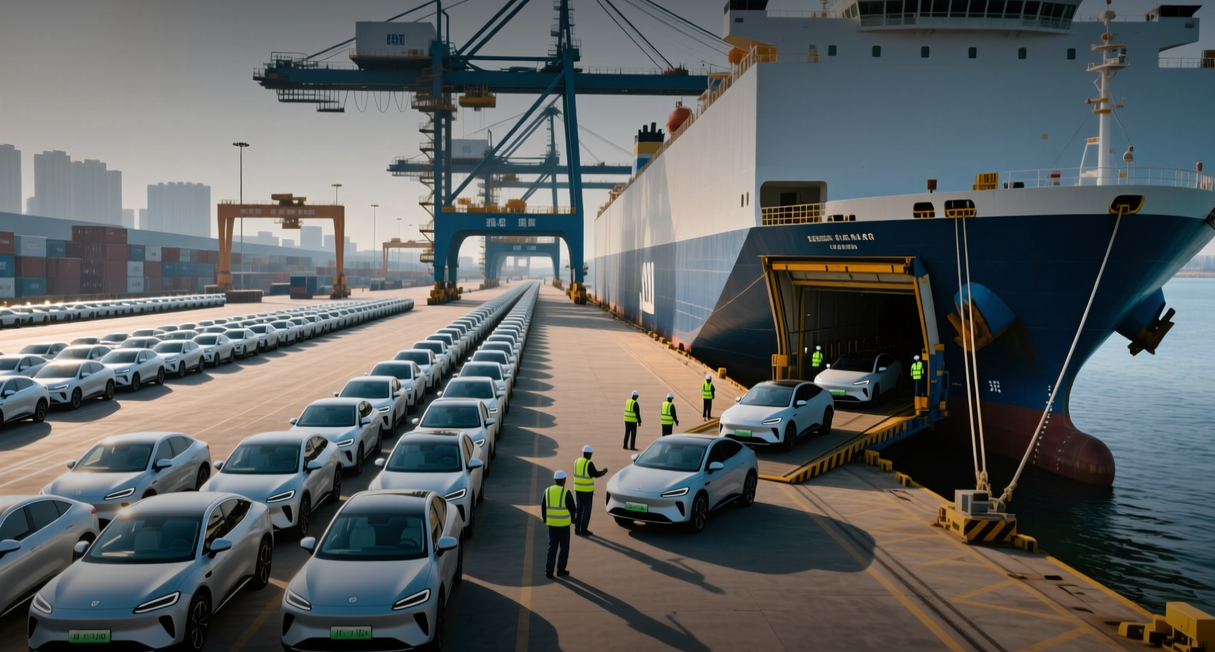
BYD's August sales recovery is now running on overseas demand alone, with record exports of 189,466 units masking a domestic market that still shrank 14.3% year-on-year.
BYD Co. sold 440,293 new energy vehicles in August, up 17.84% from a year earlier and 5.03% from July, marking a fourth consecutive year-on-year increase and its highest monthly total this year, according to a Hong Kong exchange filing. The recovery, however, is heavily weighted toward foreign markets: overseas shipments jumped 134.45% to a record 189,466 units, while China domestic sales of 250,827 units fell 14.34% year-on-year.
"Overseas markets remain the main growth driver," the company said in its monthly release, with exports now accounting for 43.03% of total NEV volume. The geographic split echoes BYD's first-half results, where overseas revenue of CNY181.3 billion overtook domestic for the first time, reaching 53% of the total.
The August mix shifted further toward all-electric models. Passenger battery electric vehicle sales hit a record 256,230 units, up 28.38% year-on-year, while plug-in hybrid sales of 177,154 units rose just 3.05%. BEVs now make up 59.1% of passenger NEV sales, up from 53.7% a year earlier. Commercial NEV sales surged 225.13% to 6,909 units.
The export surge is the bright spot in an otherwise strained profit picture. BYD's first-half net profit fell 20.54% to CNY12.3 billion on revenue of CNY344.8 billion, down 7.13%, as domestic price competition and currency effects weighed on earnings. Yet second-quarter net income rebounded 30% to CNY8.2 billion, ending four straight quarters of decline, with gross margin hitting a one-year high of 18.9% on a richer product mix. High-end brands Denza, Fang Cheng Bao and YangWang doubled their revenue share to 12.8% in the first half.
Export strength vs. the domestic price war
The tension between BYD's two engines is sharpening. Overseas unit volumes rose 67.9% in the first half to 789,367 vehicles, and the company may exceed its annual overseas target of 1.5 million units, Chairman Wang Chuanfu said. But cumulative domestic sales from January to August fell 32.72% to 1.505 million units, and Geely Auto's domestic volume of roughly 950,000 units in the first half has closed the gap on BYD's 1.016 million, raising the prospect that BYD could lose its crown as China's top-selling automaker this year.
Supply constraints have compounded the domestic drag. BYD said the transition from its first-generation Blade Battery to a second-generation version supporting flash charging temporarily lengthened delivery times for several key models. "This year's sales depend on battery production," Wang said, as capacity for the new LFP cells ramps up.
For investors, the read-through is a company growing abroad while defending share at home. BYD overtook Tesla as the world's largest EV seller in 2025, and its Shenzhen A-share listing traded at CNY90.40 on Aug. 31, down 2.08%, implying a market capitalization of CNY824.2 billion. With R&D spending of CNY28.9 billion and cash reserves of CNY167.4 billion in the first half, BYD has the balance sheet to fund the overseas push — but the domestic price war and battery ramp remain the swing factors on margins through year-end.
This article is for informational purposes only and does not constitute investment advice.