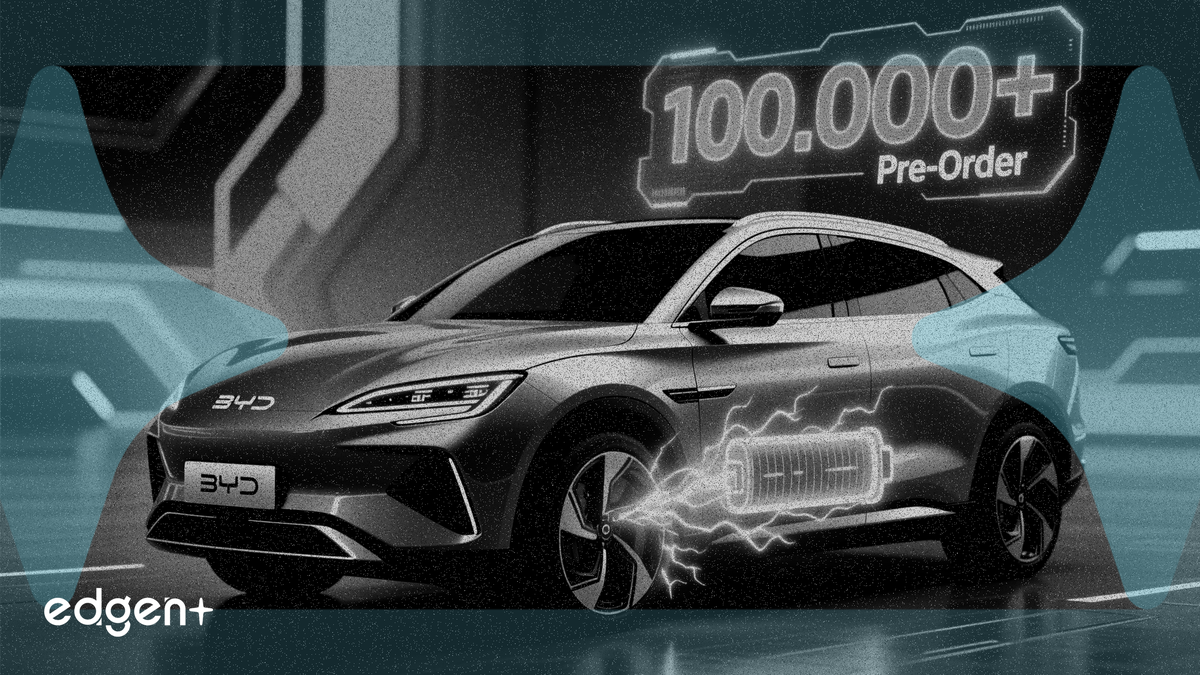
BYD Co. announced its new flagship SUV, the "Datang," has received more than 100,000 pre-sale orders, a figure that underscores the automaker's continued dominance in China's hyper-competitive electric vehicle market.
"The aggregate pre-sale orders for our flagship SUV 'Datang' have so far surpassed 100,000 units," the company's Dynasty Network division announced, highlighting the model's immediate consumer acceptance ahead of its official launch.
The Datang is equipped with BYD's second-generation Blade Battery, a key piece of in-house technology that underpins the vehicle's appeal. The company claims the new battery enables a pure electric driving range of up to 950 kilometers (590 miles) on a single charge under the China Light-Duty Vehicle Test Cycle (CLTC). This figure, while optimistic compared to stricter EPA or WLTP standards, directly addresses the primary consumer concern of range anxiety and sets a high benchmark for competitors.
The strong pre-sale performance is a bullish signal for BYD, which continues to leverage its vertical integration and battery technology to fend off rivals. The 100,000-unit figure suggests the company's product strategy is resonating with consumers, potentially boosting its stock price and solidifying its position as a global EV leader.
Blade Battery Claims Challenge Rivals
The claimed 950 km range of the Datang stands in sharp contrast to the struggles of some international competitors. Tesla, for instance, has faced criticism over the real-world performance of its 4680 battery cells. Recent data from European Model Y vehicles equipped with the 4680 pack showed a notable drop in range and a slower DC fast-charging curve compared to models with supplier cells from LG. While Tesla promised a revolutionary leap, the 4680 cells have so far delivered worse energy density and charging performance, leading to customer backlash in Europe.
BYD's ability to deliver a compelling range claim with its proprietary Blade Battery—a lithium-iron-phosphate (LFP) design known for safety and cost-effectiveness—is a significant competitive advantage. If the Datang's real-world performance is perceived as superior, it could further erode the technology premium once enjoyed by rivals like Tesla.
Price Wars and Market Pressure
The Datang's initial success comes amid an intense price war in the Chinese EV market. Domestic rivals and joint ventures are flooding the market with low-cost models, as seen with the GAC-Toyota bZ3X, which is priced as low as $14,500 and has become a best-seller. At the same time, the recent Beijing Auto Show highlighted a surge in high-performance, thousand-horsepower "hypercars" from BYD's own sub-brands like Yangwang and Fang Cheng Bao.
BYD's strategy appears to be fighting on all fronts: capturing the mass market with competitively priced and technologically advanced vehicles like the Datang, while also pushing the boundaries of performance and luxury with its high-end brands. The strong pre-sale numbers for the Datang indicate this strategy is working, allowing BYD to maintain momentum and pressure on both domestic and international competitors in the world's largest auto market.
This article is for informational purposes only and does not constitute investment advice.