


China's industry regulator has reportedly frozen new lithium battery capacity approvals, a move that could reshape supply dynamics in the world's largest battery market.
China's industry regulator has reportedly frozen new lithium battery capacity approvals, a move that could reshape supply dynamics in the world's largest battery market.
China's MIIT has stopped approving new lithium battery capacity for the second half, per online rumors, sending shares of two HK-listed equipment makers lower.
"I am unclear about the authenticity of the news, but the MIIT may make corresponding adjustments and is unlikely to impose a blanket ban," Liu Yong, Secretary General of the Energy Storage Application Branch of the China Industrial Association of Power Sources (CIAPS), said.
WUXI LEAD (00470.HK) fell 3.7 percent, with short selling of $1.01 million at a 6.7 percent ratio. GCL TECH (03800.HK) dropped 1.4 percent, with short selling of $17.42 million at a 26.9 percent ratio. A staff member from the MIIT said no related information could be found on the official website.
If confirmed, the halt would restrict supply expansion in China's lithium battery sector, potentially benefiting existing capacity holders while capping growth for expansion-focused companies. The policy would be a significant supply-side regulatory action for a strategic industry, potentially reshaping competitive dynamics in the global battery market.
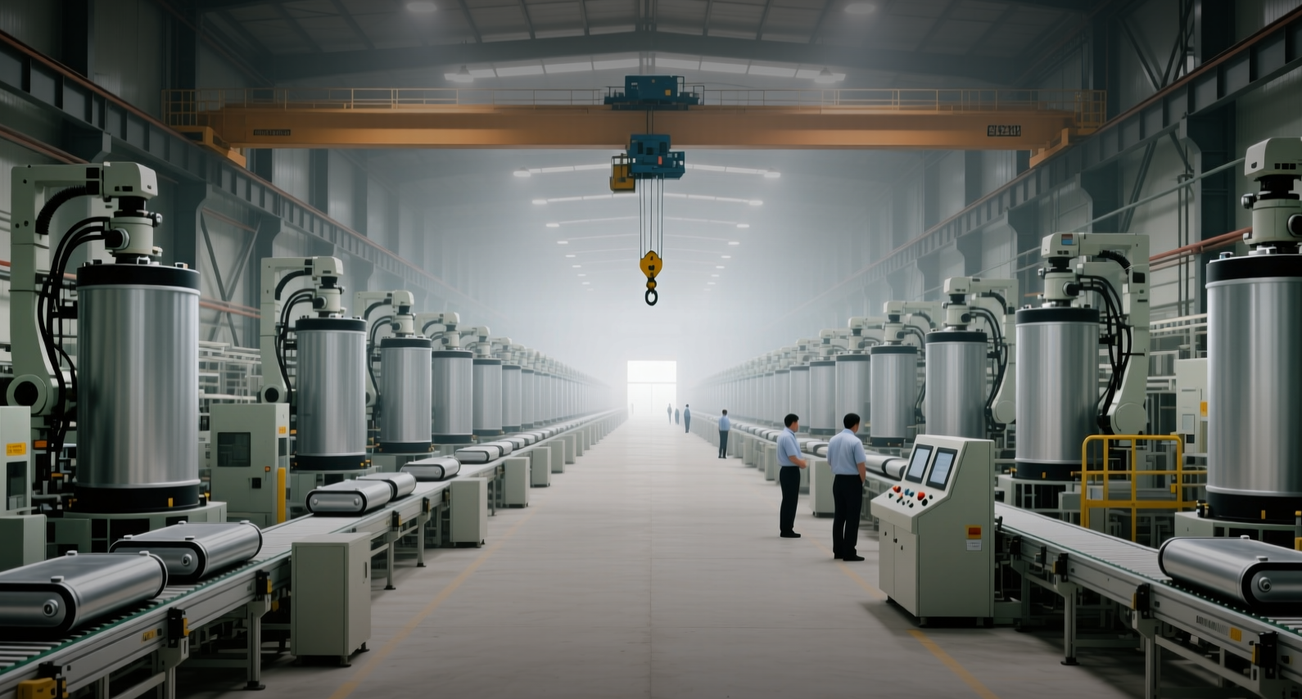
The rumor surfaced as China's battery industry continues to expand aggressively. A cylindrical lithium battery plant in China is targeting 18 GWh of annual capacity with a production line running 240 cells per minute, according to industry reports. The scale of such projects highlights the capacity glut concerns that may have prompted the MIIT's reported action.
China dominates global lithium battery production, with major players including CATL, BYD, and EVE Energy controlling a substantial share of the market. A halt on new capacity approvals would primarily affect companies with aggressive expansion plans, while existing producers with operational facilities would likely benefit from reduced competition and potentially firmer pricing.
For equipment makers like WUXI LEAD, which supplies battery manufacturing lines, a freeze on new capacity would directly impact order flow. The company's 3.7 percent decline and elevated short-selling activity reflect investor concerns about its growth outlook. GCL TECH's 26.9 percent short-selling ratio suggests particularly bearish positioning.
A freeze on new capacity would have cascading effects across the supply chain. Battery material suppliers, including cathode and anode producers, would face reduced demand for new production lines. Equipment manufacturers would see order backlogs shrink. However, existing battery producers could see improved pricing power as supply growth slows.
The timing is notable. China's battery industry has been engaged in a price war, with pack prices falling sharply as oversupply persists. A capacity freeze would help stabilize prices and improve margins for existing producers. Companies like CATL and BYD, which already have substantial operational capacity, would be better positioned than smaller players with expansion-dependent growth strategies.
The MIIT has previously used capacity approval mechanisms to manage overcapacity in strategic industries. In the solar sector, similar regulatory interventions have been deployed to address supply-demand imbalances. The lithium battery industry has seen rapid capacity expansion in recent years, driven by the electric vehicle boom and energy storage demand. If the reported halt is formalized, it would mark one of the most direct regulatory interventions in the battery sector to date.
For investors, the key question is whether the MIIT will formalize the reported halt. If confirmed, it would be a bullish signal for existing capacity holders and a bearish one for expansion-focused companies and equipment suppliers. The market reaction in WUXI LEAD and GCL TECH suggests investors are already pricing in the risk. The short-selling ratio on GCL TECH at 26.9 percent indicates particularly strong bearish conviction among institutional traders.
This article is for informational purposes only and does not constitute investment advice.
