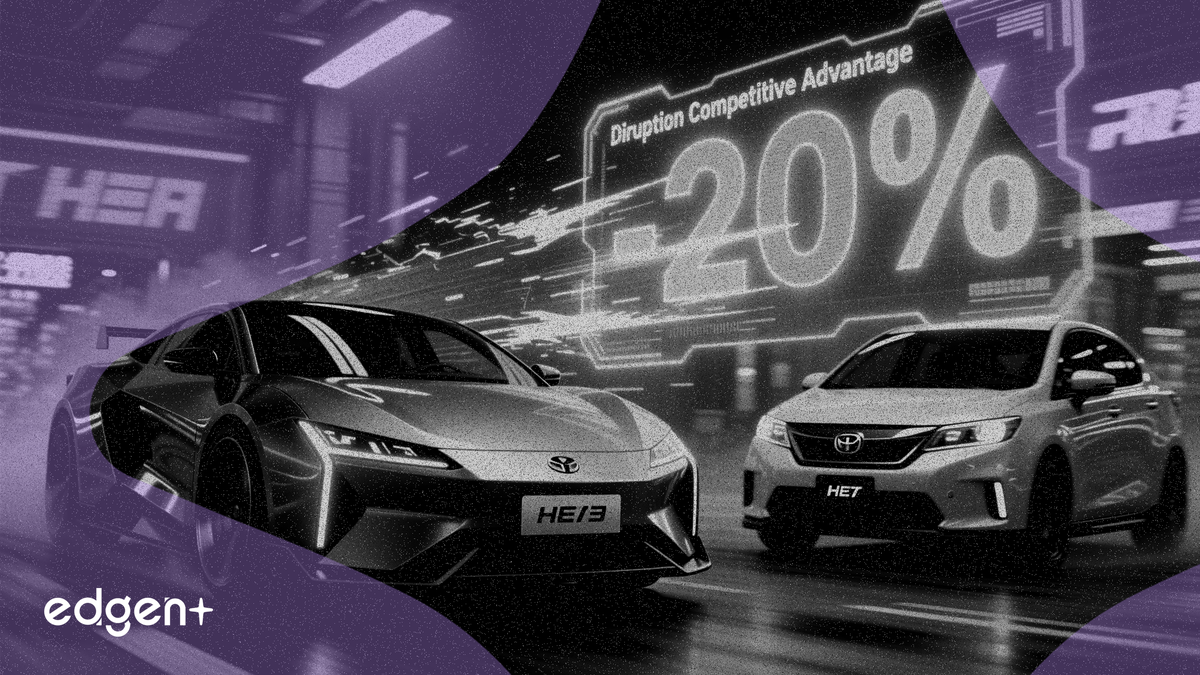
Chinese automakers are weaponizing their dominance in plug-in hybrids to launch a new assault on Toyota’s most profitable market segment: hybrid electric vehicles (HEVs).
A coalition of Chinese automakers including Geely, Great Wall, and Changan is launching a new generation of hybrid electric vehicles (HEVs) in 2026, leveraging established plug-in hybrid (PHEV) supply chains to offer intelligent models at a 15 to 20 percent lower cost than Japanese rivals.
"This can be imagined as a plug-in hybrid with a battery specifically for i-HEV," Ren Xiangfei, chief engineering and technology scientist at Geely, said in an interview, highlighting that the new models are derived directly from mature electric hybrid technology.
The move comes as HEV sales remain strong globally, with Toyota selling 4.43 million units last year and Ford's North American HEV sales growing 21.7 percent. Chinese firms are using their scaled PHEV production—Geely’s platform has been used in 1.15 million cars—to create HEVs with a bill-of-materials cost that is ¥10,000 to ¥20,000 lower than comparable PHEVs.
This strategy directly threatens the market share of established players like Toyota and Ford by combining the low fuel consumption of HEVs with the smart-vehicle technology and advanced electronic architectures previously exclusive to PHEVs and EVs, addressing a global market of over 70 million traditional car buyers.
From PHEV Dominance to HEV Disruption
For the past decade, Chinese automakers have focused almost exclusively on pure electric (EV) and plug-in hybrid (PHEV) vehicles, driven by policy incentives and rapid advances in battery technology. This left the conventional HEV market, which doesn't require external charging, largely dominated by Japanese manufacturers like Toyota and its Prius line. That is now changing.
The massive investment in PHEVs has created a robust domestic supply chain for electric drive systems, hybrid transmissions (DHTs), and electronic controls. Companies have discovered they can reconfigure these existing PHEV platforms—primarily by reducing the battery size—to create a cost-effective HEV. Geely's new i-HEV system, for example, is a direct offshoot of its Leishen electric hybrid platform, which has accumulated over 25 billion kilometers of real-world driving data in its PHEV applications.
This "reverse-engineering" from PHEV to HEV allows for rapid, low-cost product launches. Geely announced its new models are available for pre-sale immediately, with plans to make its entire Geely Star series of fuel vehicles HEV-based by 2027. Similarly, Changan's Blue Whale Super Engine hybrid, with a tested urban fuel consumption of 2.98 L/100km, is already being rolled out across its popular models.
More Than Just Fuel Economy
The new wave of Chinese HEVs is not just competing on price and fuel efficiency. They are fundamentally changing the product definition by integrating modern smart-car features that Japanese HEVs have struggled to support.
Traditional HEVs from companies like Toyota use small battery packs (1-2 kWh) sufficient for improving fuel economy but inadequate for powering modern electronics like large infotainment screens, advanced driver-assistance systems (ADAS), or even running air conditioning while the engine is off. In contrast, Chinese manufacturers are equipping their HEVs with larger batteries and more sophisticated electrical architectures. GAC's new HEV uses a 5.4 kWh battery, while Geely's i-HEV incorporates the same GEEA 3.0 electronic architecture found in its premium PHEVs.
This allows their HEVs to offer features like over-the-air (OTA) updates, high-level autonomous driving functions, and robust in-cabin technology, eliminating the trade-off between the convenience of a non-chargeable hybrid and the intelligent experience of an EV. For the nearly 50 percent of Chinese consumers without access to home charging, this presents a compelling new option.
A Global Challenge to Toyota's Stronghold
While the domestic market is poised for growth, with forecasts predicting HEV penetration to climb from 5 percent to 8 percent by 2026, the primary battleground will be overseas. In 2025, HEVs were the largest category of electrified vehicles in Europe, commanding a 35 percent market share, while U.S. HEV sales grew 26.6 percent.
Chinese automakers see a clear opening. Their HEVs are not subject to the steep tariffs the EU has placed on Chinese EVs (10 percent for HEVs vs. up to 45.3 percent for EVs), making them more competitive on price. Companies like Great Wall Motor are already competing directly with Toyota in Southeast Asia and Latin America with models like the Haval H6 HEV.
The challenge for Chinese brands is not product, but presence. Toyota’s decades of investment have built a formidable global network of dealerships, service centers, and brand trust. While Chinese firms like Chery and Geely (through its ownership of Proton in Malaysia) are expanding their footprint, they remain an order of magnitude behind. The launch of these advanced, low-cost HEVs is the entry ticket; building the brand and service infrastructure to compete globally is the long-term war.
This article is for informational purposes only and does not constitute investment advice.