
A humanoid robot from a Chinese smartphone firm just beat the human half-marathon world record by nearly seven minutes, a feat that escalates the global robotics rivalry with the U.S.
A humanoid robot from a Chinese smartphone firm just beat the human half-marathon world record by nearly seven minutes, a feat that escalates the global robotics rivalry with the U.S.
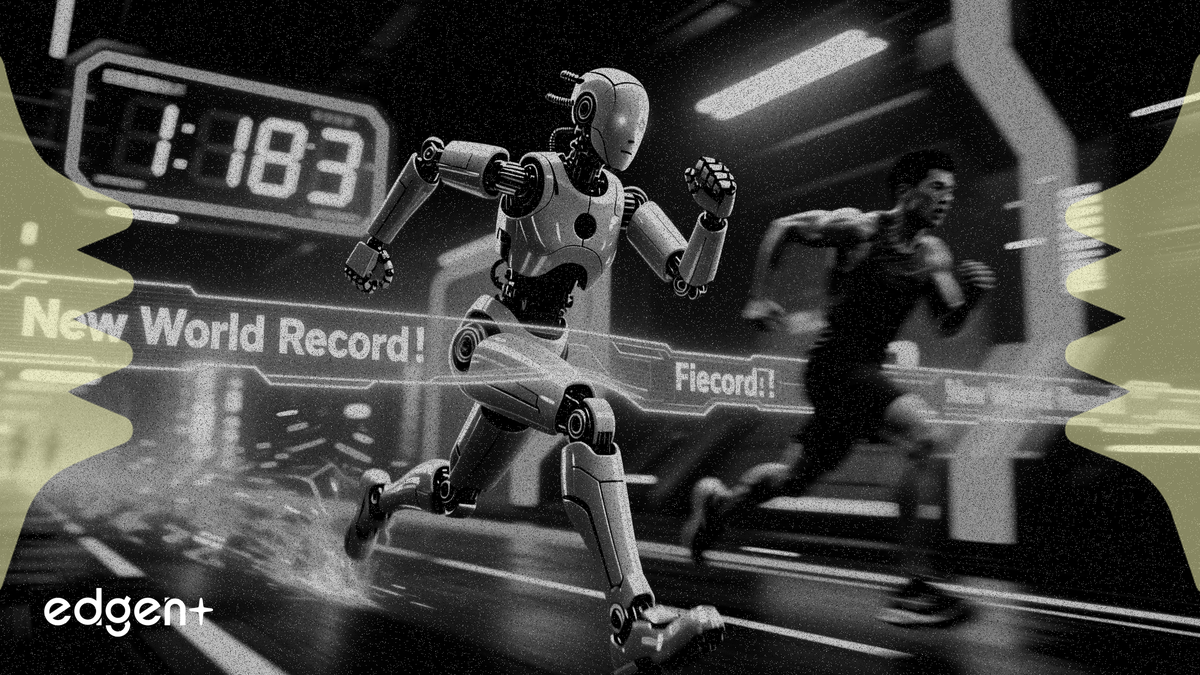
A scarlet humanoid robot developed by Chinese smartphone maker Honor completed a 13.1-mile half-marathon in 50 minutes and 26 seconds, a time that is almost seven minutes faster than the human world record. The performance at the Beijing E-Town Robot Half Marathon signals a dramatic acceleration in China's push for leadership in a technology sector both Beijing and Washington deem critical.
"Looking ahead, some of these technologies might be transferred to other areas," Du Xiaodi, a development engineer at Honor, told reporters, comparing the race to the way the automotive industry was initially developed through competitions. "Structural reliability and liquid-cooling technology could be applied in future industrial scenarios."
The achievement represents a stunning improvement from the previous year's event, where the winning robot finished in 2 hours, 40 minutes, and 42 seconds. This year, the robot champion, named Lightning, not only beat the human record of 57:20 set by Uganda’s Jacob Kiplimo but also outpaced the fastest human runner in the parallel race, Zhao Haijie, who finished in 1:07:47. Honor's autonomous robots swept the top three places, with a separate remote-controlled Honor machine clocking an even faster raw time of 48:19.
The event puts a spotlight on the diverging strategies in the global race for robotics supremacy. While U.S. firms like Figure AI and Tesla attract multi-billion-dollar valuations for their advanced prototypes, Chinese companies are demonstrating rapid, large-scale deployment and iteration in real-world environments, even if their private investment figures are a fraction of their American counterparts.
This year's race was a far cry from the inaugural 2025 event, which saw most of the 21 robotic competitors fail to finish. In contrast, over 100 humanoids participated this year, navigating a course with slopes and sharp turns. The progress was not without hiccups; Lightning itself crashed into a barricade near the end of the race and required human assistance to get back on its feet before crossing the finish line. Another favorite from competitor Unitree collapsed and was carried off the course.
Still, the leap in capability is undeniable. Lightning, standing 5-foot-5 with three-foot-long legs modeled after elite athletes, employed a liquid-cooling system adapted from Honor's smartphones to prevent its joints from overheating—a problem that plagued last year's contestants. The robot ran autonomously, using high-precision satellite positioning to navigate the course.
"I felt it was going quite fast," Zhao, the fastest human runner, told NBC News. "It just went whoosh right past me."
The half-marathon is more than a sporting spectacle; it's a proxy for national industrial strategy. China is already the world's largest market for industrial robots and is aggressively pushing to dominate the more complex humanoid sector. While the U.S. leads in foundational AI models and venture capital investment—with startups like Figure AI commanding valuations orders of magnitude higher than Chinese rivals—China leads in sheer volume and speed of implementation.
According to the International Federation of Robotics, China has more robots in operation than the rest of the world combined. Research firm Omdia noted that in 2025, at least three Chinese companies shipped over 1,000 humanoid robots each, while no U.S. maker surpassed 500. This focus on manufacturing scale and real-world application, a strategy honed in the electric vehicle and drone industries, is now being applied to humanoids.
"The U.S. leads in technological innovation, while China excels in speed of implementation," P.K. Tseng, an analyst at TrendForce, told The New York Times. The Beijing race demonstrates that China's hardware and integration capabilities are catching up to the AI software being developed globally, a trend that could shift the competitive balance in a sector with applications spanning from manufacturing and logistics to defense. The event serves as a high-profile benchmark for an industry moving from lab demonstrations to large-scale commercial viability.
This article is for informational purposes only and does not constitute investment advice.