


Chip suppliers at SEMICON Taiwan expect the AI infrastructure buildout to sustain semiconductor demand through 2030, extending a record data-center spending cycle.
Chip suppliers at SEMICON Taiwan expect the AI infrastructure buildout to sustain semiconductor demand through 2030, extending a record data-center spending cycle.
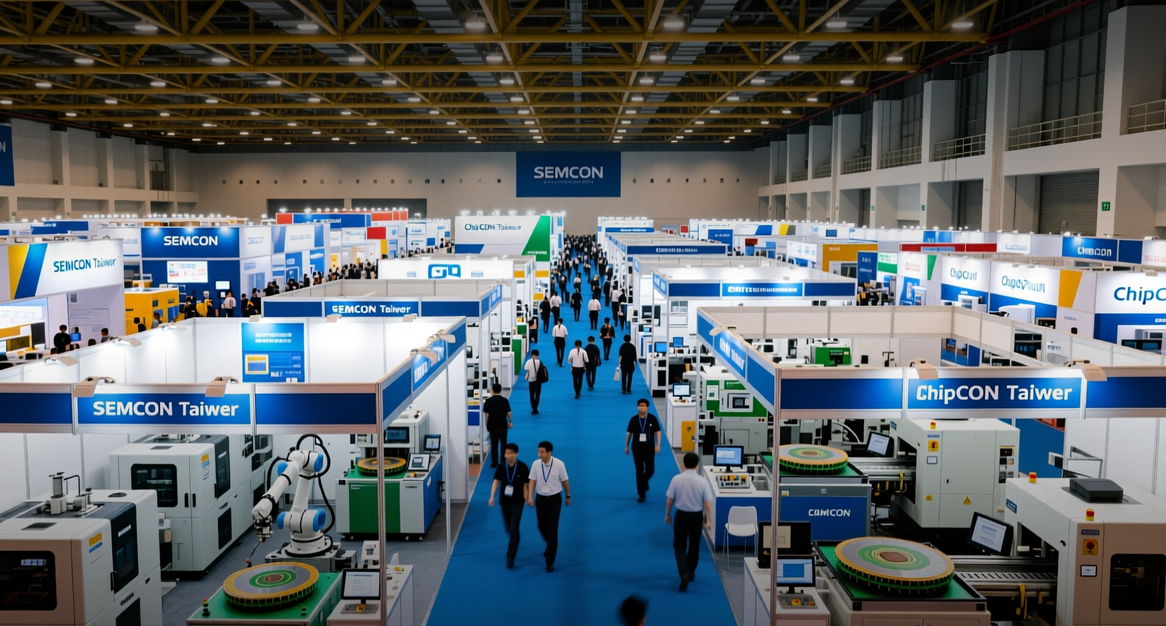
Chip suppliers at SEMICON Taiwan this week projected the AI-driven semiconductor super cycle will extend to 2030, a forecast that would keep the industry's record data-center buildout running for another four years.
The bullish outlook, reported by Bloomberg's Chief North Asia Correspondent Stephen Engle from Taipei, rests on the view that AI infrastructure demand is a multi-year capacity buildout rather than a one-off ordering surge — one that foundries, memory makers and equipment suppliers will need to serve into the next decade.
The spending behind that view is already visible. S&P Global estimates six major hyperscalers — Amazon, Microsoft, Alphabet, Meta, Oracle and SpaceX — are on track to spend a combined $1.3 trillion through 2027. Nvidia, the dominant AI chip supplier, expects capital expenditure from the top five hyperscalers to reach nearly $800 billion in 2026 and $1.3 trillion in 2027. McKinsey projects about $7 trillion in global data-center investment by 2030.
For investors, the stakes concentrate in a handful of names. Nvidia's data-center revenue surged 117 percent year over year to $89.02 billion in the second quarter of fiscal 2027, while memory maker Micron and equipment supplier Lam Research ride the same capex wave. A cycle running to 2030 would extend the earnings runway across the supply chain — and any pullback in hyperscaler budgets would hit them in tandem.
Memory and equipment suppliers price in years of tight supply
The super cycle forecast carries particular weight for memory makers, where adding fabrication capacity takes years and supply already runs short of demand. Micron's fiscal third-quarter 2026 revenue jumped to $41.46 billion from $23.86 billion in the prior quarter, with management projecting about $50 billion in the fourth quarter on a gross margin near 86 percent. Sandisk, the flash-memory supplier, saw fiscal 2026 data-center revenue surge 437 percent to $5.15 billion, with demand expected to exceed supply beyond 2027. Lam Research, which sells the etch and deposition tools used to build advanced chips, posted fiscal fourth-quarter revenue up 30 percent year over year to $6.72 billion.
The equipment maker's position further up the supply chain gives it exposure to whichever chip type wins — GPUs, high-bandwidth memory or advanced logic — because all require new fabrication capacity. That breadth is why suppliers at the Taipei show see the current upcycle as structurally different from past semiconductor booms, which typically faded after two to three years of peak ordering. Foundry leader TSMC, which fabricates most of the world's advanced AI chips, stands at the center of that capacity race.
Financing push widens the pool of AI capital
The buildout is drawing in institutional money beyond the hyperscalers' own balance sheets. Nvidia said Aug. 10 it partnered with six financial institutions, including Goldman Sachs, to raise more than $500 billion in third-party capital for AI infrastructure, an asset-backed structure that would let insurers and money managers fund data-center compute. Goldman is in talks with investors on the financing, according to reports.
The scale of that capital pool helps explain the 2030 horizon. PwC expects global data-center spending to reach $31.6 trillion through 2050, with the United States accounting for nearly half at $15.1 trillion. For chip suppliers, the question is no longer whether AI demand is real — it is how fast capacity can be added to meet it.
Nvidia shares, the sector's bellwether, trade at a premium that assumes years of sustained growth, and the SEMICON Taiwan forecasts reinforce that thesis. Any sign that hyperscalers are trimming budgets, or that cheaper AI models from China are compressing the economics of the buildout, would test the super cycle narrative before 2030 arrives.
This article is for informational purposes only and does not constitute investment advice.
