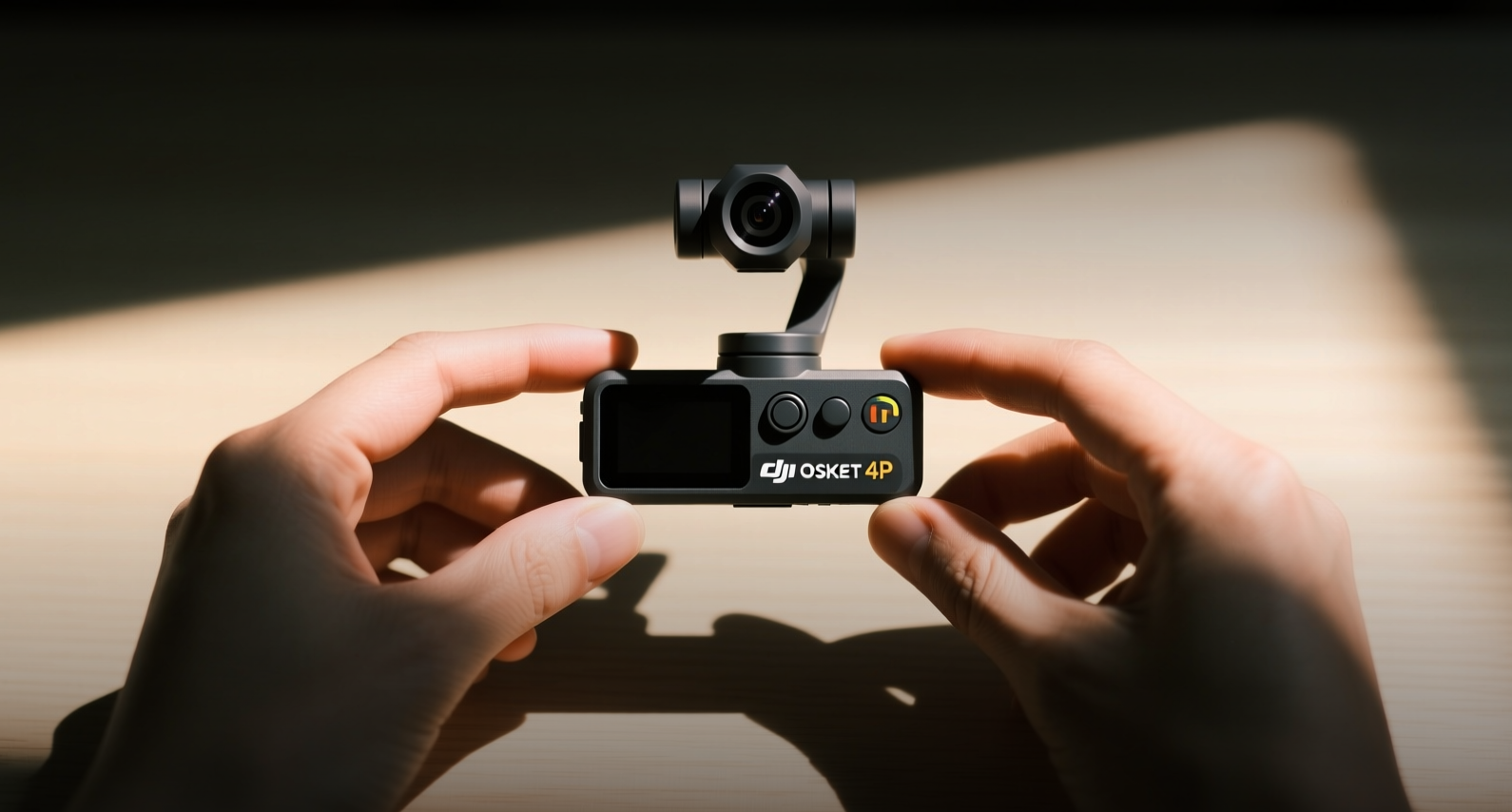
The handheld gimbal camera market that DJI created with its Pocket series is now drawing smartphone giants and a patent war — just as chipflation raises the cost of entry.
DJI on Monday launched the Osmo Pocket 4P in China at 3,799 yuan ($525), pairing a 1-inch main sensor with a 3x optical telephoto lens, as the gimbal camera market erupts into patent litigation and new entrants. The Pocket 4P records 4K video at up to 240fps for slow motion, supports 10-bit D-Log2 color grading, and charges from zero to 80% in 18 minutes. Its dual-camera system — a first for the Pocket lineup — includes a 20mm-equivalent wide lens and a 60mm-equivalent telephoto with f/1.8 aperture. The camera weighs 230 grams and packs 103GB of internal storage, expandable to 1TB via microSD.
"The Osmo Pocket 4P will officially release on June 15," a DJI China customer service representative confirmed, adding that pricing starts at 3,799 yuan.
The launch comes as DJI and Insta360 trade patent lawsuits in US federal court, with DJI alleging the Luna Ultra infringes design and utility patents covering the Osmo Pocket's body, gimbal assembly, and subject-tracking technology. Insta360 countersued on June 11, claiming DJI violated five of its own patents on stabilization algorithms and panoramic video.
The Category That Outgrew Its Creator
The legal battle underscores how valuable the pocket gimbal category has become. DJI's Osmo Pocket 3 sold more than 5 million units in 2024 alone, generating nearly 200 billion yuan ($27.6 billion) in revenue, according to supply chain sources. That success proved there is a viable market for a device that sits between a smartphone and a dedicated camera: more stable than a phone, lighter than a mirrorless rig.
Now the competition is flooding in. Insta360 launched the Luna Ultra on June 10, a dual-camera gimbal with Leica lenses and a detachable OLED screen, priced at 3,999 yuan. Vivo began developing a vlog camera in late 2025, assembling a team of nearly 100 people to build a product that directly targets DJI's Pocket series. OPPO has started a gimbal camera project codenamed "Fuyao," while Honor is working on a "Robot Phone" that integrates a gimbal camera directly into a smartphone body. Canon published a gimbal camera patent in May 2026 featuring an auto-folding design, signaling its interest in the category.
Chipflation Raises the Cost of Entry
The timing is treacherous. A wave of chipflation — the term Morgan Stanley uses to describe storage-chip price inflation driven by AI demand — is pushing up the cost of key components. Samsung and SK Hynix have shifted production capacity toward high-bandwidth memory and DDR5 for AI data centers, squeezing supply of the DRAM and NAND flash that consumer devices rely on. GoPro, the action-camera pioneer, has been pushed to the brink of a sale by the same cost pressures.
For new entrants, the math is unforgiving. The Pocket 4P and Luna Ultra both land in the 3,700-to-4,000-yuan range — roughly the price of a midrange smartphone. With component costs rising, first-generation products may struggle to recover research and development spending. Smartphone makers like vivo and OPPO have stronger supply-chain leverage due to their scale, but the gimbal camera remains a side project for them, not a core business. DJI and Insta360, by contrast, have no Plan B — this category is their primary growth engine.
Who Stays on the Table
The gimbal camera market is still small relative to smartphones, but its trajectory is steep. DJI's Pocket 3 went from an initial production forecast of 300,000 units to cumulative sales of 10 million by October 2025 — a 33x revision. If the category continues to grow, the winners will be those who can survive the cost squeeze long enough for scale to bring margins back. The losers may never reach a second generation.
This article is for informational purposes only and does not constitute investment advice.