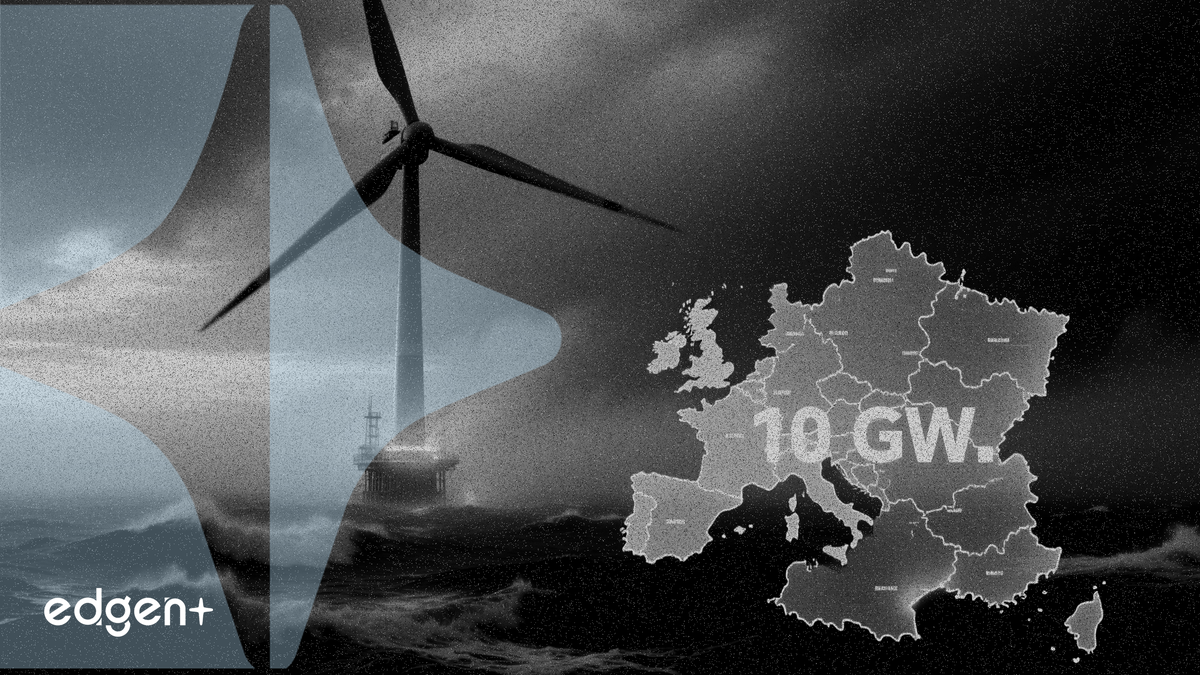
France's long-awaited offshore wind tender will more than quadruple the country's installed capacity and test the resilience of Europe's clean energy supply chain.
France's 10 GW offshore wind tender, split evenly between fixed-bottom and floating technology, will test whether Europe can scale clean energy capacity amid rising costs and political headwinds.
"This tender represents a critical step toward France's 2035 target of 15 GW of offshore wind capacity," the energy ministry said in a statement Thursday, adding that the call for tenders opens Friday.
The tender covers 5 GW of fixed-bottom wind farms, which use turbines on foundations attached to the seabed, and 5 GW of floating wind farms, which place turbines on anchored platforms for deeper waters. Companies have four months to submit offers, with winners to be selected in February 2027. France currently operates less than 2 GW of offshore wind capacity, while Europe's total stood at just under 40 GW at the end of 2025, according to industry group WindEurope.
The timing is politically significant. Selecting winners in early 2027 would allow President Emmanuel Macron's government to finalize the goals laid out in February's Energy Planning Law before the April presidential election. The far-right National Rally, which opposes offshore wind, is a favorite to reach the second-round runoff.
Floating Wind Faces a Cost Test
Floating wind technology, while opening access to deeper waters with stronger and more consistent wind, carries higher costs due to complex platforms, mooring systems, and installation work. The 5 GW allocation for floating projects makes this one of the largest such tenders globally, offering a potential template for other markets. Fixed-bottom wind, the more established technology, benefits from lower levelized costs of energy — typically $40 to $60 per MWh in European waters, compared with $100 to $150 per MWh for early floating projects, according to industry benchmarks.
Supply Chain Rules Reshape Competition
The French ministry said turbines will be subject to European rules requiring most or all components to be manufactured in Europe. Parts built outside Europe will face strict environmental regulations. The localization requirement benefits European turbine makers such as Siemens Gamesa and Vestas, while limiting exposure to cheaper Chinese imports that have gained share in other markets. The contracts for difference mechanism guarantees operators an agreed price — the state pays the gap when market prices fall below the strike price, and operators repay when prices rise above it.
The tender also includes a novel provision: the French state wants to incentivize maintenance work on turbines when French electricity prices are low, to protect against negative pricing caused by excess renewable supply. This reflects a growing challenge across European power markets as renewable penetration increases.
For investors, the 10 GW program creates a visible pipeline for European wind manufacturers and developers. Siemens Gamesa, Vestas, and EDF's renewable energy unit are among the companies positioned to compete. The program, combined with France's 15 GW target by 2035, provides long-term revenue visibility for the supply chain. However, execution risk remains: offshore wind projects globally have faced cost inflation and cancellations, including in the US under the Trump administration. European offshore wind capacity at just under 40 GW at the end of 2025, per WindEurope, suggests the continent needs to roughly double its build rate to meet 2030 targets.
This article is for informational purposes only and does not constitute investment advice.