
General Fusion became the first publicly listed fusion company, entering Nasdaq with about $150 million to fund its LM26 demonstration machine through 2028.
General Fusion became the first publicly listed fusion company, entering Nasdaq with about $150 million to fund its LM26 demonstration machine through 2028.
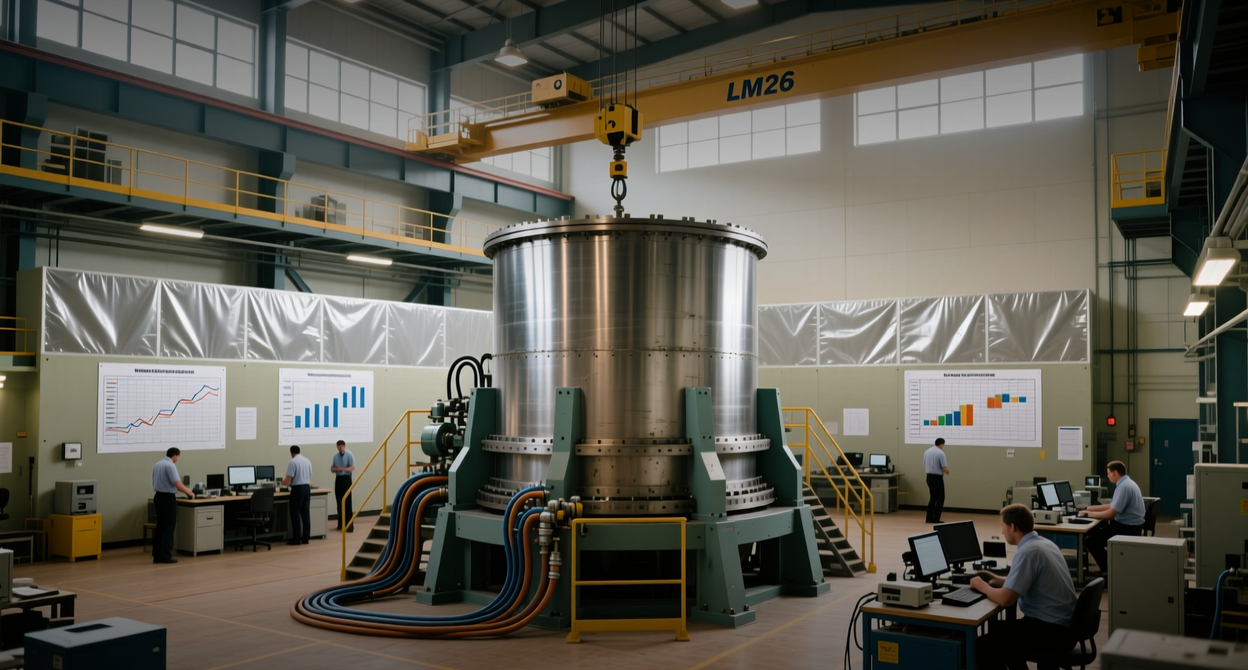
General Fusion became the first publicly listed fusion company, entering Nasdaq with about $150 million to fund its LM26 demonstration machine through 2028.
General Fusion Group Ltd. became the first publicly listed fusion company, entering Nasdaq with about $150 million in cash to fund its Lawson Machine 26 demonstration program through several technical milestones by the end of 2028. The Vancouver-based company, founded in 2002, listed under the ticker GFUZ after completing its business combination with Spring Valley Acquisition Corp. III on July 10, with warrants trading under GFUZW.
"Our listing on Nasdaq marks an important milestone for General Fusion and the broader fusion industry," Greg Twinney, chief executive officer, said. "We believe fusion is approaching an important inflection point."
The company reported its LM26 machine compressed a plasma to roughly 0.72 keV, about 8.4 million degrees Celsius, using a liquid lithium liner — more than tripling the plasma's electron temperature through mechanical compression. The results advance the machine along a path running first to 1 keV, then 10 keV, and ultimately toward the Lawson criterion, the combination of temperature, density, and confinement time that produces net fusion energy in the plasma.
General Fusion's Magnetized Target Fusion approach differs from the superconducting-magnet tokamaks and high-powered lasers favored by rivals, using mechanical compression with a liquid lithium wall to squeeze a magnetized plasma. The company aims to deploy a first-of-a-kind fusion plant by about 2035, targeting a market that could reach trillions of dollars in global energy spending as AI data centers and electrification strain grids.
A Third Route to Fusion
Most fusion approaches familiar to investors rely on one of two methods: powerful superconducting magnets to contain plasma, as in the ITER project and Commonwealth Fusion Systems' SPARC design, or high-powered lasers to compress it, as pursued by the National Ignition Facility. General Fusion's MTF takes a third route, using mechanical compression with a liquid lithium wall physically squeezing a magnetized plasma.
The company said the design leans on existing, durable materials and avoids the most expensive and fragile components of rival approaches, making it easier to integrate with the constraints of an actual power plant, including existing infrastructure. The approach has been tested over more than two decades on increasingly sophisticated demonstration systems, with results published in peer-reviewed journals. The company said the LM26 results are submitted for peer review.
Commercial Milestones and Partnerships
Beyond the technical program, General Fusion signed a milestone-based framework agreement with Renexia S.p.A., a Toto Group company, to collaborate on potential commercial deployment of its fusion technology in Italy. It also expanded its technology ecosystem through a collaboration with General Atomics Energy Group to advance plasma diagnostics capable of measuring temperatures exceeding 10 keV, about 100 million degrees Celsius, during the second phase of the LM26 program.
The timing of the listing tracks a broader shift in electricity demand. Economies are electrifying, and AI data centers are consuming power at a pace that is straining grids, pushing utilities and governments to search for firm, carbon-free baseload generation. Fusion, if it can be made to work, offers abundant power with no long-lived waste and no risk of runaway reaction.
As a de-SPAC, GFUZ carries post-combination risks including potential share volatility and dilution. The company is pre-revenue, burning capital against one of the hardest engineering problems attempted, on a timeline that has humbled well-funded efforts before. If Magnetized Target Fusion works, General Fusion is early in a market measured in potentially trillions of dollars of global energy spending; if it does not, the company faces a capital-intensive path with no revenue. The near-term markers are LM26's progress toward 1 keV and then 10 keV, independent peer-review validation of results reported so far, and execution against the 2028 milestone timeline.
This article is for informational purposes only and does not constitute investment advice.
