
Wall Street's $800 billion AI infrastructure bet is showing cracks as analysts project only 84 of 157 announced gigawatts will be built by 2030.
Wall Street's $800 billion AI infrastructure bet is showing cracks as analysts project only 84 of 157 announced gigawatts will be built by 2030.
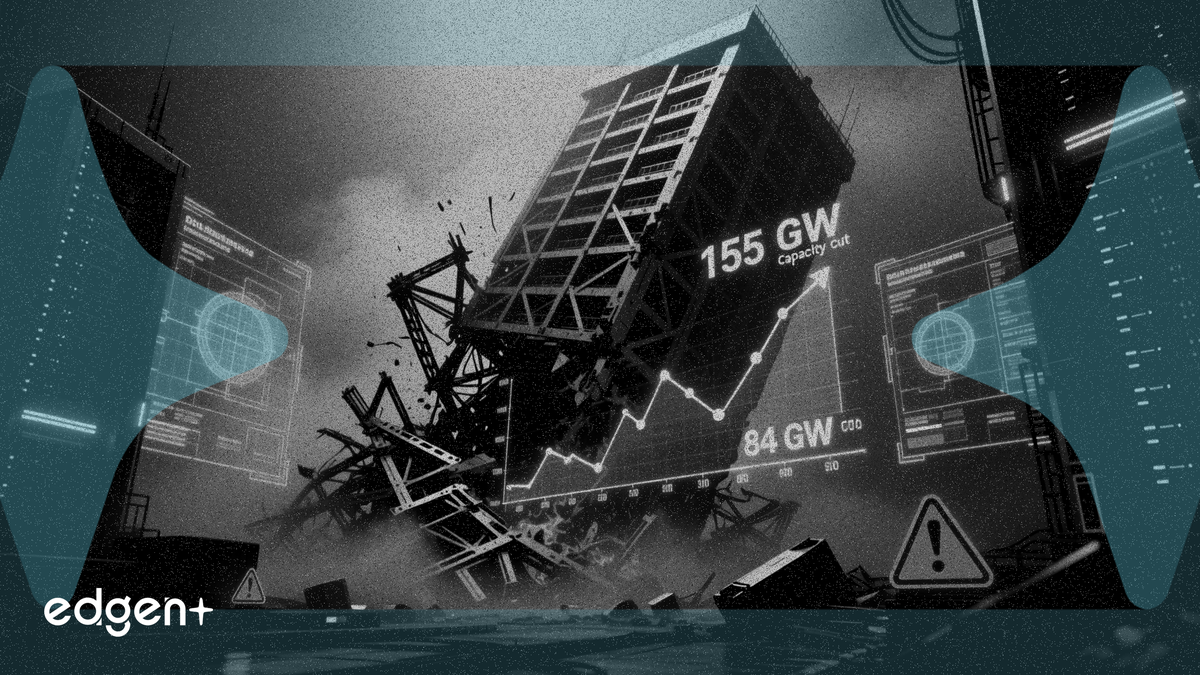
Wall Street's $800 billion AI infrastructure bet is showing cracks as analysts project only 84 of 157 announced gigawatts of data center capacity will be built by 2030, raising questions about returns on the largest capital deployment in tech history.
"Whether or not they're going to make money off of them, that's a huge unknown," Father Robert Balassare said on the This Week in Tech podcast, pointing to xAI's $20 billion facility already running Nvidia chips that newer models have surpassed.
Amazon's trailing 12-month free cash flow fell 95% to $1.2 billion after Q1 capex alone hit $44.2 billion, with cumulative AI spend approaching $291 billion. Alphabet raised its 2026 guidance to $180 billion to $190 billion, with CFO Anat Ashkenazi adding that 2027 CapEx will "significantly increase" — cumulative spend now around $262 billion. Meta lifted its full-year guide to $125 billion to $145 billion, bringing its running total to roughly $227 billion, while Microsoft expects roughly $190 billion in calendar 2026 capital expenditures.
The 10-year Treasury yield at 4.53%, in the 96th percentile of its historical range, makes every basis point harder to pencil for 15-year data center investments. Unlike dark fiber that sat underground and eventually powered the internet, obsolete GPU racks depreciate like smartphones, making stranded data centers nearly worthless.
The 1999 Fiber Parallel, With a Twist
The closest historical precedent is the telecom overbuild of 1999 to 2001, when carriers laid roughly $500 billion in fiber capex and an estimated 85% to 95% of strands went dark — what became known as "dark fiber." Cisco, Sun Microsystems and Lucent watched their order books evaporate, with equity values falling more than 80%. That fiber eventually became the substrate for the modern internet, powering everything from streaming video to cloud computing.
The difference this time is obsolescence speed. Janus Henderson analysts, cited on the TWiT panel, project that only 84 of 157 announced gigawatts will materialize by 2030 — a gap of roughly half. A rack of last-generation GPUs depreciates on a schedule closer to a smartphone than a railroad tie, Balassare argued. Dark fiber waited underground. Stranded silicon just decays.
Stocks Are Already Pricing the Question
The equity market has started to ask the same question. Meta has fallen 15% to $570.98 since its April 29 earnings report. Amazon is down 10%, Microsoft has slid 6%, and Nvidia — the primary beneficiary of every dollar in this cycle — is off 10% since its May 20 earnings report, even after disclosing $119 billion in total supply-related commitments in its latest 10-K filing. Polymarket's June 2026 contract pins Nvidia at a modal $192 with 59% probability, suggesting traders are not pricing a melt-up.
The demand is real. Nvidia's data center revenue grew 92% year over year, Microsoft's AI business run rate hit $37 billion, up 123%, and Google Cloud backlog nearly doubled quarter on quarter to $462 billion. The question is whether the returns justify the $800 billion price tag.
For investors, the math comes down to timing and survival. The four hyperscalers — Amazon at 333x price-to-free-cash-flow, Alphabet and Meta carrying cumulative spends above $200 billion each — are betting that today's overbuild becomes tomorrow's moat. If Balassare is right that the obsolescence clock ticks faster on a GPU than on glass fiber, the digestion period will be uglier than the bulls expect. The companies will survive. The open question is what kind of returns the shareholders financing this cycle actually take home, and whether the payoff arrives before the next technology cycle renders today's hardware obsolete.
This article is for informational purposes only and does not constitute investment advice.
