


Intel’s 175 percent rally this year is a bet on its foundry’s future, and Apple may be the validation that investors were waiting for.
Intel’s 175 percent rally this year is a bet on its foundry’s future, and Apple may be the validation that investors were waiting for.
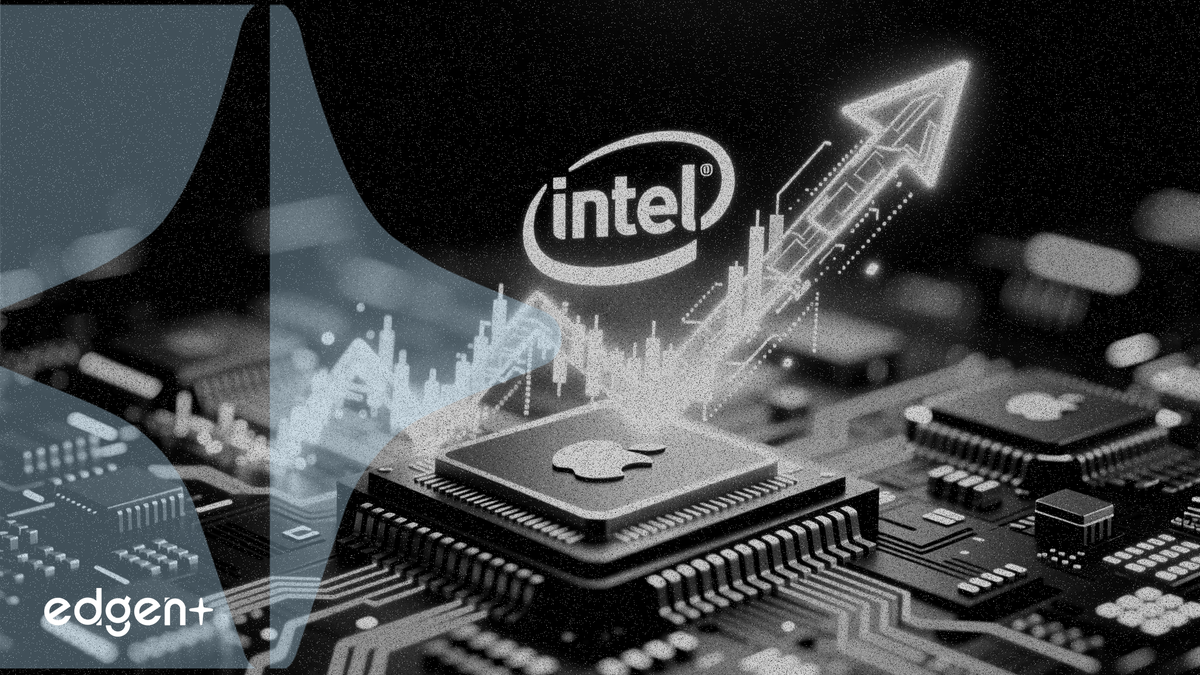
Intel Corp. shares surged 13 percent to an all-time high Tuesday after reports that Apple Inc. is in preliminary talks to use its foundry services, a move that could validate Intel’s multi-billion dollar manufacturing turnaround and challenge TSMC’s dominance.
The rally to $105.64 pushed the S&P 500 and Nasdaq Composite to new records, with Intel’s performance lifting other chipmakers including Micron Technology and Sandisk, which gained 11 percent and 12 percent, respectively.
The talks, described by Bloomberg as early-stage, are part of Apple’s “Taiwan plus one” strategy to diversify its supply chain beyond Taiwan Semiconductor Manufacturing Co. (TSMC), which produces nearly all of its advanced processors. Intel’s 18A process, a 1.8-nanometer class node shipping in late 2026, is the first American manufacturing technology theoretically capable of producing Apple’s M-series chips.
For Intel, winning even a fraction of Apple's business would provide a critical anchor tenant for its foundry ambitions, potentially adding over $600 million in annual revenue, according to one estimate. For Apple, it represents a geopolitical insurance policy, aligning with a $600 billion commitment to American manufacturing and mitigating supply chain risks concentrated in Taiwan.
The discussions are occurring against a backdrop of a concerted US government effort to onshore critical semiconductor production. The government invested $8.9 billion in Intel in August 2025 through the CHIPS Act, acquiring a nearly 10 percent stake and signaling that the company’s survival is a matter of national policy. That stake has returned over 300 percent in nine months. Other major US tech companies, including Amazon, Google, and Elon Musk’s Terafab, have also signed or are in discussions for foundry agreements, driven by the strategic imperative to have chip production capacity inside the United States.
Under CEO Lip-Bu Tan, who took over in March 2025, Intel has restructured its foundry business into a separate subsidiary and focused engineering resources on the 18A process node. The strategy has shown early signs of success, with the company beating revenue and earnings estimates for six consecutive quarters. In Q1 2026, data center and AI revenue grew 22 percent year-over-year to $5.1 billion.
Despite the stock's 175 percent rally in 2026, Intel's foundry business remains a fraction of its rivals'. The division lost $2.4 billion in the first quarter, and its external foundry revenue was just $174 million, compared to TSMC’s quarterly revenue that exceeds $20 billion. Analyst sentiment remains measured, with a consensus ‘hold’ rating and a median price target of $80, substantially below its current trading levels.
Critical risks remain for investors paying a premium for a narrative that has not fully materialized. The company has yet to announce a committed high-volume external customer for its next-generation 14A node, a key milestone for its foundry 'show-me' moment expected in the second half of 2026. Intel also faces intense competition from Nvidia’s upcoming ‘Rubin’ GPU platform, which threatens its Gaudi line of AI accelerators, and a structural shift in the PC market toward ARM-based chips from competitors like Qualcomm that could erode its core Client Computing Group revenue.
This article is for informational purposes only and does not constitute investment advice.

