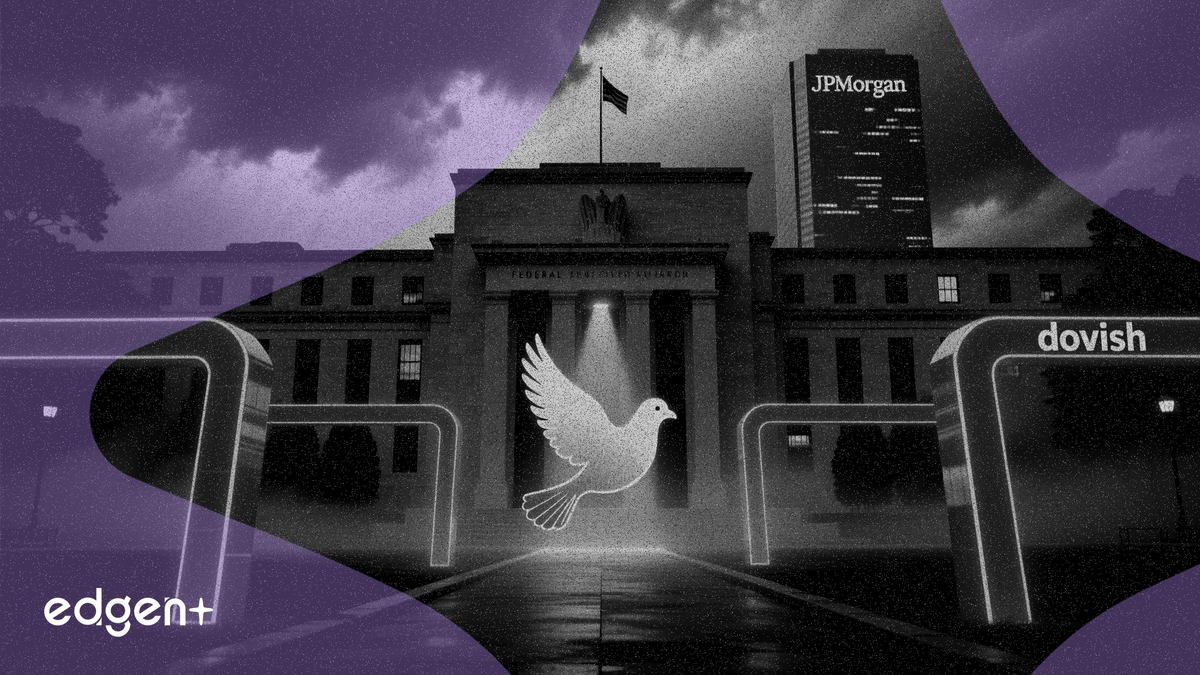
A new JPMorgan Chase & Co. report suggests incoming Federal Reserve Chair Kevin Warsh will inherit an institution that is structurally resistant to the kind of dovish pivot many investors are anticipating.
The Federal Reserve may have a new chair in Kevin Warsh, but markets expecting a rapid shift to lower interest rates will likely be disappointed, according to a new analysis from JPMorgan. The report argues that despite Warsh’s more dovish-sounding statements, he faces at least four significant institutional and technical hurdles that will constrain his ability to quickly alter the central bank's course from the one set by his predecessor, Jerome Powell.
“The Federal Reserve system will constrain Warsh, especially on the near-term direction of the federal funds rate,” Michael Feroli, an analyst at JPMorgan, said in a recent report. Feroli suggests that any path to easier policy faces major headwinds from a committee that is losing patience with inflation and is already showing a hawkish tilt, making the bar for rate cuts exceptionally high in the short term.
The challenge for Warsh is underscored by recent events at the central bank, where three officials dissented from the latest policy statement, arguing for a more hawkish stance. Warsh will replace Stephen Miran, considered one ofr the few reliable doves on the committee, meaning the new chair will not add a new vote for easing but will instead need to persuade a skeptical committee. With inflation having peaked at 9.1% in June 2022, the institutional memory of the fight to regain price stability remains fresh.
Warsh’s first test will come at the June FOMC meeting, where he will have to represent a committee consensus that may not align with his own views or the expectations of the White House. The outcome will set the tone for his chairmanship and signal whether the era of the “Fed Put”—the long-held assumption that the central bank will always rescue markets—is truly over.
The Rate-Cut Conundrum
Even if Warsh personally favors a more accommodative stance, he cannot easily deliver rate cuts. The primary obstacle is the Federal Open Market Committee (FOMC) itself. According to JPMorgan's analysis, the committee’s patience with above-target inflation is wearing thin. The three dissents at the last meeting in favor of a more hawkish policy direction highlight a committee leaning away from, not toward, imminent cuts.
Warsh’s challenge is that he is not gaining an additional vote for his column; he is replacing a departing member. This means he must build a new consensus for easing within a committee that appears to be moving in the opposite direction. Former National Economic Council Director Gary Cohn noted that Warsh is a "fundamentalist" who will focus on the Fed's core mandate, suggesting he may prioritize inflation credibility over providing short-term market relief, much like former Chair Paul Volcker.
Balance Sheet Unwind a Slow Process
A second major area where Warsh may face constraints is the Fed's nearly $6.8 trillion balance sheet. While there is broad agreement within the FOMC, and with Warsh himself, that the balance sheet should be smaller, the path to getting there is technically complex and slow.
JPMorgan’s report notes that shrinking the balance sheet without causing a shortage of bank reserves—a situation that could destabilize money markets—requires careful study and planning. This involves assessing the banking system's underlying demand for reserves, a process that could take months or even years. Consequently, while Warsh may advocate for a more aggressive reduction than Powell, any significant acceleration is unlikely to be a main policy driver in 2026 or 2027.
The Paradox of Communication Reform
Warsh has been a vocal critic of the Fed's communication strategy, particularly its use of forward guidance, which he believes constrains future policy decisions. He has signaled a desire to communicate less, potentially ending the era of a press conference after every meeting to restore an element of surprise.
However, Feroli’s report highlights a key paradox: by reducing his own platform, Warsh could inadvertently weaken his ability to shape the Fed's narrative. "If Warsh weakens this forum, the speeches of other Fed officials will fill the vacuum, and the chairman's ability to control the narrative may decline," the report states. Other committee members may also be reluctant to give up tools like the "dot plot" of rate projections, which gives each of them a voice in the Fed's public messaging.
AI and Other Arguments
Other arguments for rate cuts, such as the potential for artificial intelligence to boost productivity and lower inflation, are also likely to meet resistance. As Powell recently argued, the short-term effect of the AI boom is the construction of data centers, an activity that increases demand and is marginally inflationary. Persuading the committee that a supply-side miracle is imminent will be a difficult task for the new chair.
This article is for informational purposes only and does not constitute investment advice.