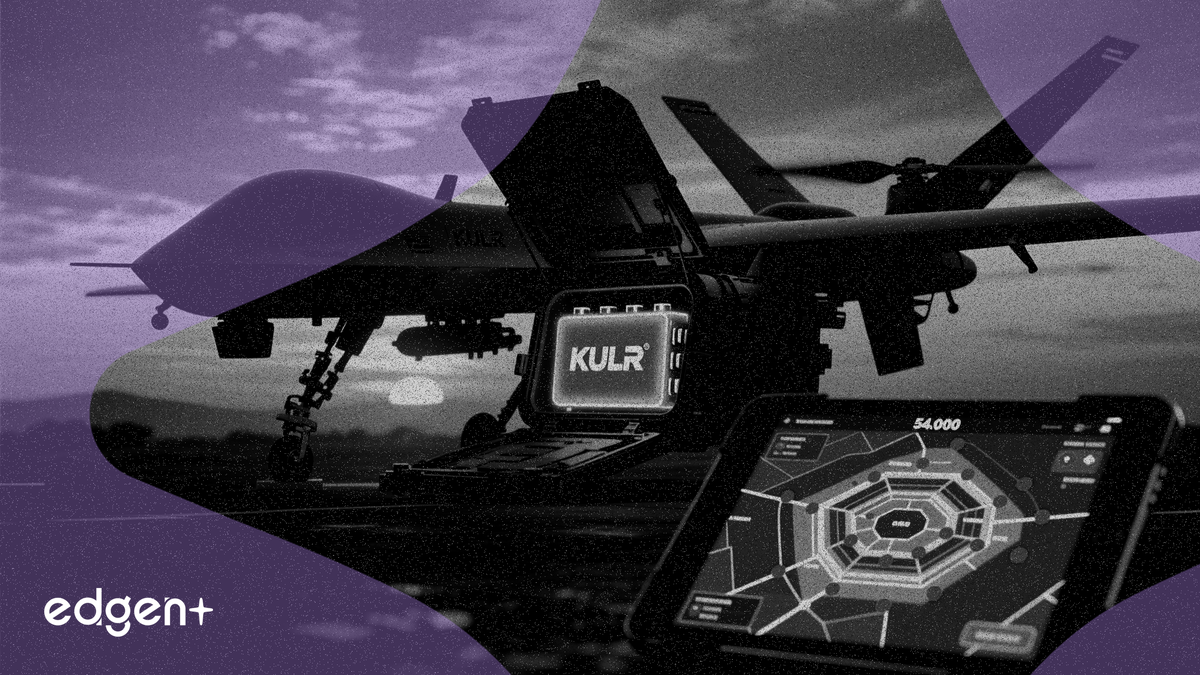
KULR Technology Group secured a prototype battery development contract with a US military drone manufacturer, placing the company at the center of the Pentagon's $54 billion push to build 300,000 attack drones by 2027.
"KULR sits at the intersection of two of the fastest-growing categories in defense: domestic drone production and the advanced battery systems that power it," the company said in a statement Tuesday, without disclosing the contract value or the manufacturer's identity.
The prototype agreement covers development of advanced battery systems for military drone applications, according to the statement. KULR, which trades on the NYSE American under KULR, specializes in thermal management and battery safety technologies — capabilities critical for drone operations where battery failure can result in platform loss. The US Defense Department currently accounts for less than 2 percent of domestic drone sales, a figure the Pentagon aims to change through its Drone Dominance Program.
The contract embeds KULR deeper into a defense supply chain the Trump administration is actively reshaping. The Office of Strategic Capital is in advanced talks to provide direct federal funding to drone manufacturers including Performance Drone Works and Nero Technologies, the Wall Street Journal reported. The Pentagon's $1.1 billion plan to mass-produce 300,000 low-cost attack drones by the end of 2027 requires sourcing batteries, motors, and components without relying on Chinese suppliers, which dominate the global market.
The development follows broader momentum in drone battery technology. SES AI showcased a 10Ah high-energy-density battery portfolio at XPONENTIAL 2026 in May, designed for longer endurance and increased payload in defense and ISR applications. SES AI also highlighted its NDAA-compliant manufacturing and AI-driven Molecular Universe platform for battery optimization. The company's 10Ah portfolio includes high-energy, high-power, and balanced-performance variants for different mission profiles.
Volatus Aerospace advanced to the next phase of the US Drone Dominance Program's Phase II evaluation in May, submitting a long-range strike platform under Mission Area A. The Canadian company's selection reflects the program's focus on scalable uncrewed aerial systems for contested environments. Embry-Riddle Aeronautical University has also expanded its UAS training courses to prepare students for careers in uncrewed aviation, showing the broader ecosystem buildout around drone operations.
The US currently manufactures about 100,000 drones annually, according to a 2025 estimate, compared with Ukraine's production of four million last year. Closing that gap requires significant investment in domestic battery production and component sourcing — areas where KULR's thermal management and battery safety expertise could find expanding demand. The Pentagon's Drone Dominance Program, which began as a rapid acquisition initiative, has drawn participation from companies ranging from defense primes to former hobbyists, reflecting the low barriers to entry in small drone manufacturing.
KULR shares have not yet reacted to the announcement. The company's entry into defense drone battery development places it alongside established suppliers such as SES AI and emerging players competing for Pentagon contracts. For investors, the contract opens potential revenue diversification into defense spending, though the prototype stage means production revenue depends on successful qualification and follow-on orders. KULR's thermal management technology, originally developed for consumer electronics and electric vehicle batteries, may prove transferable to the high-vibration, high-temperature environments of military drone operations.
This article is for informational purposes only and does not constitute investment advice.