

Key Takeaways:
- Meituan launched Tabbit 1.0, an AI-native browser integrating 10+ domestic LLMs
- Agent task success rate improved to 91.8% from 53.1% in March
- Average monthly token usage per user reached 8.53 million in May
Key Takeaways:
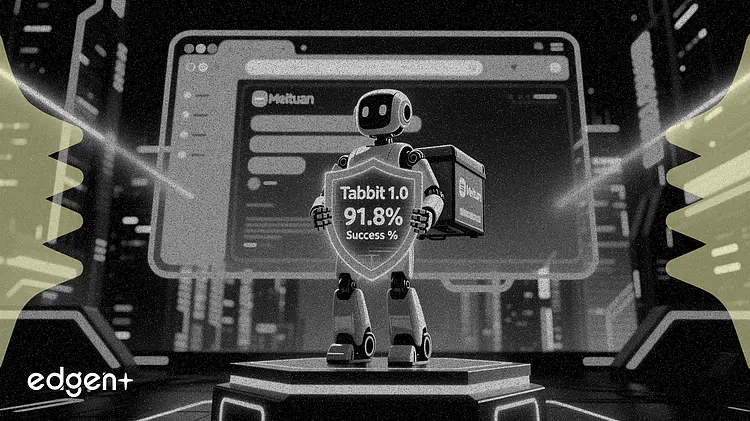
Meituan's AI-native browser Tabbit 1.0 now completes 91.8% of agent tasks, up from 53.1% in March, as the food-delivery giant pushes deeper into the AI tools market.
Meituan's GN06 team launched Tabbit 1.0, an AI-native browser that integrates more than 10 domestic large language models and completes 91.8% of agent tasks, up from 53.1% in March.
"Tabbit serves as an AI gateway in the form of a browser, automatically executing complex tasks across different software and web pages," Liu Jiong, head of Tabbit at Meituan, said.
The browser, which entered public beta on March 2, integrates models including DeepSeek, Zhipu GLM, Kimi, LongCat, MiniMax M3, Doubao-Seed-2.0, Qwen3.5 and GLM-5.1. Users can select up to five models to answer the same question simultaneously and receive a comparative summary. Average monthly token usage per user reached 8.53 million in May, Liu said.
The launch positions Meituan against Tencent's WeChat AI agent, which Bank of America expects to enter full public beta as early as the fourth quarter of 2026. Meituan shares rose 3.9% on the announcement, with short selling accounting for 25.8% of trading volume at HK$682 million.
Tabbit's core functions are permanently free, with a weekly quota allowing about 1,000 conversations, 50 illustrations and 10 automated agent tasks. A professional tier offering 10 times the usage costs 9.9 yuan ($1.37) per week. The browser supports more than 300 pre-built agent skills and is compatible with mainstream MCP tools, generating PDF, PPT, Excel and Word documents from user prompts.
The product addresses a structural problem in how professionals use AI today. White-collar workers spend more than 66 hours per week on browsers for office work, collaboration and data analysis, Liu said. Existing workflows require switching between search windows and AI chat interfaces, creating friction and information loss. Tabbit embeds AI directly into the browsing environment, giving the model access to open tabs, bookmarks and page content without manual transfer.
On Meituan's internal benchmark, Tabbit's web-operation task success rate improved from 61% to 70% between versions V0.23 and V1.0, with the overall score rising to 94.3 from 65.0. The browser adds a memory function that retains user preferences and frequently referenced information across sessions.
The AI browser market is becoming increasingly contested. Tencent is developing its WeChat AI agent, while independent tools like Lobster and Codex target desktop agent workflows. Meituan's strategy of offering a free tier with multi-model access could accelerate adoption among cost-sensitive users, though the company faces the challenge of convincing users to switch from established browsers where they have existing bookmarks and plugins.
Meituan trades at a forward price-to-earnings ratio of about 18x. The Tabbit launch, while unlikely to move revenue meaningfully in the near term, signals the company's ambition to expand beyond food delivery into AI-powered productivity tools — a market IDC projects will exceed $50 billion globally by 2028. Investors will watch user growth and retention metrics in coming quarters to gauge whether the browser can gain meaningful traction against incumbents.
This article is for informational purposes only and does not constitute investment advice.
