

A University of St Andrews physicist published evidence in Nature that Microsoft's topological qubit breakthrough may be built on noise, not physics.
A University of St Andrews physicist published evidence in Nature that Microsoft's topological qubit breakthrough may be built on noise, not physics.
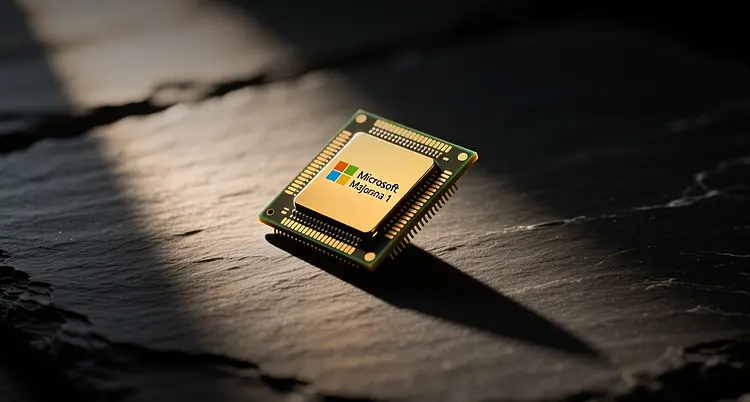
Microsoft's claim to have created the world's first topological qubit faces a formal challenge in Nature, with a physicist arguing the company's evidence may be indistinguishable from random noise — a blow to the software giant's 2029 quantum computing roadmap.
"The 'Matters Arising' makes it painfully apparent that the paper in Nature has no scientific value," Sergey Frolov, a physicist at the University of Pittsburgh who was not involved in either paper, said. "It likely needs to be retracted, like the other Nature papers associated with Microsoft."
The critique, published June 24 by University of St Andrews physicist Henry Legg in Nature's "Matters Arising" forum, targets Microsoft's February 2025 paper announcing the Majorana 1 chip. Legg compared the company's methodology to finding images in random patterns, suggesting the data Microsoft presented as evidence of topological qubits could be statistical artifacts. Nature's editors had already flagged the original paper with a rare note stating the results "do not represent evidence for the presence of Majorana zero modes."
The challenge threatens Microsoft's narrative that it can deliver scalable quantum computing by 2029 — a timeline CEO Satya Nadella has used to position the company against Google and IBM in the quantum race. Microsoft has previously retracted a 2018 Nature paper on Majorana zero modes, and the new critique raises questions about whether its fundamentally different approach to quantum error correction has produced verifiable results.
A 20-year pursuit under scrutiny
Microsoft's approach has diverged from rivals by pursuing topological qubits — a theoretical design that stores quantum information in a way that is naturally resistant to errors, rather than relying on software-based error correction. The company claims its topoconductor material, described as an entirely new state of matter, can control Majorana particles to create qubits that are "faster, more reliable, and smaller" than conventional designs.
Leading theoretical physicist John Preskill said on X that "there is no publicly available evidence that this test has been conducted successfully." Jonathan Oppenheim, a physics professor at University College London, told Fortune there is a "massive disconnect between the scientific article and their public claims." Jason Alicea, a professor of theoretical physics at Caltech, told the New York Times that while a topological qubit is "possible in principle," it needs to be verified — "otherwise, the reality may turn out to be less rosy for quantum computing."
Microsoft Technical Fellow Chetan Nayak defended the results in a statement to Scientific American, saying the company stands by its research and noting that DARPA moved Microsoft into the final phase of its Quantum Benchmarking Initiative after independent evaluation. "Skepticism and rigor are hallmarks of the scientific process," Nayak said.
What's at stake for investors
Microsoft has invested nearly two decades and undisclosed billions into its quantum program, betting that topological qubits will leapfrog competitors' approaches. Google's quantum team demonstrated its Willow chip with error correction below the surface code threshold, while IBM targets 1,000-plus qubit systems by year-end. If the topological approach cannot be independently verified, Microsoft may need to reset its quantum strategy — and its 2029 timeline — potentially ceding ground to rivals with more conventional, proven architectures.
Markus Pflitsch, founder and CEO of Terra Quantum, called the Majorana 1 "truly an advance for the industry" but agreed that a hybrid approach combining AI, high-performance computing, and quantum will deliver commercial value before universal fault-tolerant systems arrive. For Microsoft shareholders, the question is whether the company's differentiated bet on topological qubits will pay off — or whether the lack of verifiable evidence signals a longer, more uncertain path to quantum commercialization.
This article is for informational purposes only and does not constitute investment advice.
