
Elon Musk is demanding "lightspeed" progress on his Terafab semiconductor project, targeting a 2029 start even as Tesla's own AI chip development runs nearly 2 years behind schedule.
Elon Musk is demanding "lightspeed" progress on his Terafab semiconductor project, targeting a 2029 start even as Tesla's own AI chip development runs nearly 2 years behind schedule.
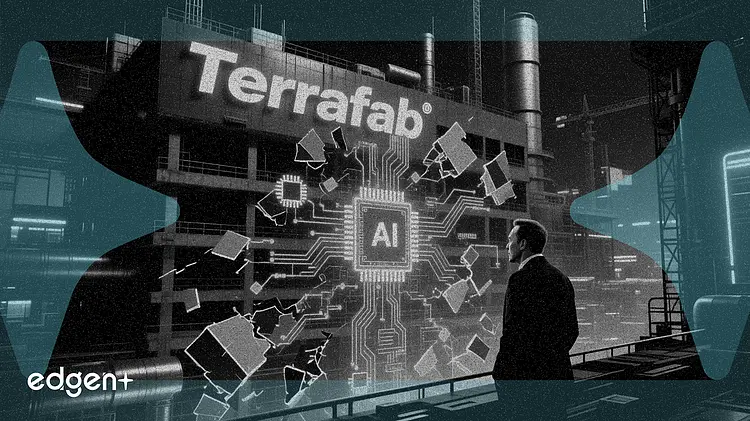
Elon Musk is accelerating his ambitious Terafab semiconductor project, directing his team to secure equipment quotes for a 2029 manufacturing start that aims to challenge the global foundry market and secure supply for his sprawling industrial empire.
The project represents a “strategic alliance,” with Intel CEO Lip-Bu Tan noting in a staff memo that Musk’s “expansive vision across AI, transportation, communications, robotics and space travel relies heavily on an ample and uninterrupted supply of silicon chips.”
The Terafab initiative, backed by Tesla, SpaceX, and xAI, aims to produce chips equivalent to one terawatt of computing capacity annually—roughly double the current U.S. capacity—to power future humanoid robots and AI data centers in space. Intel joined the project in April to help design, fabricate, and package the high-performance chips.
Musk’s aggressive push into chip manufacturing is a direct response to his companies’ future needs, but it clashes with a history of production delays. While Musk’s team is asking for “lightspeed” delivery, Tesla’s own next-generation AI5 chip just reached its tape-out milestone nearly two years behind its original schedule, raising questions about the feasibility of the 2029 Terafab goal.
The urgency for Terafab comes as Tesla’s internal chip design efforts continue to face significant delays. The company’s next-generation AI5 self-driving chip was officially taped out on April 15, 2026, a key milestone that sends the final design to a foundry for fabrication. However, this milestone comes nearly two years after Musk’s original promise to have the chip in vehicles by the second half of 2025.
The path to tape-out was marked by shifting timelines. In July 2025, Musk stated the AI5 design was "finished," yet six months later, in January 2026, he said it was "almost done." The delays forced Tesla to launch its Cybercab on the current-generation AI4 hardware and introduce a stopgap "AI4.5" computer in some 2026 Model Y vehicles to handle larger Full Self-Driving (FSD) neural networks. For the AI5 chip, volume production is not expected until mid-2027, a typical 12- to 18-month cycle after tape-out for testing and validation.
Despite the internal delays, Musk is pushing forward with Terafab, an initiative he claims is essential. “We either build the Terafab or we don’t have the chips,” he said previously. The project starts with two fabs in Austin, Texas, and has brought in semiconductor giant Intel as a key partner.
In a memo to employees, Intel CEO Lip-Bu Tan called the collaboration a "strategic alliance" and stated the company would disclose the scope of its engagement in the "coming weeks." Tan revealed he had held “wide-ranging and deep conversations” with Musk, leading to the conclusion that working together would be "mutually beneficial." Intel's CTO, Pushkar Ranade, has been tapped to manage the company's involvement, a project Tan will personally oversee.
The move into custom fabrication is a massive undertaking, with supply chain expert Brad Gastwirth noting that "visibility into execution remains limited." Key metrics such as capital intensity, cost per wafer, and yield ramp expectations have not been disclosed, making it difficult to assess the project's financial viability against established foundries like TSMC and Samsung, which are reportedly tied to Tesla's AI5 and AI6 chips, respectively.
This article is for informational purposes only and does not constitute investment advice.