

Nvidia's 85% revenue surge to $81.6 billion failed to shield the stock from a 6% sell-off, but Wall Street sees a 47% rebound ahead.
Nvidia's 85% revenue surge to $81.6 billion failed to shield the stock from a 6% sell-off, but Wall Street sees a 47% rebound ahead.
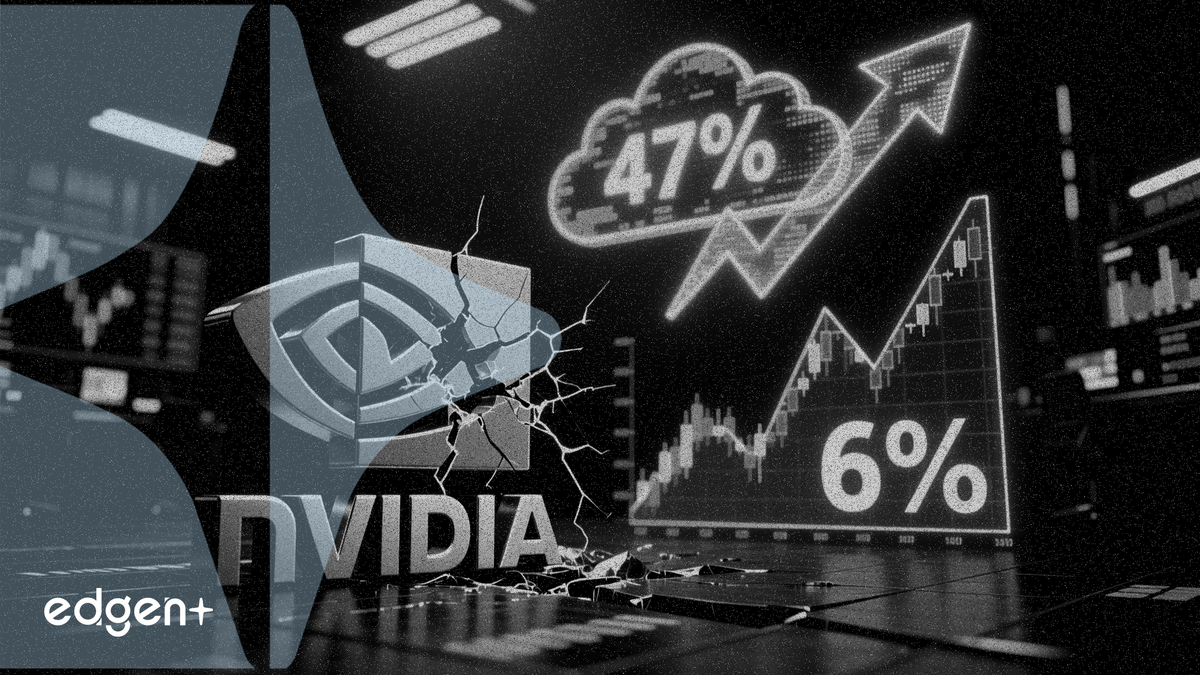
Nvidia Corp. posted 85% revenue growth to a record $81.6 billion in its fiscal first quarter, yet the stock slid 6.2% on June 5 as a broader semiconductor sell-off erased more than $1 trillion in market value across chip stocks.
"The AI infrastructure buildout is the largest infrastructure expansion in human history," Chief Executive Officer Jensen Huang said on the earnings call, unveiling the Vera Rubin platform and an $80 billion share buyback authorization.
Data Center revenue, Nvidia's primary growth engine, surged 92% year over year to $75.2 billion, accounting for more than 92% of total sales. Networking revenue climbed 199% to $14.8 billion, while Edge Computing revenue rose 29% to $6.4 billion, supported by growth in gaming GPUs, autonomous driving platforms, and robotics. Adjusted earnings per share jumped 140% to $1.87, beating the $1.77 consensus. The company guided second-quarter revenue to approximately $91 billion, well ahead of the $86.11 billion estimate, excluding any contribution from China Data Center compute as US export restrictions remain in place.
The sell-off, triggered by a stronger-than-expected US jobs report that reignited fears the Federal Reserve may keep interest rates higher for longer, and disappointing guidance from Broadcom Inc. that raised concerns about moderating AI spending, has left Nvidia trading at 25 times forward earnings — a discount to the semiconductor industry median of 26 times. Analysts see a 47% upside to the $303.71 average price target, with the most bullish forecast of $500 implying a 143% gain.
Director Mark Stevens sold 1 million shares in two separate transactions between June 1 and June 5, worth roughly $221 million. The sale represented about 2.5% of his indirect holdings, leaving him with approximately 39 million shares. While insider selling is common after prolonged rallies, the timing — coinciding with a 6.2% single-day drop and broader semiconductor rout — has drawn attention from investors. Adding to the uncertainty, Chief Executive Jensen Huang declined an invitation to testify before the US Senate Banking Committee on June 11 at a hearing focused on AI, China, and national security concerns tied to advanced AI chip exports. Senator Elizabeth Warren had invited Huang to answer questions about Nvidia's China business and compliance with export-control laws after reports raised concerns about potential loopholes in AI chip sales.
TS Lombard recently warned that Nvidia's run echoes the dot-com era, comparing the company to Cisco Systems Inc. before the 2000 market reset. The concern centers on circular financing within the AI sector, where some capital may be circulating among the same players rather than reflecting genuine end-user demand. Yet Nvidia's guidance of $91 billion in second-quarter revenue — well ahead of the $86.11 billion consensus — suggests the spending cycle remains intact. The company also raised its quarterly dividend 25-fold from $0.01 to $0.25 per share and authorized an $80 billion buyback, a move that reflects management's confidence. Morgan Stanley reiterated its "Overweight" rating with a $288 price target, calling Nvidia its top semiconductor pick. Truist Securities maintained a "Buy" rating and $307 target after Nvidia unveiled new AI products at GTC Taipei, including the Vera Rubin platform and BlueField 4 STX infrastructure.
For investors, the key question is whether Nvidia's valuation — 25 times forward earnings with a PEG ratio of 0.7 — adequately prices in the risks. Roughly half of Data Center revenue comes from hyperscalers simultaneously building custom silicon, with Amazon's Trainium having scaled into a multi-billion-dollar business. China revenue has effectively fallen to zero, versus $4.6 billion a year prior, and reports of H200 GPU rental prices falling 38% have hinted at softening spot demand. Yet the company's free cash flow reached $48.6 billion in the quarter, and its $80 billion buyback authorization signals that management sees the stock as undervalued. With 49 analysts assigning a consensus "Strong Buy" rating and an average price target of $303.71, Wall Street is betting the AI cycle has years left to run.
This article is for informational purposes only and does not constitute investment advice.
