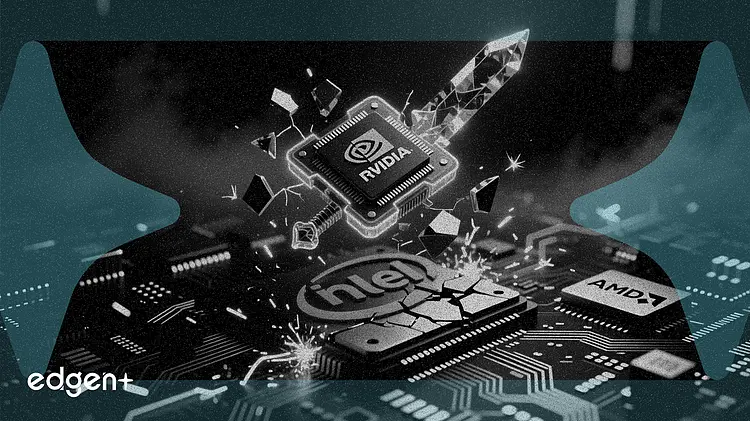
Nvidia's 'New Era of PCs' teaser, co-signed by Microsoft and Arm, sets the stage for the company's long-rumored entry into the consumer Windows processor market.

Nvidia, backed by Microsoft and Arm, teased a consumer PC chip launch ahead of Computex 2026, threatening to upend Intel and AMD's decades-old dominance in the Windows processor market.
"This is the most significant architectural shift for Windows PCs since the x86 era began," said Rachel Kim, semiconductor analyst at Edgen. "Nvidia brings GPU integration and AI capability that neither Intel nor AMD can match in a single SoC."
The company posted "New Era of PCs" on social media Friday alongside coordinates of the Taipei Performing Arts Center — the venue for CEO Jensen Huang's keynote Monday at 11:00 AM local time. Microsoft Windows and Arm official accounts reposted the message, signaling a coordinated launch. Rumored specifications point to the N1X, an Arm-based APU with 20 CPU cores (10 performance, 10 efficiency) and Blackwell graphics packing 6,144 CUDA cores, delivering performance comparable to laptops with discrete RTX 5060 graphics, according to leaked benchmarks reported by VideoCardz. A mainstream variant, the N1, is also expected.
The move would mark Nvidia's first assault on the $120 billion annual PC processor market, directly challenging Intel's Core Ultra and AMD's Ryzen lines while intensifying competition with Qualcomm's Snapdragon X series. Nvidia shares trade at roughly 35x forward earnings; a successful PC chip push could expand its addressable market by an estimated $30 billion.
What Nvidia's PC Chip Means for the x86 Duopoly
For 40 years, Intel and AMD have controlled the Windows PC ecosystem through the x86 architecture. Apple shattered that model in 2020 with its Arm-based M-series chips, proving that Arm could outperform x86 on performance-per-watt. Qualcomm followed with Snapdragon X, but adoption has been limited. Nvidia's entry changes the calculus: the company brings best-in-class GPU architecture, a mature AI software stack through CUDA, and deep relationships with every major PC OEM.
The N1X integrates CPU, GPU, and NPU into a single die — a design that mirrors Apple's system-on-chip approach but with Nvidia's AI acceleration advantage. The chip's Blackwell GPU alone could eliminate the need for discrete graphics in many laptops, a feature that neither Intel nor AMD can currently match in a single package.
Competitive Pressures Mount Across the Market
Nvidia's timing is strategic. Intel is navigating a turnaround under CEO Lip-Bu Tan, who will deliver a Computex keynote focused on Intel 18A (1.8nm) process technology and Clearwater Forest server chips. AMD just launched its Ryzen 9 9950X3D2 with 3D V-Cache and is expected to discuss Zen 6-based Epyc server processors. Qualcomm, meanwhile, announced Snapdragon C chips for laptops starting at $300, using Kryo-derived cores from its phone lineup rather than the premium Oryon cores found in Snapdragon X.
The PC market is also grappling with a memory shortage driven by AI data center demand, which has pushed up component costs. Apple's MacBook Neo, starting at a competitive price point, has already forced Windows OEMs to rethink budget laptop pricing. Nvidia's entry could further compress margins for Intel and AMD in the mid-range segment, where the N1 is expected to compete.
For investors, the key question is whether Nvidia can replicate its data center dominance in the PC market — and at what cost to Intel and AMD. Intel shares have fallen 12% this year amid execution concerns, while AMD has gained 8% on data center strength. Nvidia, up 140% over the past 12 months, faces little immediate earnings impact from a PC chip launch, but the long-term strategic implications are significant: every laptop that ships with an Nvidia chip is one less Intel or AMD processor sold.
This article is for informational purposes only and does not constitute investment advice.