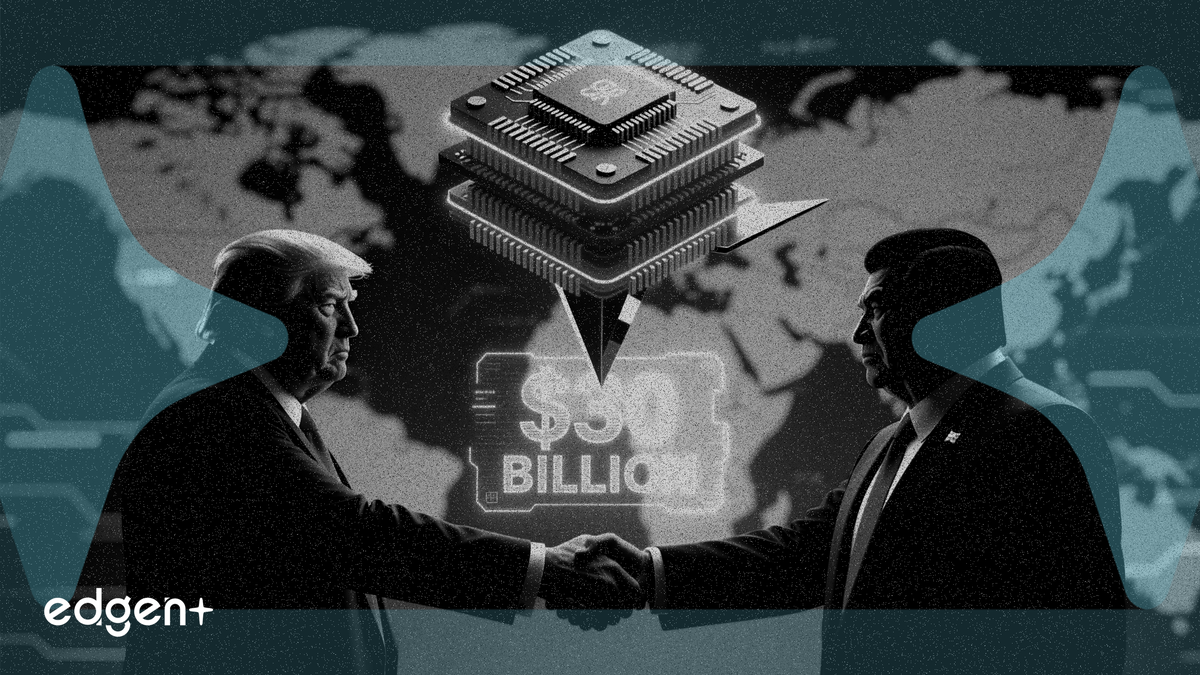
A last-minute addition to President Trump's China trip could unlock $30 billion in AI chip sales for Nvidia, testing the limits of U.S. export controls.

Nvidia Corp. Chief Executive Jensen Huang’s presence on President Donald Trump’s flight to Beijing signals a potential breakthrough for its China-specific H200 chips, a deal that could secure billions in revenue while testing the effectiveness of U.S. technology restrictions.
“I will be asking President Xi, a Leader of extraordinary distinction, to ‘open up’ China so that these brilliant people can work their magic,” Trump said in a post on his Truth Social platform, confirming Huang was part of the executive delegation.
The trip could finalize large-scale sales of the H200 processor, with KeyBanc analyst John Vinh estimating Chinese companies are willing to buy 1.5 million units, representing roughly $30 billion in revenue. Under a reported arrangement, Nvidia has agreed to pass on a 25% cut of the sales to the U.S. government. The H200 is a modified version of its more powerful processors, designed specifically to comply with U.S. export controls.
For Nvidia, the deal represents a significant new revenue stream after Washington blocked sales of its top-tier chips to China. The summit’s outcome will serve as a major indicator of how the U.S. intends to balance national security concerns with the economic interests of its leading technology firms, which face growing competition from Chinese rivals like Huawei.
Huang's last-minute inclusion on the trip, confirmed by sources familiar with the matter, underscores the importance of the semiconductor issue amid a complex agenda. Trump and Xi are also set to discuss the war in Iran, U.S. arms sales to Taiwan, and a fragile truce in the trade war. Treasury Secretary Scott Bessent has already begun preparatory talks with Chinese Vice Premier He Lifeng in South Korea.
While Washington seeks deals on Boeing airplanes and agricultural goods to reduce its trade deficit, Beijing wants the U.S. to ease curbs on chipmaking equipment and advanced semiconductors. The talks come at a time of political pressure for Trump, whose Republican party faces midterm elections in November, while Xi does not face comparable domestic pressure.
The Nvidia H200 is at the heart of the negotiations. The U.S. government in January gave a conditional green light for sales of the chip, which has been designed to have lower performance than the company's cutting-edge H100 and forthcoming H200 models to fall within export control limits. Chinese technology giants including Alibaba and Tencent are in need of powerful processors for their AI development, creating immense demand.
Nvidia said in March it had restarted manufacturing of the H200 processors for China after navigating regulatory hurdles in both Washington and Beijing. A successful deal would set a precedent for other U.S. tech companies like Apple and Tesla, whose CEOs are also on the trip, as they navigate the increasingly complex geopolitical landscape.
This article is for informational purposes only and does not constitute investment advice.