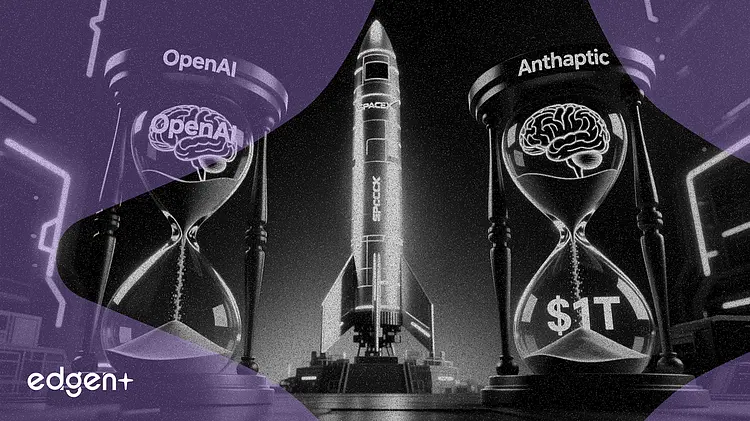
The two leading AI model developers are racing to go public in 2026, with the winner likely to capture a disproportionate share of investor capital before SpaceX's record-breaking debut absorbs the market's attention.
The race between OpenAI and Anthropic to become the first major AI-model developer to go public carries trillion-dollar consequences, as the company that lists first stands to capture a larger share of investor capital before SpaceX's expected $1.5 trillion IPO this summer.
"There's only so much oxygen in the room," Patrick Healy, founder of Issuer Network, which advises companies on going public, said. "SpaceX is going to consume an absolute ton of capital, and the guy that goes second is going to have a better position than the guy that goes third."
OpenAI was last valued at $852 billion in a March fundraising round, while Anthropic recently raised money at a valuation approaching $1 trillion. SpaceX, led by Elon Musk, plans to follow up this summer in what may be the largest IPO in history, with a targeted valuation of $1.5 trillion. The window for technology IPOs is receptive: Cerebras, an AI-chip company, rose 68% on its first trading day last month, while design platform Figma posted a 250% gain in its 2025 debut — the largest first-day pop for a company valued above $10 billion in five years, according to FactSet.
Which company gets to market first could shape the next phase of the AI boom. A strong debut would reinforce confidence in AI's transformative potential and unlock liquidity for employees and early investors. A poor reception could chill the market for subsequent listings, forcing the second mover to delay or accept a lower valuation — a dynamic that played out in 2019 when Lyft's disappointing IPO forced Uber to cut its target valuation two months later.
Academic research shows that IPOs tend to cluster by industry, with early movers typically outperforming later entrants. Higher-quality companies with deeper competitive moats tend to list first, triggering a wave of followers that often lack the same fundamentals. In a hot but finite market, the first AI developer to go public could absorb a disproportionate share of available capital, leaving less for its rival.
The Lyft-Uber precedent is instructive. Lyft, the smaller ride-hailing company, went public in March 2019 with an IPO that failed to meet expectations. Its post-debut decline directly affected Uber's listing two months later. Uber reduced its target valuation, and its shares still fell after pricing, even as other technology listings were performing well.
For Anthropic, currently valued above OpenAI, the cost of waiting may be especially large. A lukewarm reception for an early OpenAI listing — plausible given the steady drumbeat of organizational dysfunction at the Sam Altman-led company — could force Anthropic to delay or scale back its own plans.
Being first is not without hazards. The initial public market may struggle to price a company in a nascent industry without a long track record. Facebook's stock lost more than half its value in its first three months of trading in 2012 amid concerns about its ability to adapt to mobile advertising. The company later recovered and went on a sustained upward run, but the weak debut forced other would-be issuers — notably Twitter — to delay their listings.
Even when the market's initial verdict is negative, however, early movers benefit from being public. They raise capital from the offering, provide liquidity for employees, and establish a public currency for acquisitions. Those advantages add urgency to both OpenAI and Anthropic's timelines.
SpaceX's expected IPO this summer adds another layer of complexity. With a valuation target of $1.5 trillion and a deal that could raise tens of billions of dollars, the space and AI company will compete for the same institutional capital that AI model developers are seeking. Investors may rotate out of other positions to participate in the SpaceX offering, then reshuffle again to make room for OpenAI and Anthropic later this year or early next.
OpenAI has been working with bankers to file initial IPO paperwork and could do so shortly, according to people familiar with the matter. Anthropic's timeline is less clear. Both companies are racing against a clock that ticks faster with every percentage point of market attention that SpaceX absorbs.
This article is for informational purposes only and does not constitute investment advice.