

Qualcomm nearly doubled its fiscal 2029 non-handset revenue target to $40 billion and unveiled a data center AI chip strategy, marking its most aggressive diversification push since the company's founding.
Qualcomm nearly doubled its fiscal 2029 non-handset revenue target to $40 billion and unveiled a data center AI chip strategy, marking its most aggressive diversification push since the company's founding.
Qualcomm nearly doubled its fiscal 2029 non-handset revenue target to $40 billion and unveiled a data center AI chip strategy, marking its most aggressive diversification push since the company's founding.
Qualcomm's push into data center AI chips and automotive silicon targets a combined $25 billion in new revenue by fiscal 2029, threatening Nvidia's dominance in AI inference and challenging Intel in server CPUs.
"We are defining Qualcomm's next chapter as we accelerate our edge diversification strategy, introduce a comprehensive roadmap for next-generation AI data centers, and evolve into a platform company," Cristiano Amon, president and chief executive officer of Qualcomm, said at the company's 2026 Investor Day in New York.
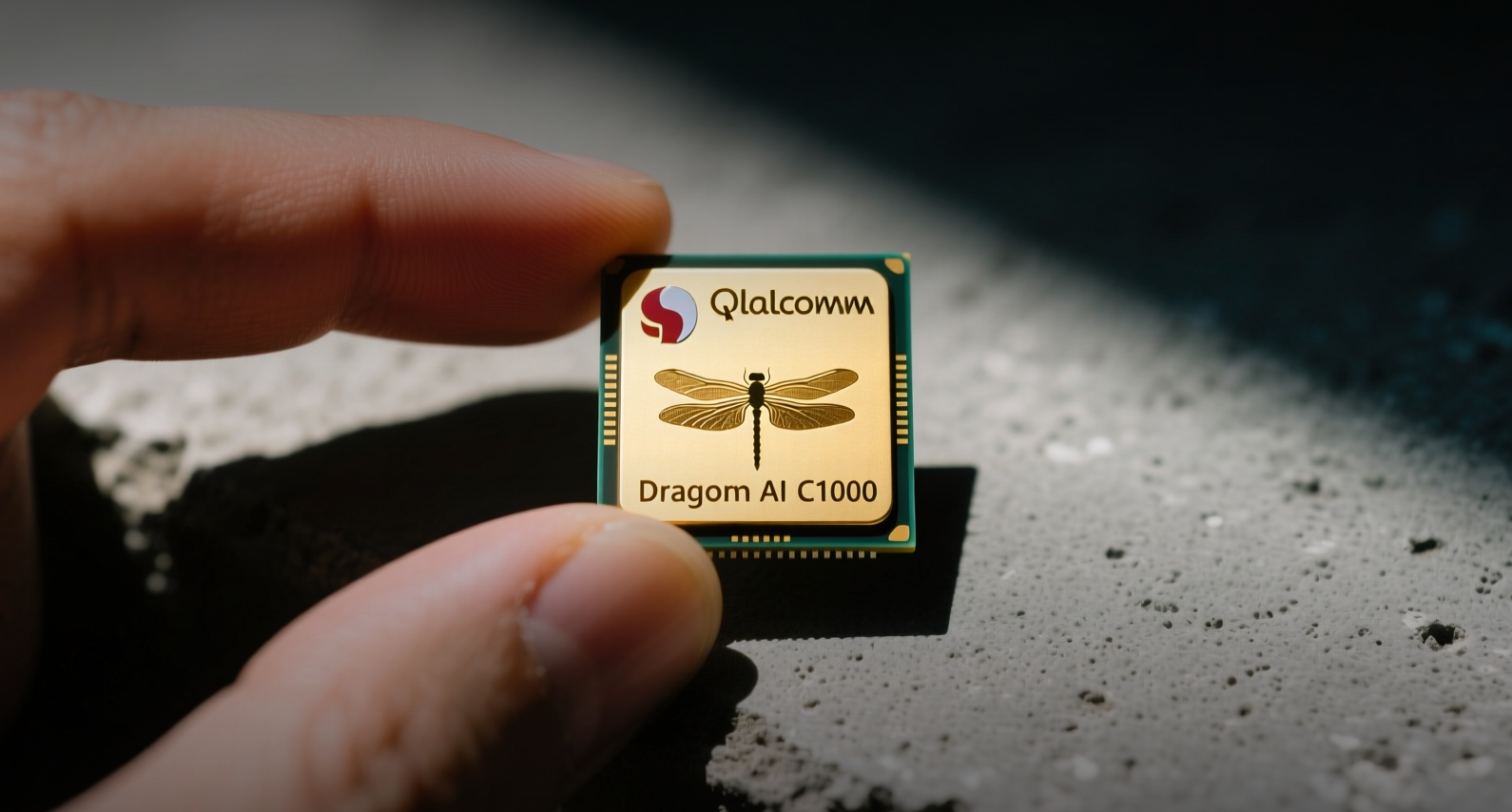
The San Diego-based chipmaker raised its fiscal 2029 non-handset revenue target to $40 billion, roughly double its prior goal. Data center infrastructure alone is expected to contribute more than $15 billion, powered by the newly unveiled Dragonfly C1000 CPU and Dragonfly AI300 inference accelerator. Qualcomm's automotive design-win pipeline expanded to $65 billion, with a revenue target of $10 billion, while IoT — spanning industrial, networking, robotics and personal AI — is forecast to exceed $14 billion. The company also targets more than $18 in non-GAAP earnings per share for fiscal 2029.
The targets imply handsets will shrink to roughly one-third of Qualcomm's QCT revenue by fiscal 2029, down from the vast majority today. Qualcomm shares rose 8% on the news, reflecting investor optimism that the company can replicate its mobile-chip efficiency advantage in the data center, where power-per-watt has become the defining competitive metric.
Qualcomm's data center strategy centers on its High Bandwidth Compute technology, which the company says achieves a sixfold reduction in energy per token compared with traditional GPU and HBM and SRAM solutions. The Dragonfly C1000, built on an advanced process node, is slated for production in the second half of 2028, with Meta already signed as a customer for its next-generation server fleet. The Dragonfly AI300 inference accelerator targets the fast-growing market for AI inference, where Nvidia's H100 and B200 GPUs currently dominate but face criticism over power consumption.
The company also confirmed the acquisition of Modular, a software startup, for approximately $3.9 billion. Modular's platform enables AI models to run across different chip architectures, similar to Nvidia's CUDA ecosystem, giving Qualcomm a software layer to complement its hardware push. A separate partnership with Hugging Face will extend AI models from devices to cloud infrastructure, targeting the company's 16 million-developer community.
Competitive Landscape
Qualcomm's automotive business has emerged as a second growth engine. The $65 billion design-win pipeline spans digital cockpit chips and advanced driver-assistance systems, putting Qualcomm in direct competition with Nvidia's Drive platform and Mobileye's EyeQ family. Nakul Duggal, Qualcomm's executive vice president for automotive, industrial and IoT, said the company's low-power computing heritage gives it an edge in vehicles where thermal management is constrained.
The broader opportunity is substantial. Qualcomm estimates the combined addressable market for agent-ready edge devices, data center infrastructure, automotive, industrial systems, networking and robotics will reach approximately $1.7 trillion by 2030. Over 35 technology and AI companies have publicly backed Qualcomm's data center vision, including Microsoft, whose chief executive indicated plans to deploy Qualcomm's HBC solutions.
Investor Implications
Qualcomm's diversification comes as its core smartphone market matures. The company's ability to hit the $40 billion non-handset target depends on execution in data center, where Nvidia holds an estimated 80% market share in AI accelerators, and in automotive, where design wins take years to convert into production revenue. Qualcomm trades at roughly 22 times forward earnings, a discount to Nvidia's 35 times, reflecting the market's skepticism about the pace of diversification. If Qualcomm delivers on its fiscal 2029 targets, that multiple could expand as the revenue mix shifts toward higher-growth segments.
This article is for informational purposes only and does not constitute investment advice.
