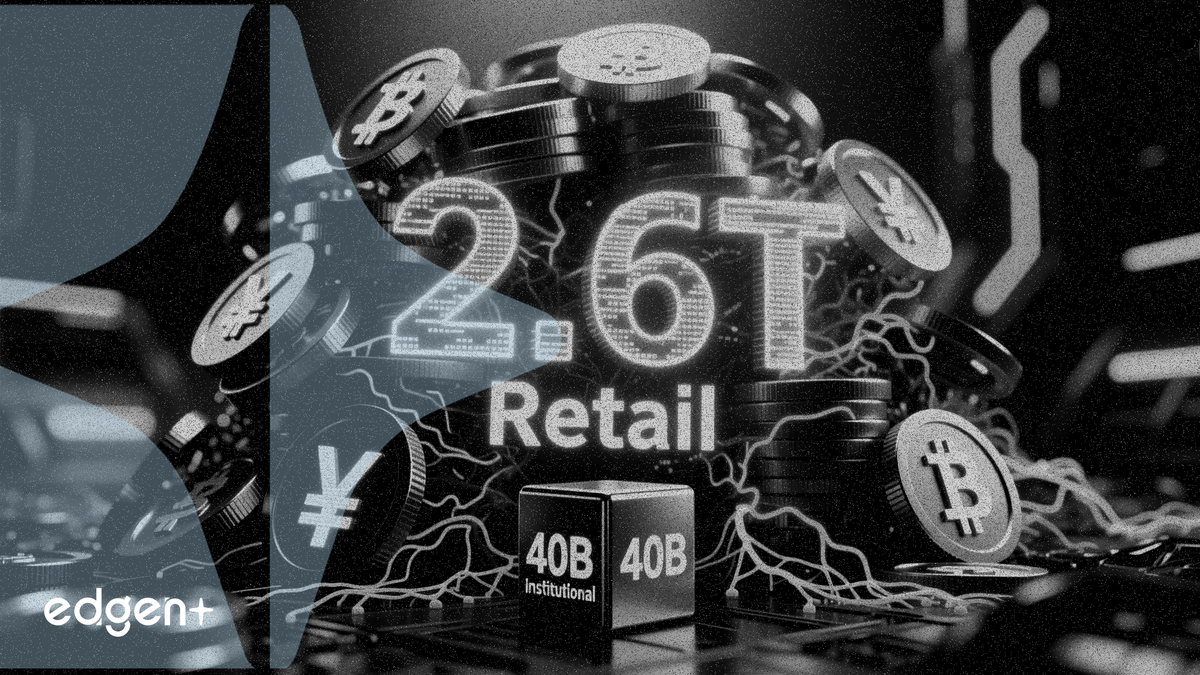
A stark divergence is splitting the U.S. stock market, with retail investors betting a notional $2.6 trillion on call options to chase the AI-driven rally as institutional "smart money" builds a $40 billion cash position on the sidelines.
"Retail does so well because it’s been beaten into them to buy the dip," Michael Khouw of YieldMax said at the NYSE Creator Economy Summit, pointing to a learned behavior that has been rewarded in the post-pandemic market.
This pattern of resilient retail buying in U.S. equities, which now accounts for roughly 20 percent of total market activity, comes even as professional investors grow more cautious. Institutional managers are pointing to "elevated market volatility" and are shifting toward "higher-capture, high-touch order flow" that prioritizes profitability over chasing momentum, according to recent industry commentary. This stands in sharp contrast to the retail segment's broad embrace of high-risk call options, particularly in popular AI-linked technology names.
The divergence sets up a fragile, high-stakes environment. Continued upward pressure from retail buyers could force institutions to abandon their defensive stance, potentially inflating the AI bubble further. Conversely, any wavering in the bullish AI narrative could trigger a rapid and sharp correction, disproportionately hitting the leveraged positions held by individual investors.
The Retail ‘Fight Response’
The surge in retail options trading reflects more than just speculative fervor; some analysts see it as a behavioral response to economic precarity. Financial therapist Aja Evans, attending the NYSE summit, framed the intense retail engagement not just as optimism but as a potential "fight response to the threat of money." From this perspective, the relentless "buy the dip" strategy is a form of safety-seeking behavior. If all dominant financial narratives point to investing as the primary path to wealth creation, sitting on the sidelines can feel more dangerous than participating, regardless of the underlying macro signals. This dynamic is amplified by the gamification of trading platforms and the social media reinforcement of quick wins, creating a powerful incentive to stay in the game.
Institutional Strategic Pause
While retail traders are doubling down, institutional investors are exercising restraint. The $40 billion increase in cash holdings is not a sign of panic, but a strategic pause. Facing rising geopolitical risk and mixed economic data, large funds are focused on protecting gains and maintaining liquidity. Their strategy is reflected in a pivot toward operational efficiency and improved pricing to achieve positive capture rates, as noted in recent performance reports from exchange operators. This disciplined approach suggests they are waiting for a clearer signal or a more attractive entry point, content to leave the high-risk, momentum-driven trades to the retail crowd for now. The focus is on long-term capital preservation and identifying opportunities with strong underlying fundamentals rather than chasing the latest narrative.
This article is for informational purposes only and does not constitute investment advice.