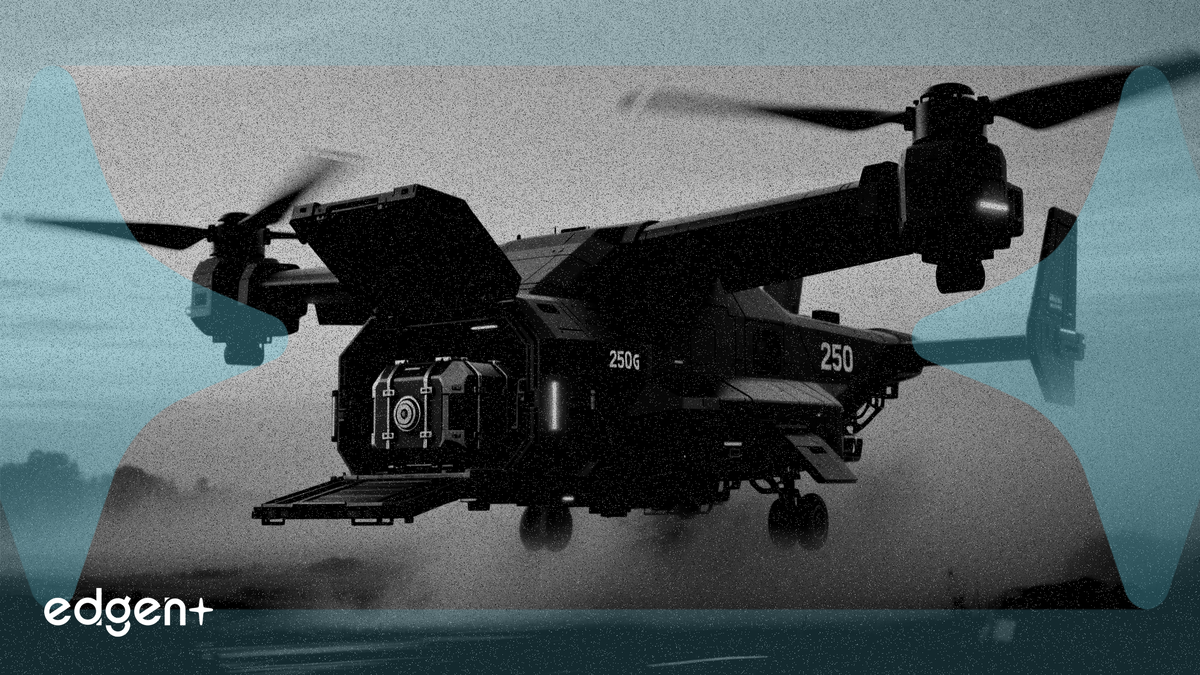
Rheinmetall and ERC System aim to close a logistics gap between small drones and helicopters with a 250-kg payload eVTOL.
Rheinmetall and Munich-based startup ERC System signed a letter of intent with the state of North Rhine-Westphalia to produce a 250-kg heavy-lift cargo drone, targeting a logistics gap in European defense supply chains.
"Militaries have identified a gap — there are a lot of drones that can carry 20 kg, and above 500 kg there are helicopters, but there are very few products that can carry 150-300 kg vertically," Maximilian Oligschläger, co-founder and chief commercial officer at ERC System, said.
The Victor U250 is a hybrid-electric uncrewed aircraft with a 300-km range and 250-km/h cruise speed, using eight lifting propellers for vertical takeoff and a pusher propeller for forward flight. ERC plans to fly a prototype in the second half of 2026 and target first deliveries in 2028, with production scaling to about 250 aircraft annually by 2032.
The partnership could create hundreds of jobs in North Rhine-Westphalia by 2029 and positions Rheinmetall to capture a share of European defense logistics spending, which has accelerated since the war in Ukraine exposed gaps in military supply chains. Rheinmetall CEO Armin Papperger said the goal is to scale the Victor U250 both technologically and industrially.
From Romeo to Victor
ERC's Victor builds on technology from the Romeo demonstrator, a 2.7-tonne, 16-metre-wingspan aircraft that began hover testing near Munich in November 2025. ERC described Romeo as the heaviest uncrewed eVTOL to have flown in Europe, completing about 10 flights that validated its flight-control system and lift-and-cruise configuration. The company was founded in 2019 in Ottobrunn and emerged from stealth in July 2024, backed by IABG, a German aerospace testing and certification specialist that serves the Bundeswehr. IABG has invested a significant double-digit-million-euro sum and remains ERC's sole institutional backer.
A Steppingstone to Crewed Flight
ERC views Victor as a near-term revenue generator while it develops Charlie, a crewed eVTOL for inter-hospital patient transfers targeted for certification around 2031 in collaboration with German air rescue operator DRF Luftrettung. The company claims Victor's direct operating costs will be roughly 70% lower than those of a small helicopter, though that figure has not been independently verified and no uncrewed eVTOL of this size has operated commercially in Europe. The aircraft's modular interior can be configured for cargo, medical supplies, or mission-specific equipment, with rear clamshell doors for loading.
The 2028 delivery timeline is ambitious for an industry where at least six European eVTOL manufacturers have entered insolvency since 2023, including Lilium and Volocopter. ERC has no revenue, no certified aircraft, and no publicly disclosed customer contracts, but it has a flying full-scale prototype and a strategic investor with deep ties to the German defense establishment. The partnership with Rheinmetall, Germany's largest defense contractor by revenue, provides a potential path to serial production that most eVTOL startups lack.
This article is for informational purposes only and does not constitute investment advice.