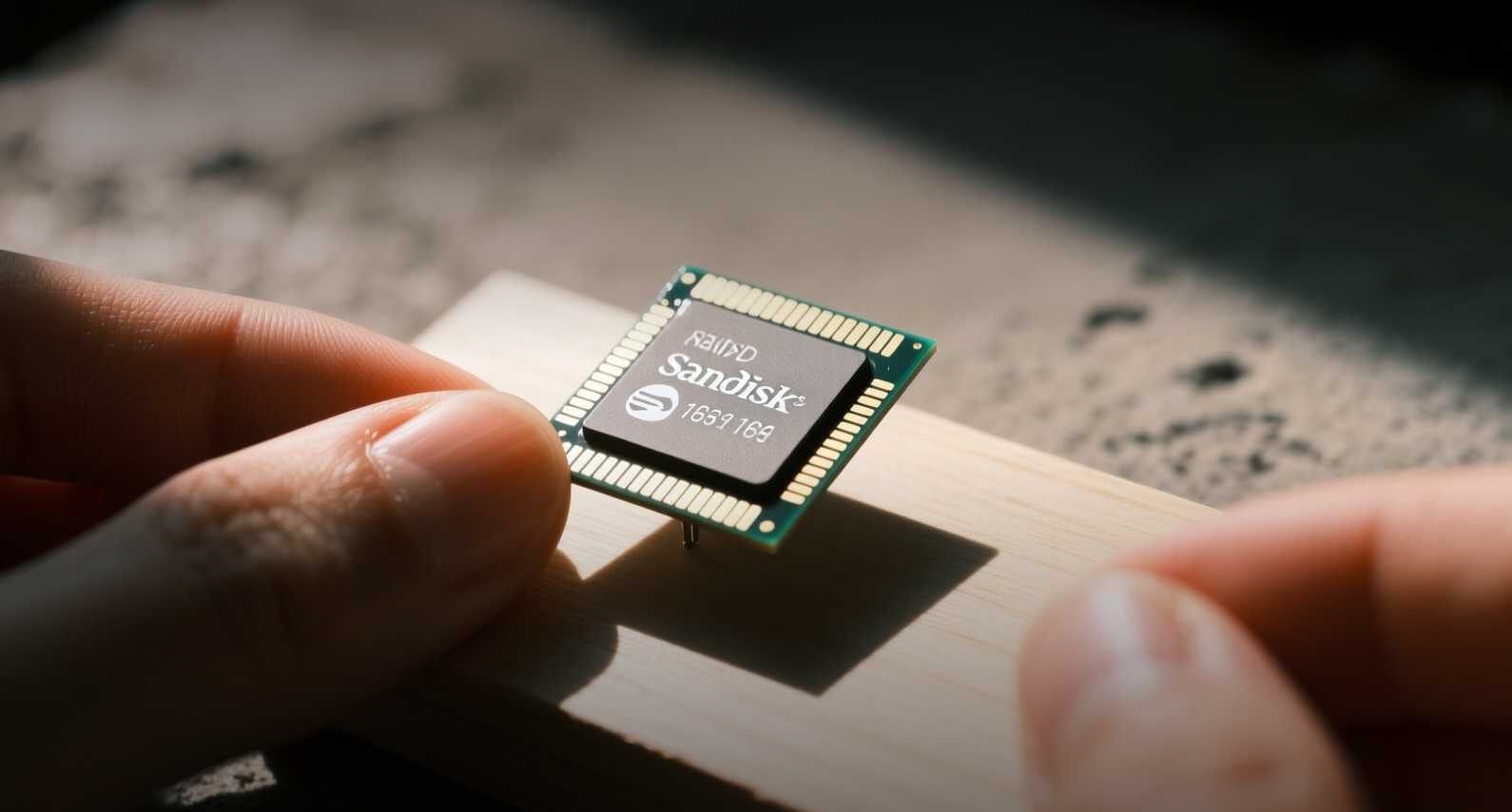
Sandisk has delivered a 3,900% cumulative gain since its spinoff from Western Digital 16 months ago, making it the best-performing stock in the S&P 500 by a wide margin — and the AI memory cycle shows no signs of peaking.
The artificial intelligence infrastructure build-out has created an unexpected winner in the semiconductor industry. While Nvidia captured headlines with its GPU dominance, Sandisk (SNDK) has quietly become the top-performing stock in the S&P 500 this year, surging 781% through the first six months of 2026. The company, which began trading independently on Feb. 24, 2025, after separating from Western Digital (WDC), has posted a cumulative gain of roughly 3,900% from its debut price of about $52.
"The memory and storage segment is experiencing a structural shift, not just a cyclical upswing," said Rachel Kim, semiconductor supply chain analyst at Edgen. "Multiyear supply agreements worth tens of billions of dollars are giving Sandisk revenue visibility that memory companies have never had before."
The scale of Sandisk's outperformance is striking. The second-best S&P 500 performer this year, Micron Technology (MU), has gained 297% — less than half of Sandisk's return. Intel (INTC) has risen 248%, while Nvidia (NVDA) has added just 3.2%. Sandisk's rally has been fueled by hyperscale cloud providers spending hundreds of billions of dollars on AI data centers, driving demand for high-capacity solid-state drives far beyond the industry's manufacturing capacity. Average selling prices for NAND flash have climbed sharply as supply remains disciplined following production cuts during the 2023-2024 downturn.
The question for investors is whether a stock that has already multiplied nearly 40 times can keep rising. The answer, based on the company's contracted revenue backlog and Wall Street's earnings estimates, may be yes.
Multiyear Contracts Reduce Cyclical Risk
Memory has historically been one of the semiconductor industry's most cyclical businesses. Pricing booms have always been followed by busts as manufacturers add capacity and supply overwhelms demand. Sandisk's management has taken steps to change that pattern.
During the company's fiscal third-quarter earnings call, executives disclosed that Sandisk has signed five multiyear supply agreements this year. The three contracts inked during the most recent quarter alone carry a minimum total value of $42 billion. These performance obligations extend Sandisk's revenue runway well into 2028, providing earnings visibility that memory companies have historically lacked.
The new business model represents a fundamental shift. Instead of selling into a spot market where prices can swing 50% in a quarter, Sandisk now has contracted revenue streams that reduce its exposure to the traditional memory cycle. Analysts project earnings per share of approximately $65 in fiscal 2026, rising to roughly $183 in fiscal 2027 as volumes scale and margins widen.
Valuation Still Supports Further Upside
Sandisk's forward price-to-earnings multiple has expanded significantly during its rally, but the valuation remains reasonable given the duration and magnitude of the demand outlook. At a forward P/E of about 33, the stock is priced for continued growth — but the earnings trajectory suggests room for further gains.
If Sandisk hits analysts' 2027 EPS target of $183 and maintains its current multiple, the stock would reach approximately $6,000, representing 160% upside from current levels near $2,170. Even if the multiple contracts to the S&P 500 average of 22, the stock would still trade at roughly $4,000 by the end of next year.
The bullish case rests on two pillars: sustained AI infrastructure spending by major cloud providers and disciplined supply from NAND manufacturers. Enterprise AI adoption remains in its early innings, and hyperscalers continue to deploy AI training clusters that require vast quantities of high-performance storage alongside accelerated compute systems. Micron's fiscal third-quarter results, which showed revenue more than quadrupling year-over-year to $41.46 billion with margins expanding to 84.6%, confirmed that the memory supercycle is still accelerating.
The bear case centers on the memory industry's historical tendency toward oversupply. When profits rise, manufacturers eventually add capacity, and pricing pressure follows. Sandisk's multiyear contracts mitigate this risk but do not eliminate it. After a 3,900% gain, expectations leave little room for disappointment — even strong earnings could trigger selloffs if growth shows any sign of deceleration.
For now, the fundamentals support additional upside. The combination of secular AI demand, contracted revenue visibility, and compounding earnings creates a setup that could deliver another year of outsized returns. But investors should expect far more volatility in the second half of 2026 than they experienced during the first.
This article is for informational purposes only and does not constitute investment advice.