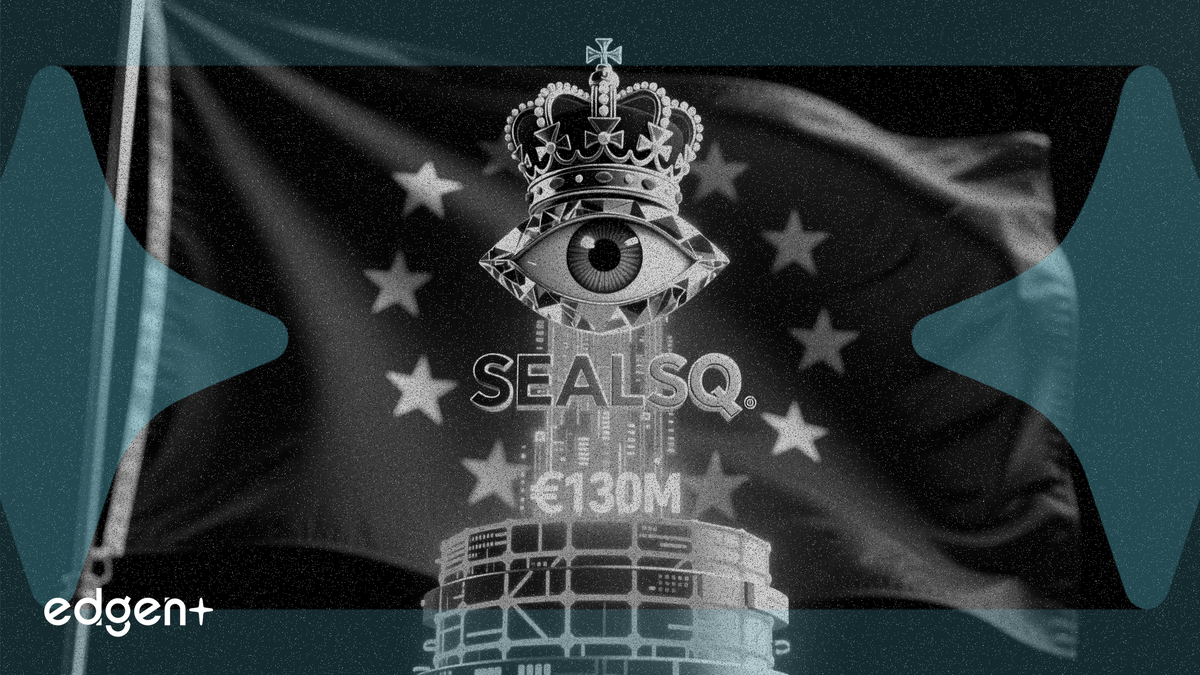
SEALSQ Corp led a €130 million investment in Quobly, betting silicon-based quantum processors can deliver sovereign European computing infrastructure.

SEALSQ Corp joined STMicroelectronics and BPI France in Quobly's €130 million Series A, the largest European quantum hardware round this year, backing silicon-based quantum processors built on standard chip manufacturing lines.
"SEALSQ's participation as a lead investor in Quobly's Series A financing represents a significant milestone in the execution of our Quantum Vertical Sovereign Stack strategy," Carlos Moreira, chairman and chief executive officer of SEALSQ, said.
Quobly's FD-SOI (fully depleted silicon-on-insulator) quantum processors use the same manufacturing processes as conventional semiconductors, a departure from superconducting approaches used by Google's Sycamore and IBM's Eagle processors that require dilution refrigerators operating near absolute zero. The company raised €19 million in 2023 — a European seed record for quantum hardware — and an additional €21 million in 2025 for its Q100T fault-tolerance program. SEALSQ's Quantum Fund, launched in February 2025 with $20 million, has grown to $200 million and deployed roughly $30 million across seven quantum-related investments before this round.
For SEALSQ (LAES), the investment extends its reach beyond post-quantum cryptography into quantum processor production. The company's Quantum Vertical Sovereign Stack strategy aims to integrate cryptographic root-of-trust chips, post-quantum security modules and silicon quantum processors into a single architecture protected from the qubit level upward — a full-stack approach that no other listed company currently offers.
The collaboration builds on a technical partnership announced in November 2025, when SEALSQ and Quobly agreed to embed post-quantum cryptography and hardware root-of-trust into Quobly's silicon quantum architectures. By combining Quobly's FD-SOI processors with SEALSQ's QVault TPM and post-quantum cryptographic solutions, the two companies are developing secure-by-design quantum computing systems that protect data during processing, not just in transit or at rest.
Quobly, founded in 2022 in Grenoble, emerged from more than 15 years of collaborative research between CEA-Leti and CNRS, two of France's premier research institutions. Chief Executive Officer Maud Vinet, a Ph.D. in quantum physics with more than 300 papers and 70 patents, co-founded the company with Tristan Meunier, a semiconductor quantum engineering expert trained under Nobel laureate Serge Haroche. The company maintains offices in France, Singapore and Canada and has a strategic partnership with STMicroelectronics to industrialize its chip production.
The investment carries sovereign implications. BPI France, the French public investment bank, co-led the round alongside STMicroelectronics, SEALSQ and Isalt, reflecting European government interest in building independent quantum computing capacity. The European Union has designated quantum technology as a strategic priority, with member states committing more than €7 billion in combined public investment through 2027 under the Quantum Flagship program.
SEALSQ's Quantum Fund has deployed capital across IC'Alps (a French ASIC design firm), EeroQ (a US quantum computing startup using single electrons on superfluid helium), ColibriTD (a quantum optimization platform targeting semiconductor yield improvements), WISeSat (a LEO satellite constellation for secure IoT), Quantix Edge Security (a Spanish post-quantum semiconductor design and test center backed by €19.6 million from the Spanish government) and WeCan Group (a Swiss blockchain compliance platform serving more than 100 financial institutions) — seven portfolio companies spanning the full quantum value chain from silicon to orbit.
As part of the deal, Moreira will join Quobly's board of directors. SEALSQ did not disclose the exact size of its investment in the round.
For investors, the question is whether SEALSQ can execute on a strategy that spans post-quantum security chips, quantum processor hardware and orbital infrastructure — a scope that rivals much larger competitors. The company's $200 million Quantum Fund provides a dedicated war chest, but the path from silicon qubits to fault-tolerant commercial quantum computers remains years from material revenue. SEALSQ shares trade on Nasdaq under the ticker LAES.
This article is for informational purposes only and does not constitute investment advice.