
China's installed solar capacity of 1,286 gigawatts surpassed coal's 1,285 gigawatts at the end of July, making photovoltaics the country's largest power source for the first time.
China's installed solar capacity of 1,286 gigawatts surpassed coal's 1,285 gigawatts at the end of July, making photovoltaics the country's largest power source for the first time.
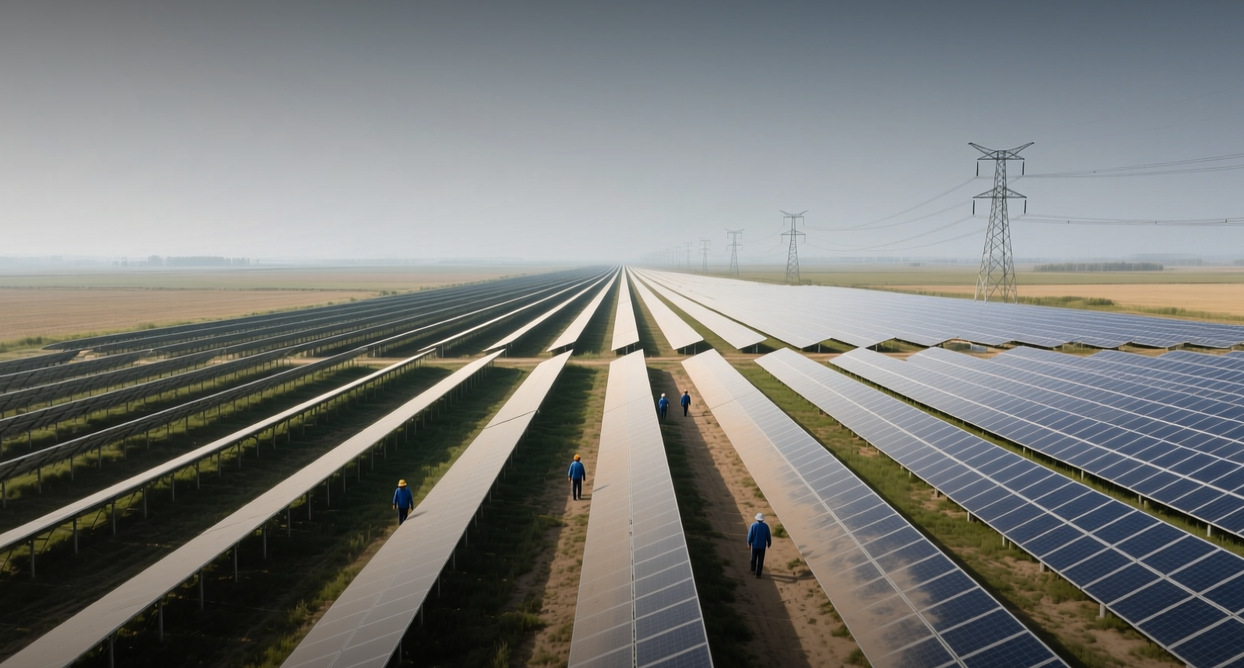
China's solar capacity of 1,286 gigawatts overtook coal's 1,285 gigawatts at the end of July, making photovoltaics the country's largest installed power source and marking a structural shift in the world's biggest energy market.
Solar capacity reached 1,286 gigawatts at the end of July, accounting for 31.5 percent of China's total installed power generation capacity, the National Energy Administration said, as reported by state broadcaster China Central Television. The China Electricity Council had earlier flagged that solar was just one gigawatt behind coal at the end of June, setting up the crossover that has now been confirmed.
The milestone comes as China's record pace of renewable installations has slowed significantly this year after a policy overhaul ended guaranteed revenue for wind and solar projects. The country added 86 gigawatts of solar in the first seven months of 2026, after adding 93 gigawatts in May 2025 alone — the last month before the new policy took effect. The slowdown reflects a deliberate shift from volume-driven buildout to market-based deployment, as Beijing pushes developers to compete on cost and grid integration rather than simply maximize capacity.
The crossover carries implications for both the renewable supply chain and the coal sector. Investment in China's solar industry is expected to top two trillion yuan (US$298 billion) over the next five years, according to the NEA report. Solar generation rose 15.5 percent from a year earlier to 802.4 billion kilowatt-hours in the first seven months of 2026, about one-eighth of the country's total electricity output.
Distributed Solar Drives the Capacity Surge
Of the 1,286 gigawatts of installed solar capacity, centralized projects account for 704 gigawatts and distributed installations for 582 gigawatts, the NEA data shows. Distributed solar — rooftop and small-scale systems — has been the fastest-growing segment, supported by provincial incentives and falling module prices that have made small-scale installations economically viable without subsidies.
China remains the dominant player in the global solar supply chain, controlling the majority of polysilicon, wafer, cell, and module manufacturing capacity. The country's module makers have faced margin pressure from oversupply, but the continued domestic buildout provides a demand floor for manufacturers including Longi Green Energy Technology Co., Tongwei Co., and JA Solar Technology Co. These companies have been competing aggressively on price, with module costs falling to record lows as production capacity outpaces near-term demand.
Coal's Decline Is Structural, Not Cyclical
Coal-fired capacity of 1,285 gigawatts still dwarfs solar in terms of actual electricity generation — coal plants run at far higher utilization rates than solar arrays, which only generate during daylight hours. But the capacity crossover shows where new investment is flowing. China approved fewer new coal plants in 2025 than in any year since 2021, and the policy shift that removed guaranteed revenue for renewables has not reversed the long-term trajectory.
The transition is not without friction. The end of guaranteed grid access for wind and solar projects has slowed installations, and grid operators are grappling with how to integrate intermittent renewable output. Battery storage deployment and ultra-high-voltage transmission lines are being expanded to absorb the growing share of variable generation, though grid congestion remains a constraint in several provinces.
For investors, the crossover reinforces the structural decline of coal demand in China, the world's largest coal consumer. Coal companies face long-term demand erosion as renewables gain share, while solar equipment manufacturers and renewable utilities benefit from continued policy tailwinds. The slowdown in new installations this year, however, suggests the pace of growth may moderate before the next phase of grid expansion unlocks further capacity. The NEA's five-year investment outlook of two trillion yuan implies the sector will remain a central pillar of China's energy strategy, even as the industry adjusts to a market-based pricing regime.
This article is for informational purposes only and does not constitute investment advice.
