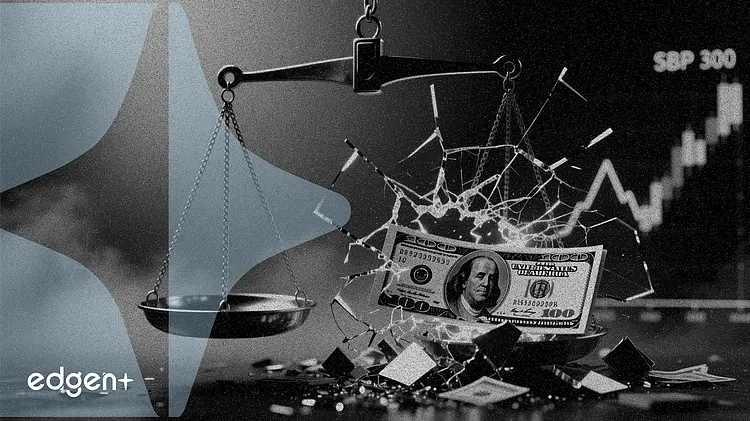

The compensation investors receive for owning stocks over bonds has nearly evaporated, a setup not seen since the aftermath of the dot-com bubble.

The S&P 500's equity risk premium has nearly disappeared, with the gap between earnings yields and 10-year Treasury yields hovering near levels last seen after the dot-com crash.
"There's a disconnect between the bond market and the equity market," said Don Calcagni, chief investment officer at Mercer Advisors. "This tells us inflation fears are growing and valuations are stretched."
The 10-year yield settled at 4.57% on Friday, up 61 basis points from 3.96% before the U.S. and Israel launched strikes against Iran in late February. Brent crude tumbled back below $100 a barrel after the Trump administration reached a tentative framework agreement with Iran to reopen the Strait of Hormuz, a chokepoint carrying roughly 20% of global oil supply. Oil had surged about 60% this year following Iran's disruption of the waterway, pushing national gasoline prices to four-year highs, according to AAA data.
The vanishing risk premium leaves stocks exposed if earnings growth fails to justify valuations. UBS had projected the S&P 500 reaching 7,500 by year-end 2026 on roughly 14% earnings growth, with about half driven by AI and tech — a milestone the index has already matched on Memorial Day.
Bond Market Sends a Warning
The divergence between equity and fixed-income markets has widened into one of the most pronounced gaps in two decades. The earnings yield on the S&P 500 — based on projected profits over the next 12 months — has dropped as share prices surged and Wall Street extended a weekslong buying spree. Meanwhile, inflation expectations embedded in the bond market have climbed, pushing real yields higher and tightening financial conditions.
The equity risk premium briefly dipped below zero early last year under similar conditions of rising yields and elevated stock valuations. The last extended period of negative or near-zero readings came in the early 2000s, when the S&P 500 fell nearly 50% from its peak.
Oil's Disinflationary Pivot
The Iran deal introduces a clean causal chain that could reshape the macro backdrop: lower crude prices reduce CPI expectations, giving the Federal Reserve less reason to hold rates at restrictive levels. A softer dollar and looser liquidity conditions would then allow risk assets, including equities, to reprice higher.
But the outcome hinges on execution. "If we're still looking at $100 oil in late summer, then the formula changes," said Jeff Buchbinder, chief equity strategist at LPL Financial. He identified two ingredients essential to sustaining the rally: lower rates and more earnings. "If we don't get both those things, then this stock market looks expensive."
The Cboe Volatility Index, which had climbed during the weeks of geopolitical uncertainty, has yet to fully reflect the oil-driven disinflation narrative. Trading volumes on the S&P 500 remain above the 20-day average as institutional allocators rotate positioning ahead of the next macro data print, including the Federal Reserve's preferred inflation gauge due this week.
The Bitcoin correlation with the S&P 500 has also reemerged as a factor, with the 90-day correlation climbing into the 0.3-to-0.5 range during prior risk-on equity waves. Bitcoin reclaimed its 200-day exponential moving average, though spot ETF flows have yet to turn positive after a volatile week.
This article is for informational purposes only and does not constitute investment advice.