
Key Takeaways:
- S&P 500 futures pared gains after US CPI hit 4.2%
- Nasdaq 100 futures also narrowed as rate-hike fears resurfaced
- Fed meeting on June 16-17 now in focus after hot inflation print
Key Takeaways:
Key Takeaways:
S&P 500 futures and Nasdaq 100 futures trimmed their intraday gains Thursday after fresh US economic data reinforced the inflation picture that sent equities lower earlier in the week.
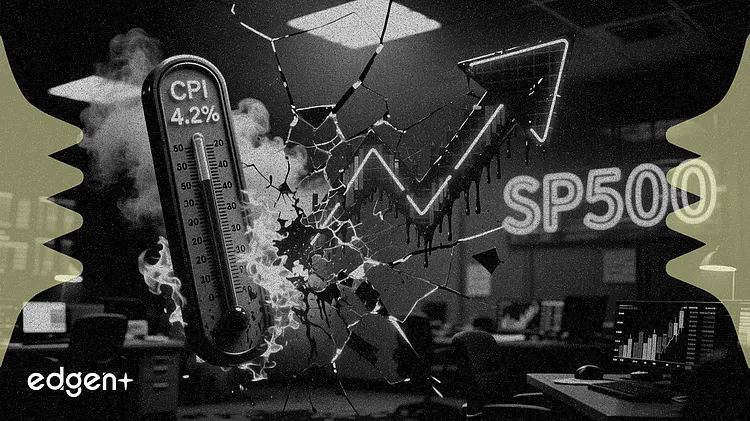
The S&P 500 futures contract, which had been up as much as 0.6% in early trading, pared its advance to 0.2% following the release. Nasdaq 100 futures narrowed to a 0.3% gain from a session high of 0.8%. The moves came one day after the Bureau of Labor Statistics reported the consumer price index rose to 4.2% in May, its highest level in three years and above the 3.8% reading in April.
"The data confirms the inflation problem isn't going away, which keeps a rate hike on the table for the Fed's next meeting," said Savita Subramanian, equity strategist at Bank of America. "We've been advising clients to take profits because too many bear-market signposts have triggered."
The inflation print compounded a selloff that began Tuesday after Bank of America warned that 70% of its bear-market signposts had triggered, matching levels seen at past market peaks. The S&P 500 fell 1.63% to 7,261 on Tuesday, while the Nasdaq Composite dropped 2.86% to 25,188 as a deepening chip rout hammered technology stocks. The Dow Jones Industrial Average held up better, slipping 0.50% to 50,533 on defensive strength.
Sector rotation accelerated as investors shifted toward defensive positions. Real estate led gainers at plus 1.92%, followed by consumer defensive stocks rising 1.47% and utilities adding 0.87%. Technology plunged 4.88% as the worst-performing sector, with Advanced Micro Devices falling 9.35%, Micron Technology dropping 9.09% and Oracle declining 5.75%. Energy fell 2.13% as oil slipped on stalled US-Iran ceasefire talks, while basic materials dropped 1.44% on a stronger dollar.
The 10-year US Treasury yield held near elevated levels above 4.5%, reflecting expectations that the Federal Reserve may need to raise rates further. The US dollar index strengthened, adding pressure on commodity prices. West Texas Intermediate crude traded at $91 a barrel, down 2.1% on the session, as traders weighed the breakdown of the US-Iran ceasefire against the demand implications of higher rates.
The Cboe Volatility Index, or VIX, remained elevated near 22, above its trailing one-year average, signaling persistent uncertainty. Trading volume on the New York Stock Exchange came in roughly 15% above the 20-day average, reflecting heightened participation during the selloff.
The Federal Reserve's next policy meeting on June 16-17 now dominates the outlook. April inflation already ran hot at 3.8%, and the May reading of 4.2% hardens the case for a rate increase. Traders will scrutinize Fed Chair Jerome Powell's press conference for any signal on the timing of a potential hike.
For now, the S&P 500 must hold above 7,333 to maintain its consolidation pattern, according to technical analysts. A break below that level risks a slide toward 7,287 and the stronger support at 7,040. The next catalyst is the Fed decision, and the data released this week has shifted the odds firmly toward a hawkish outcome.
This article is for informational purposes only and does not constitute investment advice.
